
Pulp Fiction, 1911 · page 115 of 196
Adventure Magazine Cover, October 1911 — page 115: what you’re looking at
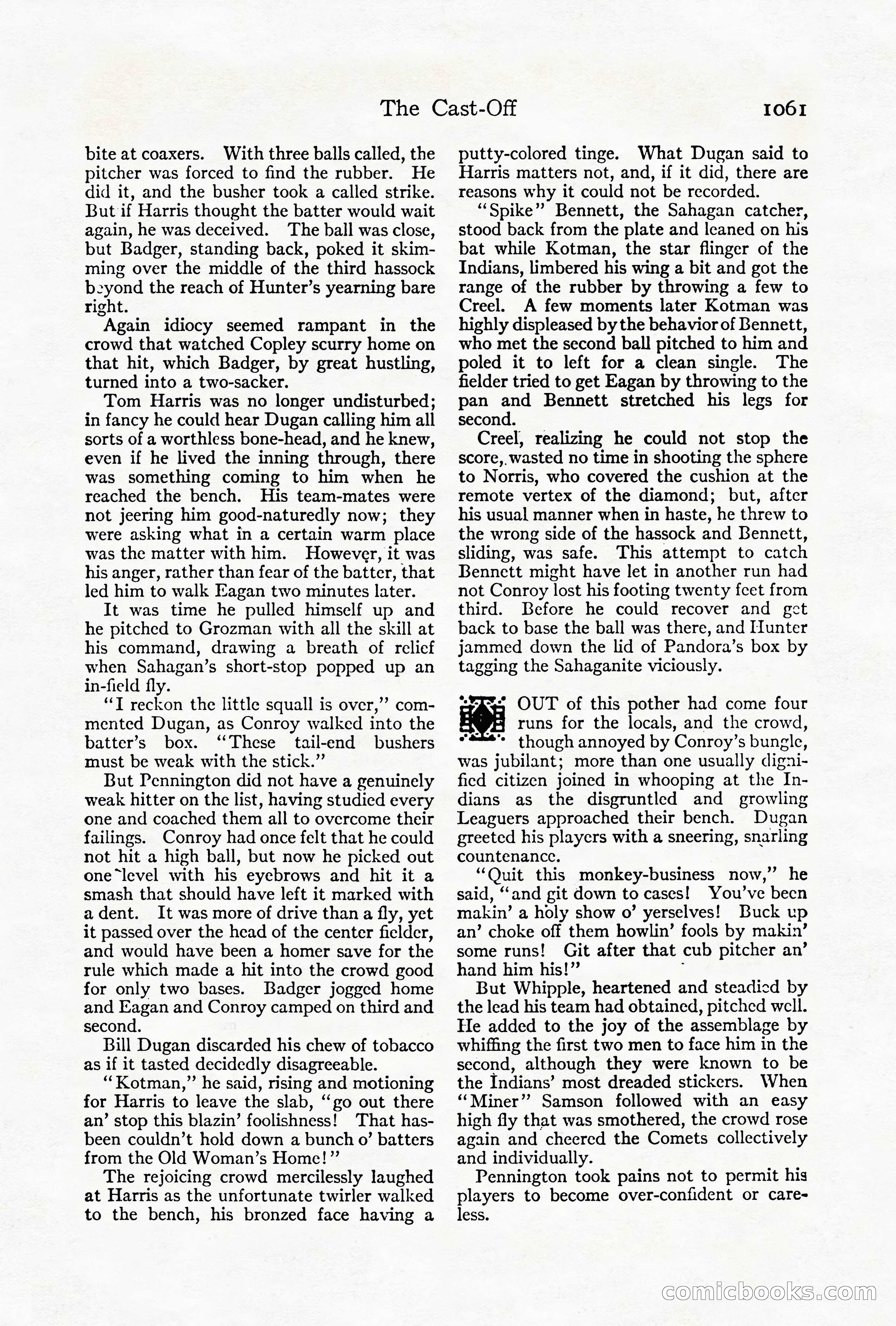
A restored page from Pulp Fiction, 1911. Page through the whole issue in the reader above.
📄 Transcribed text from this page (OCR, searchable)
Machine-transcribed from the original scan — historical spelling and the odd misread are preserved.
The Cast-Off bite at coaxers. With three balls called, the pitcher was forced to find the rubber. He did it, and the busher took a called strike. But if Harris thought the batter would wait again, he was deceived. The ball was close, but Badger, standing back, poked it skim- ming over the middle of the third hassock beyond the reach of Hunter’s yearning bare right. Again idiocy seemed rampant in the crowd that watched Copley scurry home on that hit, which Badger, by great hustling, turned into a two-sacker. Tom Harris was no longer undisturbed; in fancy he could hear Dugan calling him all sorts of a worthless bone-head, and he knew, even if he lived the inning through, there was something coming to him when he reached the bench. His team-mates were not jeering him good-naturedly now; they were asking what in a certain warm place was the matter with him. However, it was his anger, rather than fear of the batter, that led him to walk Eagan two minutes later. It was time he pulled himself up and he pitched to Grozman with all the skill at his command, drawing a breath of relief when Sahagan’s short-stop popped up an in-field fly. “T reckon the little squall is over,” com- mented Dugan, as Conroy walked into the batter’s box. ‘“‘These tail-end bushers must be weak with the stick.” But Pennington did not have a genuinely weak hitter on the list, having studied every one and coached them all to overcome their failings. Conroy had once felt that he could not hit a high ball, but now he picked out one level with his eyebrows and hit it a smash that should have left it marked with adent. It was more of drive than a fly, yet it passed over the head of the center fielder, and would have been a homer save for the rule which made a hit into the crowd good for only two bases. Badger jogged home and Eagan and Conroy camped on third and second. Bill Dugan discarded his chew of tobacco as if it tasted decidedly disagreeable. ““Kotman,” he said, nsing and motioning for Harris to leave the slab, ‘“‘go out there an’ stop this blazin’ foolishness! That has- been couldn’t hold down a bunch o’ batters from the Old Woman’s Home!” The rejoicing crowd mercilessly laughed at Harris as the unfortunate twirler walked to the bench, his bronzed face having a 1061 putty-colored tinge. What Dugan said to Harris matters not, and, if it did, there are reasons why it could not be recorded. “Spike” Bennett, the Sahagan catcher, stood back from the plate and leaned on his bat while Kotman, the star flinger of the Indians, limbered his wing a bit and got the range of the rubber by throwing a few to Creel. A few moments later Kotman was highly displeased by the behavior of Bennett, who met the second ball pitched to him and poled it to left for a clean single. The fielder tried to get Eagan by throwing to the pan and Bennett stretched his legs for second. Creel, realizing he could not stop the score, wasted no time in shooting the sphere to Norris, who covered the cushion at the remote vertex of the diamond; but, after his usual manner when in haste, he threw to the wrong side of the hassock and Bennett, sliding, was safe. This attempt to catch Bennett might have let in another run had not Conroy lost his footing twenty feet from third. Before he could recover and get back to base the ball was there, and [Iunter jammed down the lid of Pandora’s box by tagging the Sahaganite viciously. % OUT of this pother had come four runs for the locals, and the crowd, “aes though annoyed by Conroy’s bungle, was jubilant; more than one usually digni- fied citizen joined in whooping at the In- dians as the disgruntled and _ growling Leaguers approached their bench. Dugan greeted his players with a sneering, snarling countenance. “Quit this monkey-business now,” he said, “‘and git down to cases! You’ve becn makin’ a holy show o’ yerselves! Buck up an’ choke off them howlin’ fools by makin’ some runs! Git after that cub pitcher an’ hand him his!” But Whipple, heartened and steadicd by the lead his team had obtained, pitched well. He added to the joy of the assemblage by whiffing the first two men to face him in the second, although they were known to be the Indians’ most dreaded stickers. When ‘“‘Miner’”’ Samson followed with an easy high fly that was smothered, the crowd rose again and cheered the Comets collectively and individually. Pennington took pains not to permit his players to become over-confident or care- less. CoMmicbhook CO