
Pulp Fiction, 1911 · page 111 of 196
Adventure Magazine Cover, October 1911 — page 111: what you’re looking at
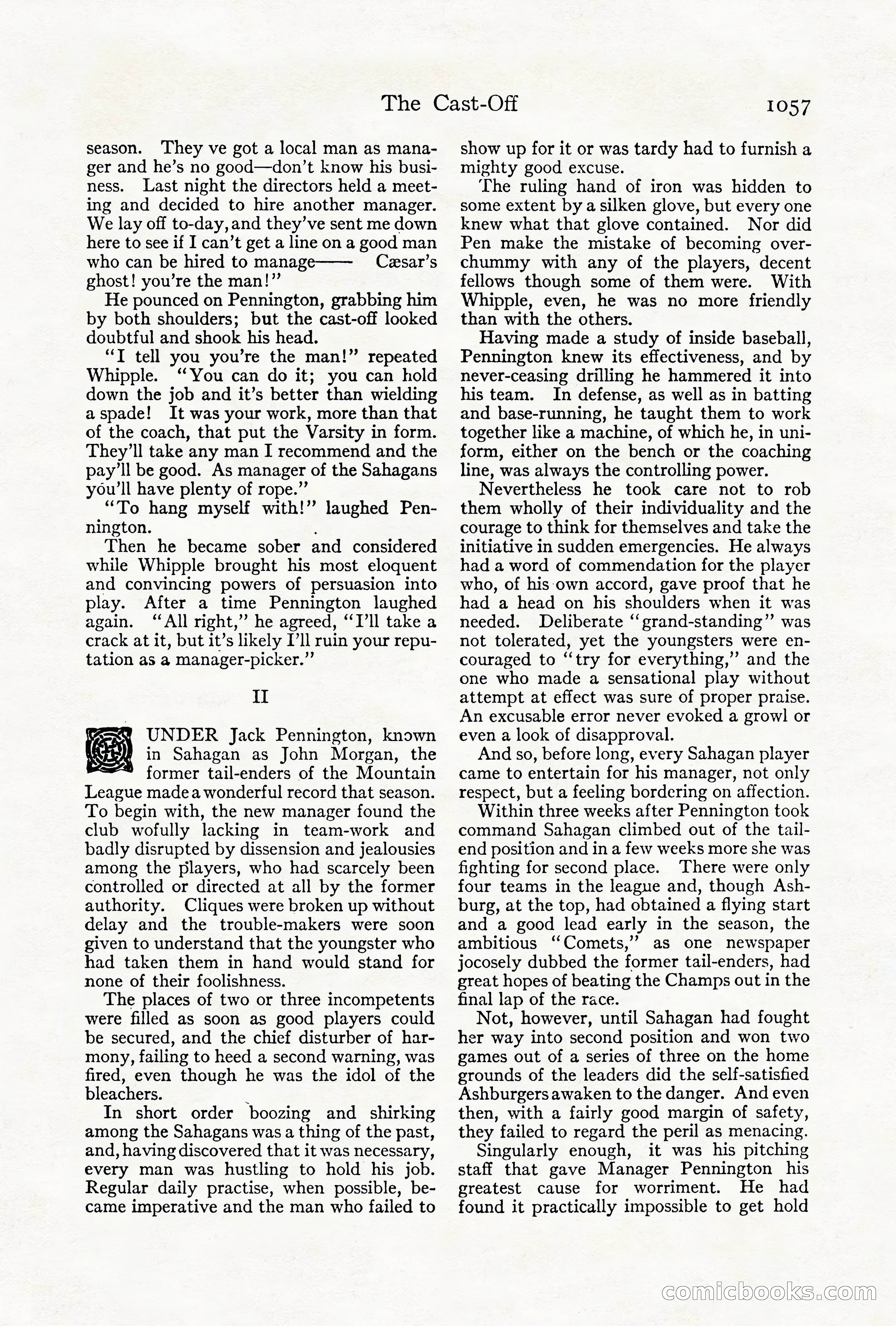
A restored page from Pulp Fiction, 1911. Page through the whole issue in the reader above.
📄 Transcribed text from this page (OCR, searchable)
Machine-transcribed from the original scan — historical spelling and the odd misread are preserved.
The Cast-Off season. ‘They ve got a local man as mana- ger and he’s no good—don’t know his busi- ness. Last night the directors held a meet- ing and decided to hire another manager. We lay off to-day, and they’ve sent me down here to see if I can’t get a line on a good man who can be hired to manage——-_ Cesar’s ghost! you’re the man!” He pounced on Pennington, grabbing him by both shoulders; but the cast-off looked doubtful and shook his head. “T tell you you’re the man!” repeated Whipple. “You can do it; you can hold down the job and it’s better than wielding aspade! It was your work, more than that of the coach, that put the Varsity in form. They’ll take any man I recommend and the pay’ll be good. As manager of the Sahagans you'll have plenty of rope.’’ “To hang myself with!” laughed Pen- nington. Then he became sober and considered while Whipple brought his most eloquent and convincing powers of persuasion into play. After a time Pennington laughed again. ‘All right,” he agreed, “‘I’ll take a crack at it, but it’s likely I'll ruin your repu- tation as a manager-picker.”’ Il <Y UNDER Jack Pennington, known wie in Sahagan as John Morgan, the <=" former tail-enders of the Mountain League madea wonderful record that season. To begin with, the new manager found the club wofully lacking in team-work and badly disrupted by dissension and jealousies among the players, who had scarcely been controlled or directed at all by the former authority. Cliques were broken up without delay and the trouble-makers were soon given to understand that the youngster who had taken them in hand would stand for none of their foolishness. The places of two or three incompetents were filled as soon as good players could be secured, and the chief disturber of har- mony, failing to heed a second warning, was fired, even though he was the idol of the bleachers. : In short order boozing and shirking among the Sahagans was a thing of the past, and, having discovered that it was necessary, every man was hustling to hold his job. Regular daily practise, when possible, be- came imperative and the man who failed to 1057 show up for it or was tardy had to furnish a mighty good excuse. The ruling hand of iron was hidden to some extent by a silken glove, but every one knew what that glove contained. Nor did Pen make the mistake of becoming over- chummy with any of the players, decent fellows though some of them were. With Whipple, even, he was no more friendly than with the others. Having made a study of inside baseball, Pennington knew its effectiveness, and by never-ceasing drilling he hammered it into his team. In defense, as well as in batting and base-running, he taught them to work together like a machine, of which he, in uni- form, either on the bench or the coaching line, was always the controlling power. Nevertheless he took care not to rob them wholly of their individuality and the courage to think for themselves and take the initiative in sudden emergencies. He always had a word of commendation for the player who, of his own accord, gave proof that he had a head on his shoulders when it was needed. Deliberate “‘grand-standing”’ was not tolerated, yet the youngsters were en- couraged to “‘try for everything,”’ and the one who made a sensational play without attempt at effect was sure of proper praise. An excusable error never evoked a growl or even a look of disapproval. And so, before long, every Sahagan player came to entertain for his manager, not only respect, but a feeling bordering on affection. Within three weeks after Pennington took command Sahagan climbed out of the tail- end position and in a few weeks more she was fighting for second place. There were only four teams in the league and, though Ash- burg, at the top, had obtained a flying start and a good lead early in the season, the ambitious ‘‘Comets,’’ as one newspaper jocosely dubbed the former tail-enders, had great hopes of beating the Champs out in the final lap of the race. Not, however, until Sahagan had fought her way into second position and won two games out of a series of three on the home grounds of the leaders did the self-satisfied Ashburgers awaken to the danger. And even then, with a fairly good margin of safety, they failed to regard the peril as menacing. Singularly enough, it was his pitching staff that gave Manager Pennington his greatest cause for worriment. He had found it practically impossible to get hold C© MICLOOKS C©