
Pulp Fiction, 1911 · page 93 of 196
Adventure Magazine Cover — page 93: what you’re looking at
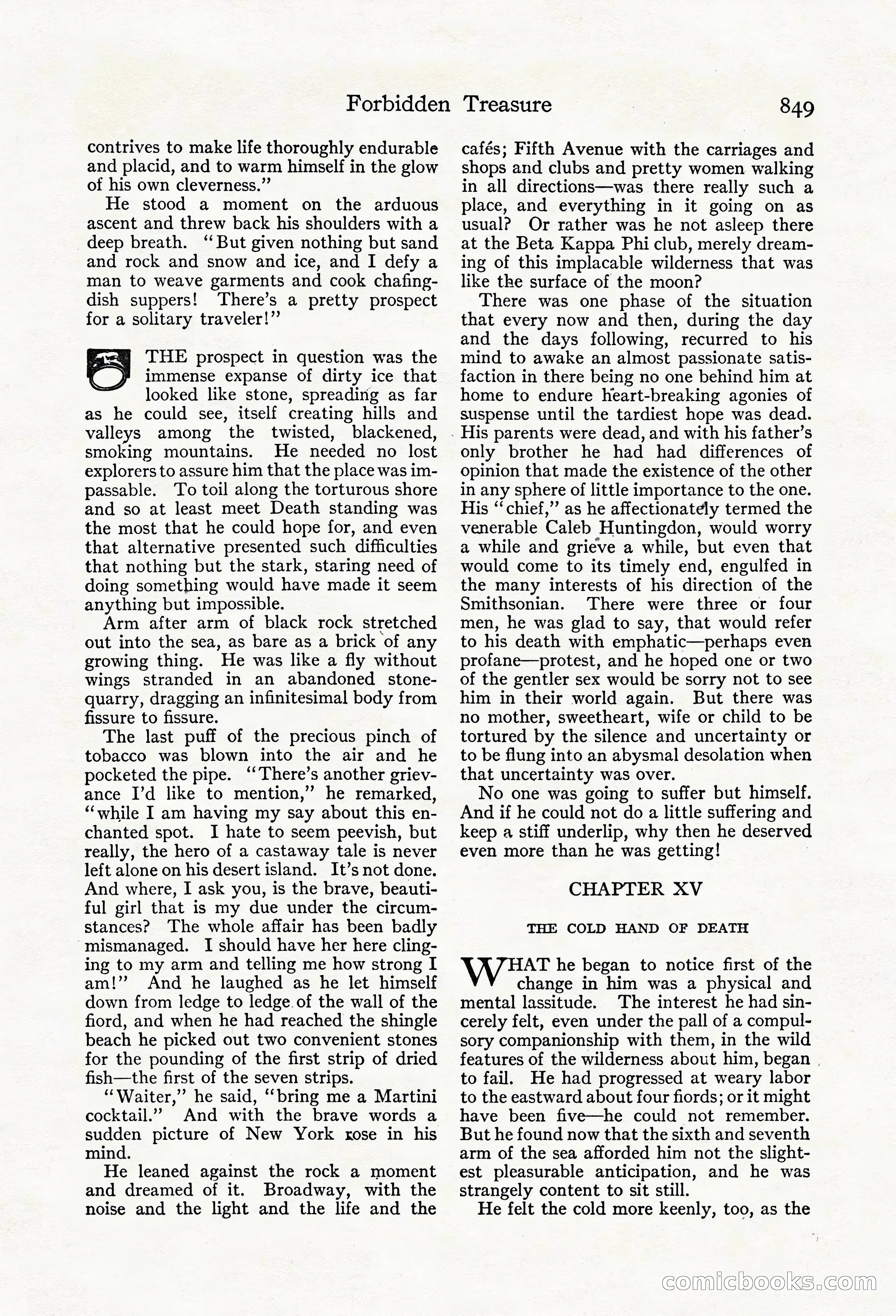
A restored page from Pulp Fiction, 1911. Page through the whole issue in the reader above.
📄 Transcribed text from this page (OCR, searchable)
Machine-transcribed from the original scan — historical spelling and the odd misread are preserved.
Forbidden Treasure contrives to make life thoroughly endurable and placid, and to warm himself in the glow of his own cleverness.” He stood a moment on the arduous ascent and threw back his shoulders with a deep breath. ‘But given nothing but sand and rock and snow and ice, and I defy a man to weave garments and cook chafing- dish suppers! ‘There’s a pretty prospect for a solitary traveler!”’ THE prospect in question was the immense expanse of dirty ice that looked like stone, spreading as far as he could see, itself creating hills and valleys among the twisted, blackened, smoking mountains. He needed no lost explorers to assure him that the place was im- passable. To toil along the torturous shore and so at least meet Death standing was the most that he could hope for, and even that alternative presented such difficulties that nothing but the stark, staring need of doing something would have made it seem anything but impossible. Arm after arm of black rock stretched out into the sea, as bare as a brick of any growing thing. He was like a fly without wings stranded in an abandoned stone- quarry, dragging an infinitesimal body from fissure to fissure. The last puff of the precious pinch of tobacco was blown into the air and he pocketed the pipe. “There’s another griev- ance I’d like to mention,” he remarked, “while I am having my say about this en- chanted spot. I hate to seem peevish, but really, the hero of a castaway tale is never left alone on his desert island. It’s not done. And where, I ask you, is the brave, beauti- ful girl that is my due under the circum- stances? The whole affair has been badly “mismanaged. I should have her here cling- ing to my arm and telling me how strong I am!’? And he laughed as he let himself down from ledge to ledge of the wall of the fiord, and when he had reached the shingle beach he picked out two convenient stones for the pounding of the first strip of dried fish—the first of the seven strips. “Waiter,” he said, “‘bring me a Martini cocktail.” sudden picture of New York xose in his mind. He leaned against the rock a moment and dreamed of it. Broadway, with the noise and the light and the life and the And with the brave words a 849 cafés; Fifth Avenue with the carriages and shops and clubs and pretty women walking in all directions—was there really such a place, and everything in it going on as usual? Or rather was he not asleep there at the Beta Kappa Phi club, merely dream- ing of this implacable wilderness that was like the surface of the moon? There was one phase of the situation that every now and then, during the day and the days following, recurred to his mind to awake an almost passionate satis- faction in there being no one behind him at home to endure heart-breaking agonies of suspense until the tardiest hope was dead. . His parents were dead, and with his father’s only brother he had had differences of opinion that made the existence of the other in any sphere of little importance to the one. His ‘‘chief,” as he affectionately termed the venerable Caleb Huntingdon, would worry a while and grieve a while, but even that would come to its timely end, engulfed in the many interests of his direction of the Smithsonian. There were three or four men, he was glad to say, that would refer to his death with emphatic—perhaps even profane—protest, and he hoped one or two of the gentler sex would be sorry not to see him in their world again. But there was no mother, sweetheart, wife or child to be tortured by the silence and uncertainty or to be flung into an abysmal desolation when that uncertainty was over. No one was going to suffer but himself. And if he could not do a little suffering and keep a stiff underlip, why then he deserved even more than he was getting! CHAPTER XV THE COLD HAND OF DEATH Wee he began to notice first of the change in him was a physical and mental lassitude. The interest he had sin- cerely felt, even under the pall of a compul- sory companionship with them, in the wild features of the wilderness about him, began | to fail. He had progressed at weary labor to the eastward about four fiords; or it might have been five—he could not remember. But he found now that the sixth and seventh arm of the sea afforded him not the slight- est pleasurable anticipation, and he was strangely content to sit still. He felt the cold more keenly, too, as the © MICLOOKS ©