
Pulp Fiction, 1911 · page 90 of 196
Adventure Magazine Cover — page 90: what you’re looking at
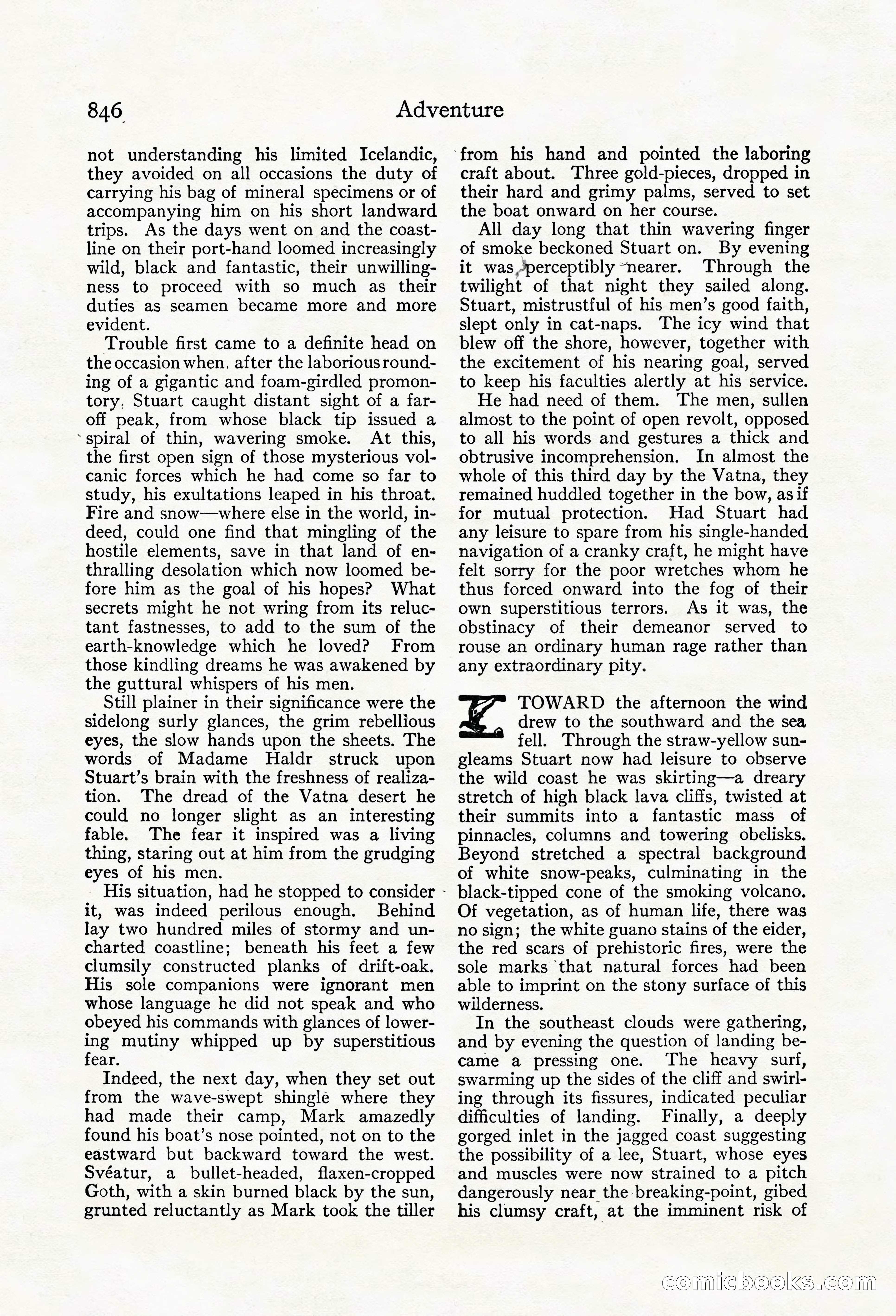
A restored page from Pulp Fiction, 1911. Page through the whole issue in the reader above.
📄 Transcribed text from this page (OCR, searchable)
Machine-transcribed from the original scan — historical spelling and the odd misread are preserved.
846 not understanding his limited Icelandic, they avoided on all occasions the duty of carrying his bag of mineral specimens or of accompanying him on his short landward trips. As the days went on and the coast- line on their port-hand loomed increasingly wild, black and fantastic, their unwilling- ness to proceed with so much as their duties as seamen became more and more evident. Trouble first came to a definite head on the occasion when. after the laborious round- ing of a gigantic and foam-girdled promon- tory. Stuart caught distant sight of a far- off peak, from whose black tip issued a ‘spiral of thin, wavering smoke. At this, the first open sign of those mysterious vol- canic forces which he had come so far to study, his exultations leaped in his throat. Fire and snow—where else in the world, in- deed, could one find that mingling of the hostile elements, save in that land of en- thralling desolation which now loomed be- fore him as the goal of his hopes? What secrets might he not wring from its reluc- tant fastnesses, to add to the sum of the earth-knowledge which he loved? From those kindling dreams he was awakened by the guttural whispers of his men. Still plainer in their significance were the sidelong surly glances, the grim rebellious eyes, the slow hands upon the sheets. The words of Madame Haldr struck upon Stuart’s brain with the freshness of realiza- tion. The dread of the Vatna desert he could no longer slight as an interesting fable. The fear it inspired was a living thing, staring out at him from the grudging eyes of his men. - His situation, had he stopped to consider - it, was indeed perilous enough. Behind lay two hundred miles of stormy and un- charted coastline; beneath his feet a few clumsily constructed planks of drift-oak. His sole companions were ignorant men whose language he did not speak and who obeyed his commands with glances of lower- ng mutiny whipped up by superstitious ear. Indeed, the next day, when they set out from the wave-swept shingle where they had made their camp, Mark amazedly found his boat’s nose pointed, not on to the eastward but backward toward the west. Svéatur, a bullet-headed, flaxen-cropped Goth, with a skin burned black by the sun, grunted reluctantly as Mark took the tiller Adventure ‘from his hand and pointed the laboring craft about. Three gold-pieces, dropped in their hard and grimy palms, served to set the boat onward on her course. All day long that thin wavering finger of smoke beckoned Stuart on. By evening it was,perceptibly “nearer. Through the twilight of that night they sailed along. Stuart, mistrustful of his men’s good faith, slept only in cat-naps. The icy wind that blew off the shore, however, together with the excitement of his nearing goal, served to keep his faculties alertly at his service. He had need of them. The men, sullen almost to the point of open revolt, opposed to all his words and gestures a thick and obtrusive incomprehension. In almost the whole of this third day by the Vatna, they remained huddled together in the bow, as if for mutual protection. Had Stuart had any leisure to spare from his single-handed navigation of a cranky craft, he might have felt sorry for the poor wretches whom he thus forced onward into the fog of their own superstitious terrors. As it was, the obstinacy of their demeanor served to rouse an ordinary human rage rather than any extraordinary pity. i$ drew to the southward and the sea fell. Through the straw-yellow sun- gleams Stuart now had leisure to observe the wild coast he was skirting—a dreary stretch of high black lava cliffs, twisted at their summits into a fantastic mass of pinnacles, columns and towering obelisks. Beyond stretched a spectral background of white snow-peaks, culminating in the black-tipped cone of the smoking volcano. Of vegetation, as of human life, there was no sign; the white guano stains of the eider, the red scars of prehistoric fires, were the sole marks that natural forces had been able to imprint on the stony surface of this wilderness. In the southeast clouds were gathering, and by evening the question of landing be- came a pressing one. ‘The heavy surf, swarming up the sides of the cliff and swirl- ing through its fissures, indicated peculiar difficulties of landing. Finally, a deeply gorged inlet in the jagged coast suggesting the possibility of a lee, Stuart, whose eyes and muscles were now strained to a pitch dangerously near the breaking-point, gibed his clumsy craft, at the imminent risk of TOWARD the afternoon the wind Comiclbooks ©