
Pulp Fiction, 1911 · page 74 of 196
Adventure Magazine Cover — page 74: what you’re looking at
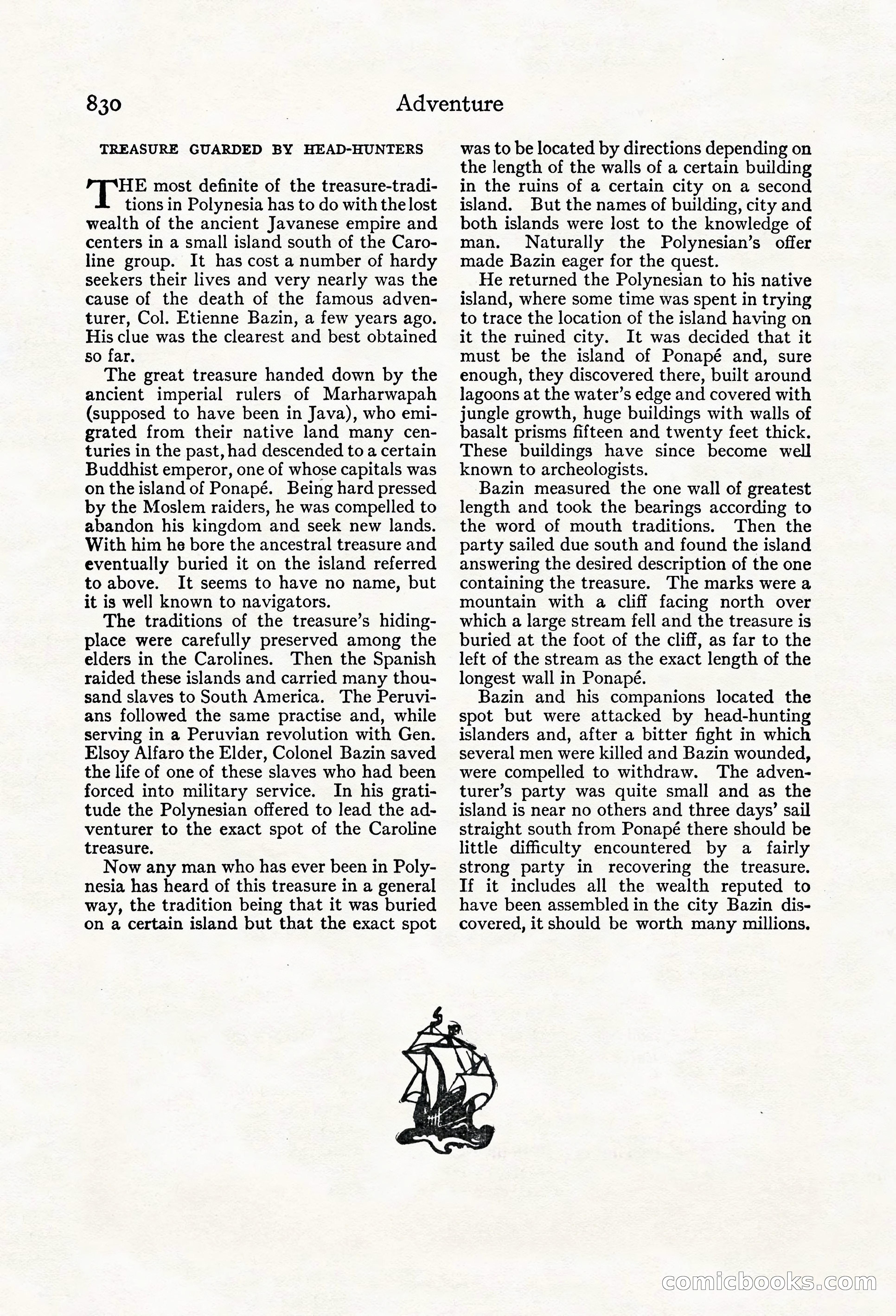
A restored page from Pulp Fiction, 1911. Page through the whole issue in the reader above.
📄 Transcribed text from this page (OCR, searchable)
Machine-transcribed from the original scan — historical spelling and the odd misread are preserved.
830 TREASURE GUARDED BY HEAD-HUNTERS HE most definite of the treasure-tradi- tions in Polynesia has to do with the lost wealth of the ancient Javanese empire and centers in a small island south of the Caro- line group. It has cost a number of hardy seekers their lives and very nearly was the cause of the death of the famous adven- turer, Col. Etienne Bazin, a few years ago. His clue was the clearest and best obtained So far. The great treasure handed down by the ancient imperial rulers of Marharwapah (supposed to have been in Java), who emi- grated from their native land many cen- turies in the past, had descended to a certain Buddhist emperor, one of whose capitals was on the island of Ponapé. Being hard pressed by the Moslem raiders, he was compelled to abandon his kingdom and seek new lands. With him he bore the ancestral treasure and eventually buried it on the island referred to above. It seems to have no name, but it is well known to navigators. The traditions of the treasure’s hiding- place were carefully preserved among the elders in the Carolines. Then the Spanish raided these islands and carried many thou- sand slaves to South America. The Peruvi- ans followed the same practise and, while serving in a Peruvian revolution with Gen. Elsoy Alfaro the Elder, Colonel Bazin saved the life of one of these slaves who had been forced into military service. In his grati- tude the Polynesian offered to lead the ad- venturer to the exact spot of the Caroline treasure. Now any man who has ever been in Poly- nesia has heard of this treasure in a general way, the tradition being that it was buried on a certain island but that the exact spot Adventure was to be located by directions depending on the length of the walls of a certain building in the ruins of a certain city on a second island. But the names of building, city and both islands were lost to the knowledge of man. Naturally the Polynesian’s offer made Bazin eager for the quest. He returned the Polynesian to his native island, where some time was spent in trying to trace the location of the island having on it the ruined city. It was decided that it must be the island of Ponapé and, sure enough, they discovered there, built around lagoons at the water’s edge and covered with jungle growth, huge buildings with walls of basalt prisms fifteen and twenty feet thick. These buildings have since become well known to archeologists. Bazin measured the one wall of greatest length and took the bearings according to the word of mouth traditions. Then the party sailed due south and found the island answering the desired description of the one containing the treasure. The marks were a mountain with a cliff facing north over which a large stream fell and the treasure is buried at the foot of the cliff, as far to the left of the stream as the exact length of the longest wall in Ponapé. Bazin and his companions located the spot but were attacked by head-hunting islanders and, after a bitter fight in which several men were killed and Bazin wounded, were compelled to withdraw. The adven- turer’s party was quite small and as the island is near no others and three days’ sail straight south from Ponapé there should be little difficulty encountered by a fairly strong party in recovering the treasure. If it includes all the wealth reputed to have been assembled in the city Bazin dis- covered, it should be worth many millions. C© MICLOOOKS C©