
Pulp Fiction, 1911 · page 44 of 196
Adventure Magazine Cover — page 44: what you’re looking at
A restored page from Pulp Fiction, 1911. Page through the whole issue in the reader above.
📄 Transcribed text from this page (OCR, searchable)
Machine-transcribed from the original scan — historical spelling and the odd misread are preserved.
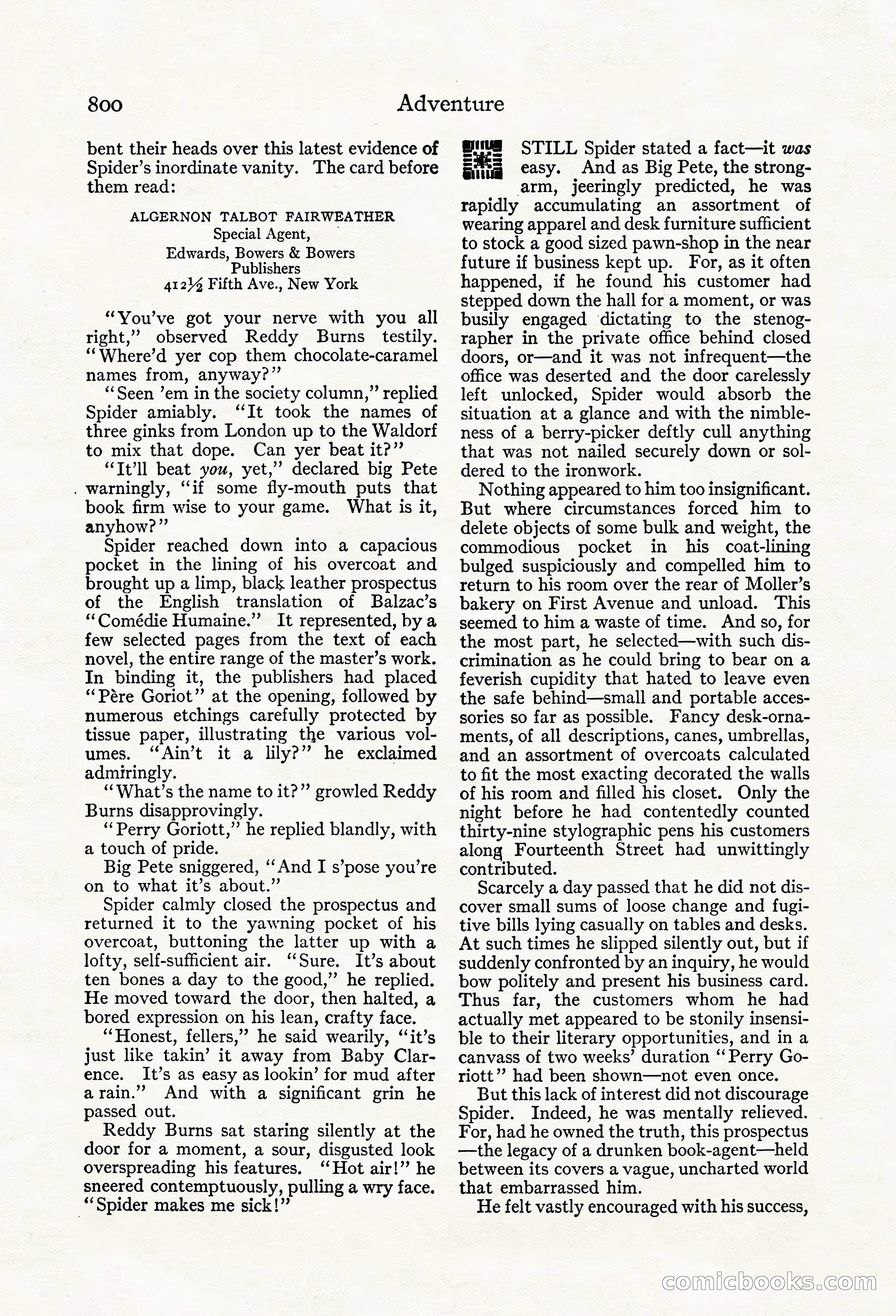
800 bent their heads over this latest evidence of Spider’s inordinate vanity. The card before them read: ALGERNON TALBOT FAIRWEATHER Special Agent, Edwards, Bowers & Bowers Publishers 41214 Fifth Ave., New York “You’ve got your nerve with you all right,” observed Reddy Burns testily. ‘““Where’d yer cop them chocolate-caramel names from, anyway?”’ ‘Seen ’em in the society column,” replied Spider amiably. “It took the names of three ginks from London up to the Waldorf to mix that dope. Can yer beat it?” “Tt’ll beat you, yet,” declared big Pete . warningly, ‘‘if some fly-mouth puts that book firm wise to your game. What is it, anyhow?” Spider reached down into a capacious pocket in the lining of his overcoat and brought up a limp, black leather prospectus of the English translation of Balzac’s “‘Comédie Humaine.” It represented, by a few selected pages from the text of each novel, the entire range of the master’s work. In binding it, the publishers had placed ‘“‘Pére Goriot” at the opening, followed by numerous etchings carefully protected by tissue paper, illustrating the various vol- umes. ‘Ain’t it a lily?” he exclaimed admiringly. ‘“‘What’s the name to it?” growled Reddy Burns disapprovingly. ‘Perry Goriott,” he replied blandly, with a touch of pride. Big Pete sniggered, ‘‘And I s’pose you’re on to what it’s about.” Spider calmly closed the prospectus and returned it to the yawning pocket of his overcoat, buttoning the latter up with a lofty, self-sufficient air. “Sure. It’s about ten bones a day to the good,” he replied. He moved toward the door, then halted, a bored expression on his lean, crafty face. ‘Honest, fellers,’’ he said wearily, ‘‘it’s just like takin’ it away from Baby Clar- ence. It’s as easy as lookin’ for mud after arain.” And with a significant grin he passed out. Reddy Burns sat staring silently at the door for a moment, a sour, disgusted look overspreading his features. ‘Hot air!” he sneered contemptuously, pulling a wry face. “Spider makes me sick!” Adventure gus STILL Spider stated a fact—it wes eae easy. And as Big Pete, the strong- arm, jeeringly predicted, he was rapidly accumulating an assortment of wearing apparel and desk furniture sufficient to stock a good sized pawn-shop in the near future if business kept up. For, as it often happened, if he found his customer had stepped down the hall for a moment, or was busily engaged dictating to the stenog- rapher in the private office behind closed doors, or—and it was not infrequent—the office was deserted and the door carelessly left unlocked, Spider would absorb the situation at a glance and with the nimble- ness of a berry-picker deftly cull anything that was not nailed securely down or sol- dered to the ironwork. Nothing appeared to him too insignificant. But where circumstances forced him to delete objects of some bulk and weight, the commodious pocket in his coat-lining bulged suspiciously and compelled him to return to his room over the rear of Moller’s bakery on First Avenue and unload. This seemed to him a waste of time. And so, for the most part, he selected—with such dis- crimination as he could bring to bear on a feverish cupidity that hated to leave even the safe behind—small and portable acces- sories so far as possible. Fancy desk-orna- ments, of all descriptions, canes, umbrellas, and an assortment of overcoats calculated to fit the most exacting decorated the walls of his room and filled his closet. Only the night before he had contentedly counted thirty-nine stylographic pens his customers along Fourteenth Street had unwittingly contributed. Scarcely a day passed that he did not dis- cover small sums of loose change and fugi- tive bills lying casually on tables and desks. At such times he slipped silently out, but if suddenly confronted by an inquiry, he would bow politely and present his business card. Thus far, the customers whom he had actually met appeared to be stonily insensi- ble to their literary opportunities, and in a canvass of two weeks’ duration ‘‘ Perry Go- riott”? had been shown—not even once. But this lack of interest did not discourage Spider. Indeed, he was mentally relieved. | For, had he owned the truth, this prospectus —the legacy of a drunken book-agent—held between its covers a vague, uncharted world that embarrassed him. He felt vastly encouraged with his success, cCoMmicbook ©