
Pulp Fiction, 1911 · page 38 of 196
Adventure Magazine Cover — page 38: what you’re looking at
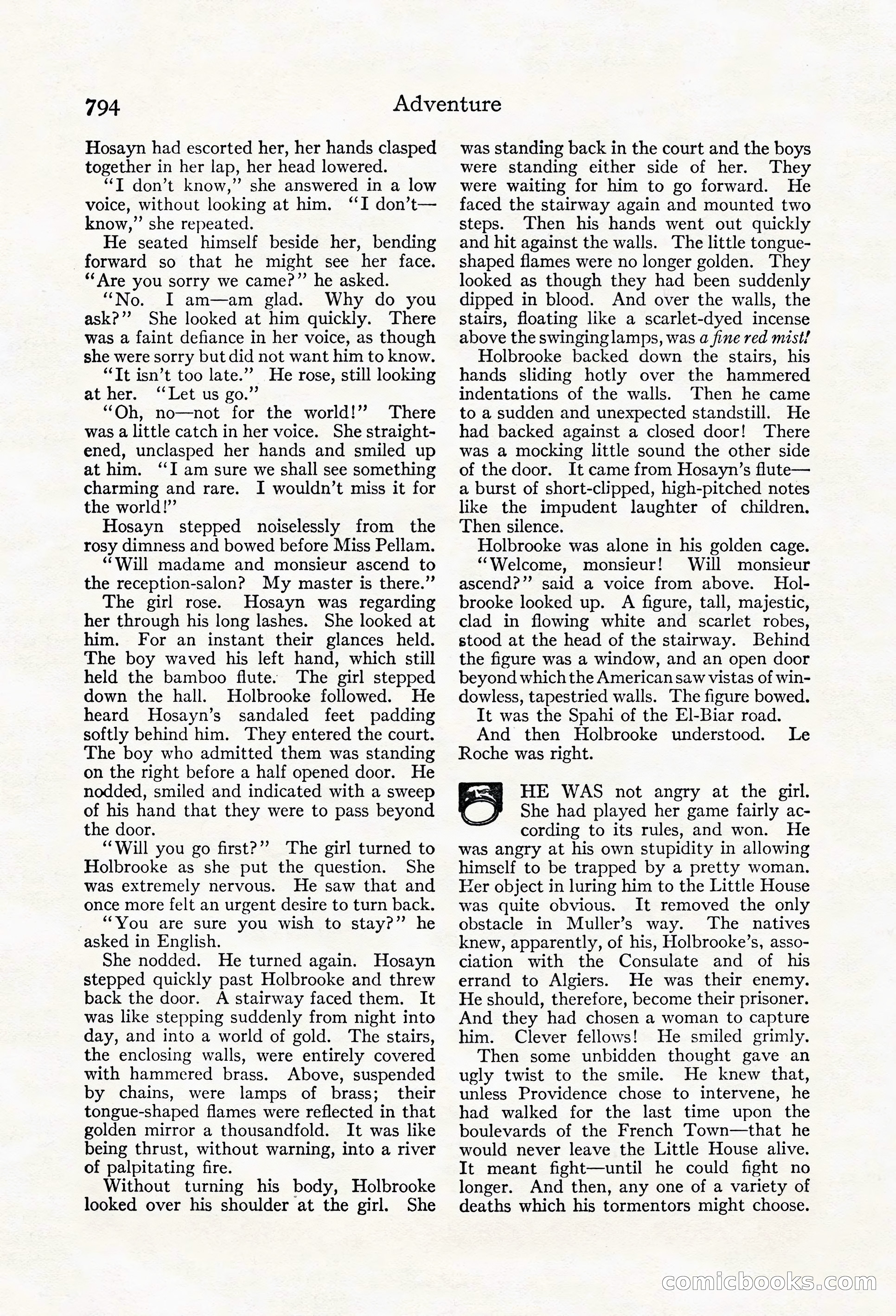
A restored page from Pulp Fiction, 1911. Page through the whole issue in the reader above.
📄 Transcribed text from this page (OCR, searchable)
Machine-transcribed from the original scan — historical spelling and the odd misread are preserved.
794 Hosayn had escorted her, her hands clasped together in her lap, her head lowered. ‘“‘T don’t know,” she answered in a low voice, without looking at him. “TI don’t— know,” she repeated. He seated himself beside her, bending forward so that he might see her face. ‘Are you sorry we came?” he asked. “No. I am—am glad. Why do you ask?”? She looked at him quickly. There was a faint defiance in her voice, as though she were sorry but did not want him to know. ‘It isn’t too late.” He rose, still looking at her. “Let us go.” “Oh, no—not for the world!” There was a little catch in her voice. She straight- ened, unclasped her hands and smiled up at him. ‘I am sure we shall see something charming and rare. I wouldn’t miss it for the world!’ Hosayn stepped noiselessly from the rosy dimness and bowed before Miss Pellam. ‘Will madame and monsieur ascend to the reception-salon? My master is there.” The girl rose. Hosayn was regarding her through his long lashes. She looked at him. For an instant their glances held. The boy waved his left hand, which still held the bamboo flute. The girl stepped down the hall. Holbrooke followed. He heard Hosayn’s sandaled feet padding softly behind him. They entered the court. The boy who admitted them was standing on the right before a half opened door. He nodded, smiled and indicated with a sweep of his hand that they were to pass beyond the door. “Will you go first?” The girl turned to Holbrooke as she put the question. She was extremely nervous. He saw that and once more felt an urgent desire to turn back. ‘You are sure you wish to stay?” he asked in English. She nodded. He turned again. Hosayn stepped quickly past Holbrooke and threw back the door. A stairway faced them. It was like stepping suddenly from night into day, and into a world of gold. The stairs, the enclosing walls, were entirely covered with hammered brass. Above, suspended by chains, were lamps of brass; _ their tongue-shaped flames were reflected in that golden mirror a thousandfold. It was like being thrust, without warning, into a river of palpitating fire. Without turning his body, Holbrooke looked over his shoulder at the girl. She Adventure was standing back in the court and the boys were standing either side of her. They were waiting for him to go forward. He faced the stairway again and mounted two steps. Then his hands went out quickly and hit against the walls. The little tongue- shaped flames were no longer golden. They looked as though they had been suddenly dipped in blood. And over the walls, the stairs, floating like a scarlet-dyed incense above the swinging lamps, was a fine red mist! Holbrooke backed down the stairs, his hands sliding hotly over the hammered indentations of the walls. Then he came to a sudden and unexpected standstill. He had backed against a closed door! ‘There was a mocking little sound the other side of the door. It came from Hosayn’s flute— a burst of short-clipped, high-pitched notes like the impudent laughter of children. Then silence. Holbrooke was alone in his golden cage. “Welcome, monsieur! Will monsieur ascend?”’ said a voice from above. Hol- brooke looked up. A figure, tall, majestic, clad in flowing white and scarlet robes, stood at the head of the stairway. Behind the figure was a window, and an open door beyond which the American saw vistas of win- dowless, tapestried walls. The figure bowed. It was the Spahi of the El-Biar road. And then Holbrooke understood. Roche was right. 7 —™~ © a Le HE WAS not angry at the girl. She had played her game fairly ac- cording to its rules, and won. He was angry at his own stupidity in allowing himself to be trapped by a pretty woman. Her object in luring him to the Little House was quite obvious. It removed the only obstacle in Muller’s way. ‘The natives knew, apparently, of his, Holbrooke’s, asso- ciation with the Consulate and of his errand to Algiers. He was their enemy. He should, therefore, become their prisoner. And they had chosen a woman to capture him. Clever fellows! He smiled grimly. Then some unbidden thought gave an ugly twist to the smile. He knew that, unless Providence chose to intervene, he had walked for the last time upon the boulevards of the French Town—that he would never leave the Little House alive. It meant fight—until he could fight no longer. And then, any one of a variety of deaths which his tormentors might choose. COmiclbook (©