
Pulp Fiction, 1911 · page 33 of 196
Adventure Magazine Cover — page 33: what you’re looking at
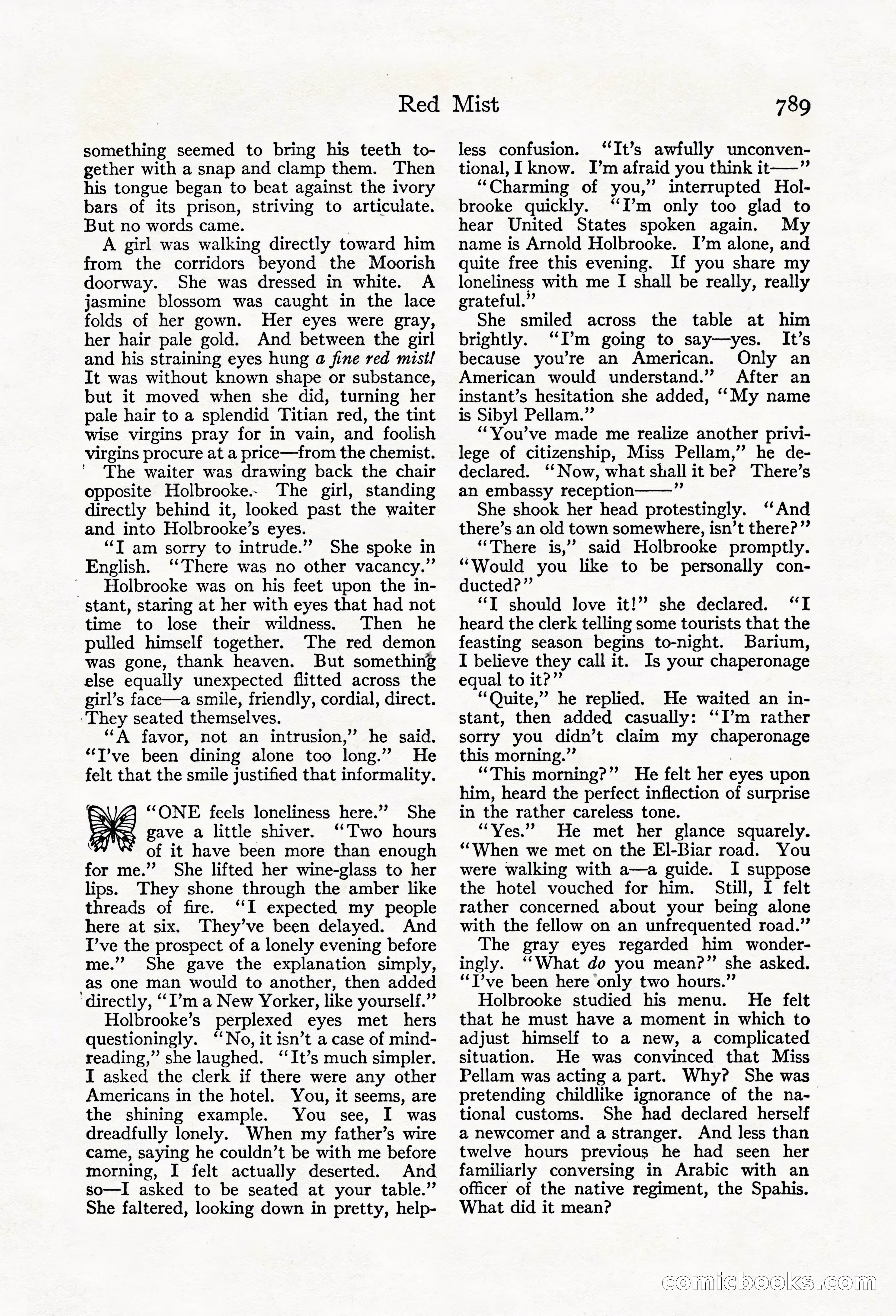
A restored page from Pulp Fiction, 1911. Page through the whole issue in the reader above.
📄 Transcribed text from this page (OCR, searchable)
Machine-transcribed from the original scan — historical spelling and the odd misread are preserved.
Red Mist something seemed to bring his teeth to- gether with a snap and clamp them. Then his tongue began to beat against the ivory bars of its prison, striving to articulate. But no words came. | A girl was walking directly toward him from the corridors beyond the Moorish doorway. She was dressed in white. A jasmine blossom was caught in the lace folds of her gown. Her eyes were gray, her hair pale gold. And between the girl and his straining eyes hung a fine red mist! It was without known shape or substance, but it moved when she did, turning her pale hair to a splendid Titian red, the tint wise virgins pray for in vain, and foolish virgins procure at a price—from the chemist. ' The waiter was drawing back the chair opposite Holbrooke. The girl, standing directly behind it, looked past the waiter and into Holbrooke’s eyes. “IT am sorry to intrude.”’ She spoke in English. ‘‘There was no other vacancy.” _ Holbrooke was on his feet upon the in- stant, staring at her with eyes that had not time to lose their wildness. Then he pulled himself together. The red demon was gone, thank heaven. But something else equally unexpected flitted across the girl’s face—a smile, friendly, cordial, direct. ‘They seated themselves. “A favor, not an intrusion,” he said. “T’ve been dining alone too long.” He felt that the smile justified that informality. Be gave a little shiver. ‘Two hours : of it have been more than enough for me.”’ She lifted her wine-glass to her lips. They shone through the amber like threads of fire. ‘‘I expected my people here at six. They’ve been delayed. And I’ve the prospect of a lonely evening before me.”’ She gave the explanation simply, as one man would to another, then added ‘directly, ‘I’m a New Yorker, like yourself.” Holbrooke’s perplexed eyes met hers questioningly. “No, it isn’t a case of mind- reading,” she laughed. ‘‘It’s much simpler. I asked the clerk if there were any other Americans in the hotel. You, it seems, are the shining example. You see, I was dreadfully lonely. When my father’s wire came, saying he couldn’t be with me before morning, I felt actually deserted. And so—I asked to be seated at your table.” She faltered, looking down in pretty, help- “ONE feels loneliness here.’? She 789 less confusion. “It’s awfully unconven- tional, I know. I’m afraid you think it——”’ ‘“‘Charming of you,” interrupted Hol- brooke quickly. “I’m only too glad to hear United States spoken again. My name is Arnold Holbrooke. I’m alone, and quite free this evening. If you share my loneliness with me I shall be really, really grateful.” She smiled across the table at him brightly. ‘“‘I’m going to say—yes. It’s because youre an American. Only an American would understand.” After an instant’s hesitation she added, ‘‘My name is Sibyl Pellam.” ““You’ve made me realize another privi- lege of citizenship, Miss Pellam,” he de- declared. ‘‘ Now, what shall it be? There’s an embassy reception i She shook her head protestingly. ‘And there’s an old town somewhere, isn’t there? ”’ “There is,’ said Holbrooke promptly. “Would you like to be personally con- ducted?” “T should love it!” she declared. “I heard the clerk telling some tourists that the feasting season begins to-night. Barium, I believe they call it. Is your chaperonage equal to it?” “Quite,” he replied. He waited an in- stant, then added casually: “I’m rather sorry you didn’t claim my chaperonage this morning.” 3 “This morning?” He felt her eyes upon him, heard the perfect inflection of surprise in the rather careless tone. “Yes.” He met her glance squarely. ‘““When we met on the El-Biar road. You were walking with a—a guide. I suppose the hotel vouched for him. Still, I felt rather concerned about your being alone with the fellow on an unfrequented road.” The gray eyes regarded him wonder- ingly. ‘‘What do you mean?” she asked. “‘T’ve been here only two hours.” Holbrooke studied his menu. He felt that he must have a moment in which to adjust himself to a new, a complicated situation. He was convinced that Miss Pellam was acting a part. Why? She was pretending childlike ignorance of the na- tional customs. She had declared herself a newcomer and a stranger. And less than twelve hours previous he had seen her familiarly conversing in Arabic with an officer of the native regiment, the Spahis. What did it mean? COmiclbook ©