
Pulp Fiction, 1911 · page 180 of 196
Adventure Magazine Cover — page 180: what you’re looking at
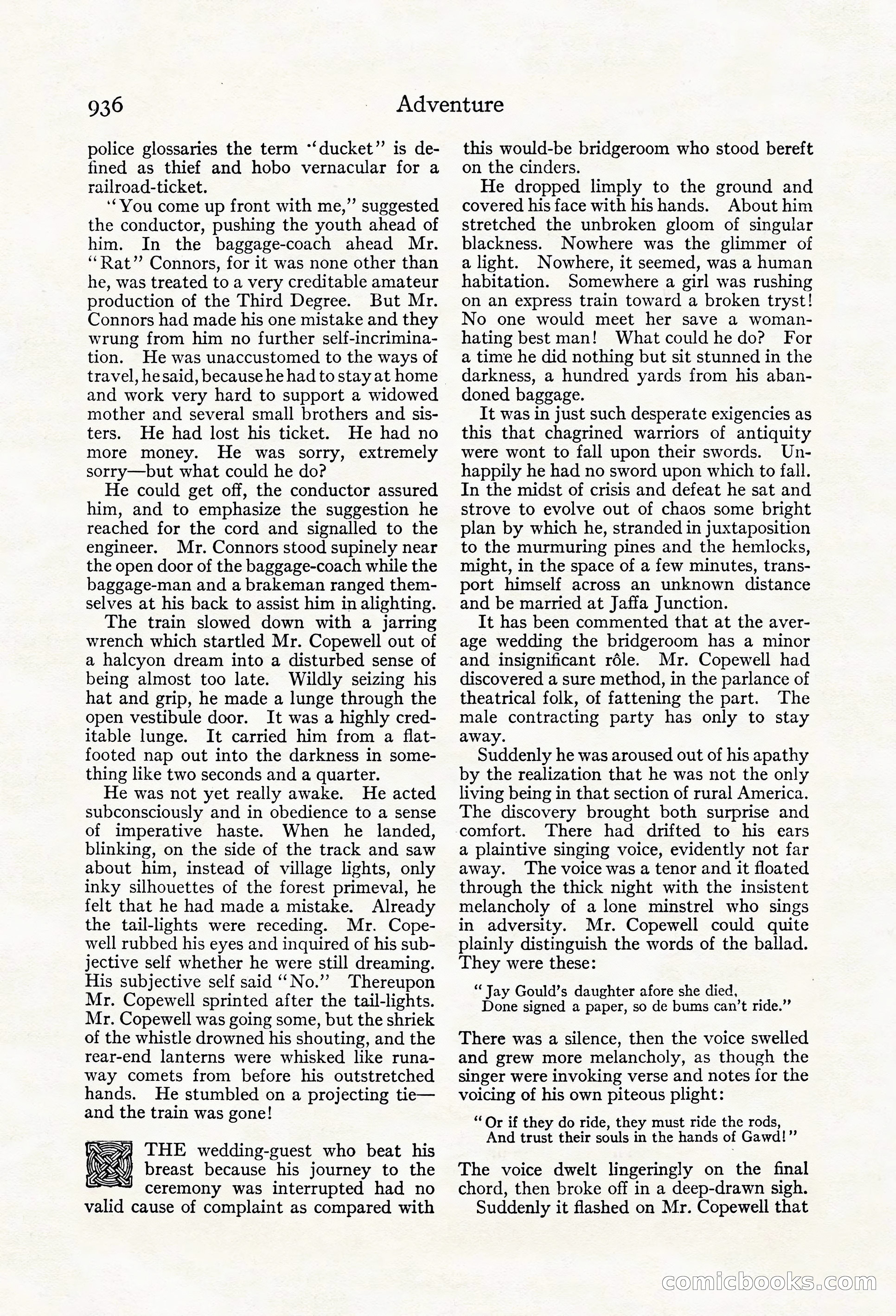
A restored page from Pulp Fiction, 1911. Page through the whole issue in the reader above.
📄 Transcribed text from this page (OCR, searchable)
Machine-transcribed from the original scan — historical spelling and the odd misread are preserved.
936 police glossaries the term *‘ducket”’ is de- fined as thief and hobo vernacular for a railroad-ticket. ‘“You come up front with me,” suggested the conductor, pushing the youth ahead of him. In the baggage-coach ahead Mr. “Rat”? Connors, for it was none other than he, was treated to a very creditable amateur production of the Third Degree. But Mr. Connors had made his one mistake and they wrung from him no further self-incrimina- tion. He was unaccustomed to the ways of travel, hesaid, because he had to stay at home > and work very hard to support a widowed mother and several small brothers and sis- ters. He had lost his ticket. He had no more money. He was sorry, extremely sorry—but what could he do? He could get off, the conductor assured him, and to emphasize the suggestion he reached for the cord and signalled to the engineer. Mr. Connors stood supinely near the open door of the baggage-coach while the baggage-man and a brakeman ranged them- selves at his back to assist him in alighting. The train slowed down with a jarring wrench which startled Mr. Copewell out of a halcyon dream into a disturbed sense of being almost too late. Wildly seizing his hat and grip, he made a lunge through the open vestibule door. It was a highly cred- itable lunge. It carried him from a flat- footed nap out into the darkness in some- thing like two seconds and a quarter. He was not yet really awake. He acted subconsciously and in obedience to a sense of imperative haste. When he landed, blinking, on the side of the track and saw about him, instead of village lights, only inky silhouettes of the forest primeval, he felt that he had made a mistake. Already the tail-lights were receding. Mr. Cope- well rubbed his eyes and inquired of his sub- jective self whether he were still dreaming. His subjective self said ‘No.’ Thereupon Mr. Copewell sprinted after the tail-lights. Mr. Copewell was going some, but the shriek of the whistle drowned his shouting, and the rear-end lanterns were whisked like runa- way comets from before his outstretched hands. He stumbled on a projecting tie— and the train was gone! <x, THE wedding-guest who beat his ne breast because his journey to the SSS ceremony was interrupted had no valid cause of complaint as compared with Adventure this would-be bridgeroom who stood bereft on the cinders. He dropped limply to the ground and covered his face with hishands. About him stretched the unbroken gloom of singular blackness. Nowhere was the glimmer of a light. Nowhere, it seemed, was a human habitation. Somewhere a girl was rushing on an express train toward a broken tryst! No one would meet her save a woman- hating best man! Whatcould he do? For a time he did nothing but sit stunned in the darkness, a hundred yards from his aban- doned baggage. It was in just such desperate exigencies as this that chagrined warriors of antiquity were wont to fall upon their swords. Un- happily he had no sword upon which to fall. In the midst of crisis and defeat he sat and strove to evolve out of chaos some bright plan by which he, stranded in juxtaposition to the murmuring pines and the hemlocks, might, in the space of a few minutes, trans- port himself across an unknown distance and be married at Jaffa Junction. It has been commented that at the aver- age wedding the bridgeroom has a minor and insignificant rdle. Mr. Copewell had discovered a sure method, in the parlance of theatrical folk, of fattening the part. The male contracting party has only to stay away siddaaly he was aroused out of his apathy by the realization that he was not the only living being in that section of rural America. The discovery brought both surprise and comfort. There had drifted to his ears a plaintive singing voice, evidently not far away. ‘The voice was a tenor and it floated through the thick night with the insistent melancholy of a lone minstrel who sings in adversity. Mr. Copewell could quite plainly distinguish the words of the ballad. They were these: ‘Jay Gould’s daughter afore she died, Done signed a paper, so de bums can’t ride.” There was a silence, then the voice swelled and grew more melancholy, as though the singer were invoking verse and notes for the voicing of his own piteous plight: “Or if they do ride, they must ride the rods, And trust their souls in the hands of Gawd!” The voice dwelt lingeringly on the final chord, then broke off in a deep-drawn sigh. Suddenly it flashed on Mr. Copewell that cComiclbooks (©