
Pulp Fiction, 1911 · page 154 of 196
Adventure Magazine Cover — page 154: what you’re looking at
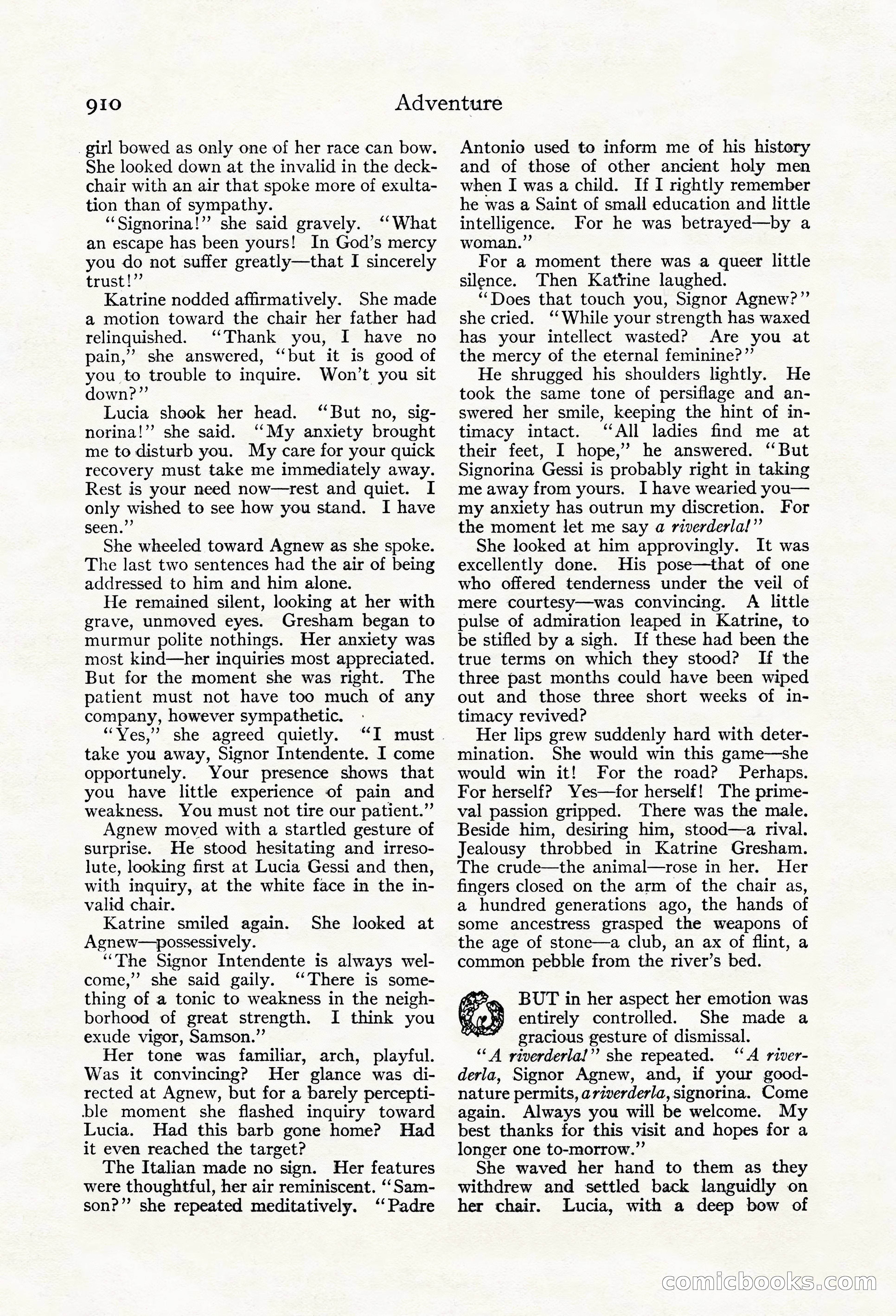
A restored page from Pulp Fiction, 1911. Page through the whole issue in the reader above.
📄 Transcribed text from this page (OCR, searchable)
Machine-transcribed from the original scan — historical spelling and the odd misread are preserved.
or ce) girl bowed as only one of her race can bow. She looked down at the invalid in the deck- chair with an air that spoke more of exulta- tion than of sympathy. ‘“‘Signorina!’”’ she said gravely. ‘“‘What an escape has been yours! In God’s mercy you do not suffer greatly—that I sincerely trust!” Katrine nodded affirmatively. She made a motion toward the chair her father had relinquished. ‘Thank you, I have no pain,” she answered, “‘but it is good of you to trouble to inquire. Won’t you sit down?” Lucia shook her head. “But no, sig- norina!”’ she said. ‘“‘My anxiety brought me to disturb you. My care for your quick recovery must take me immediately away. Rest is your need now—rest and quiet. I only wished to see how you stand. I have seen.”’ She wheeled toward Agnew as she spoke. The last two sentences had the air of being addressed to him and him alone. He remained silent, looking at her with grave, unmoved eyes. Gresham began to murmur polite nothings. Her anxiety was most kind—her inquiries most appreciated. But for the moment she was right. The patient must not have too much of any company, however sympathetic. “Yes,” she agreed quietly. take you away, Signor Intendente. I come opportunely. Your presence shows that you have little experience of pain and weakness. You must not tire our patient.” Agnew moved with a startled gesture of surprise. He stood hesitating and irreso- lute, looking first at Lucia Gessi and then, with inquiry, at the white face in the in- valid chair. Katrine smiled again. Agnew—possessively. “The Signor Intendente is always wel- come,” she said gaily. ‘“‘There is some- thing of a tonic to weakness in the neigh- borhood of great strength. I think you exude vigor, Samson.”’ Her tone was familiar, arch, playful. Was it convincing? Her glance was di- rected at Agnew, but for a barely percepti- ‘ble moment she flashed inquiry toward Lucia. Had this barb gone home? Had it even reached the target? The Italian made no sign. Her features were thoughtful, her air reminiscent. ‘‘Sam- son?”’ she repeated meditatively. ‘‘ Padre She looked at “TI must . Adventure Antonio used to inform me of his history and of those of other ancient holy men when I was a child. If I rightly remember he was a Saint of small education and little intelligence. For he was betrayed—by a woman.” For a moment there was a queer little silence. Then Kattine laughed. “Does that touch you, Signor Agnew?” she cried. ‘‘While your strength has waxed has your intellect wasted? Are you at the mercy of the eternal feminine?”’ He shrugged his shoulders lightly. He took the same tone of persiflage and an- swered her smile, keeping the hint of in- timacy intact. ‘All ladies find me at their feet, I hope,’ he answered. “But Signorina Gessi is probably right in taking me away from yours. I have wearied you— my anxiety has outrun my discretion. For the moment let me say a riverderlal”’ She looked at him approvingly. It was excellently done. His pose—that of one who offered tenderness under the veil of mere courtesy—was convincing. A little pulse of admiration leaped in Katrine, to be stifled by a sigh. If these had been the true terms on which they stood? If the three past months could have been wiped out and those three short weeks of in- timacy revived? Her lips grew suddenly hard with deter- mination. She would win this game—she would win it! For the road? Perhaps. For herself? Yes—for herself! The prime- val passion gripped. There was the male. Beside him, desiring him, stood—a rival. Jealousy throbbed in Katrine Gresham. The crude—the animal—rose in her. Her fingers closed on the arm of the chair as, a hundred generations ago, the hands of some ancestress grasped the weapons of the age of stone—a club, an ax of flint, a common pebble from the river’s bed. BUT in her aspect her emotion was entirely controlled. She made a gracious gesture of dismissal. ““A riverderlal”’ she repeated. “A river- derla, Signor Agnew, and, if your good- nature permits, ariverderla, signorina. Come again. Always you will be welcome. My best thanks for this visit and hopes for a longer one to-morrow.”’ She waved her hand to them as they withdrew and settled back languidly on her chair. Lucia, with a deep bow of C© MICLOOKS CO