
Pulp Fiction, 1911 · page 101 of 196
Adventure Magazine Cover — page 101: what you’re looking at
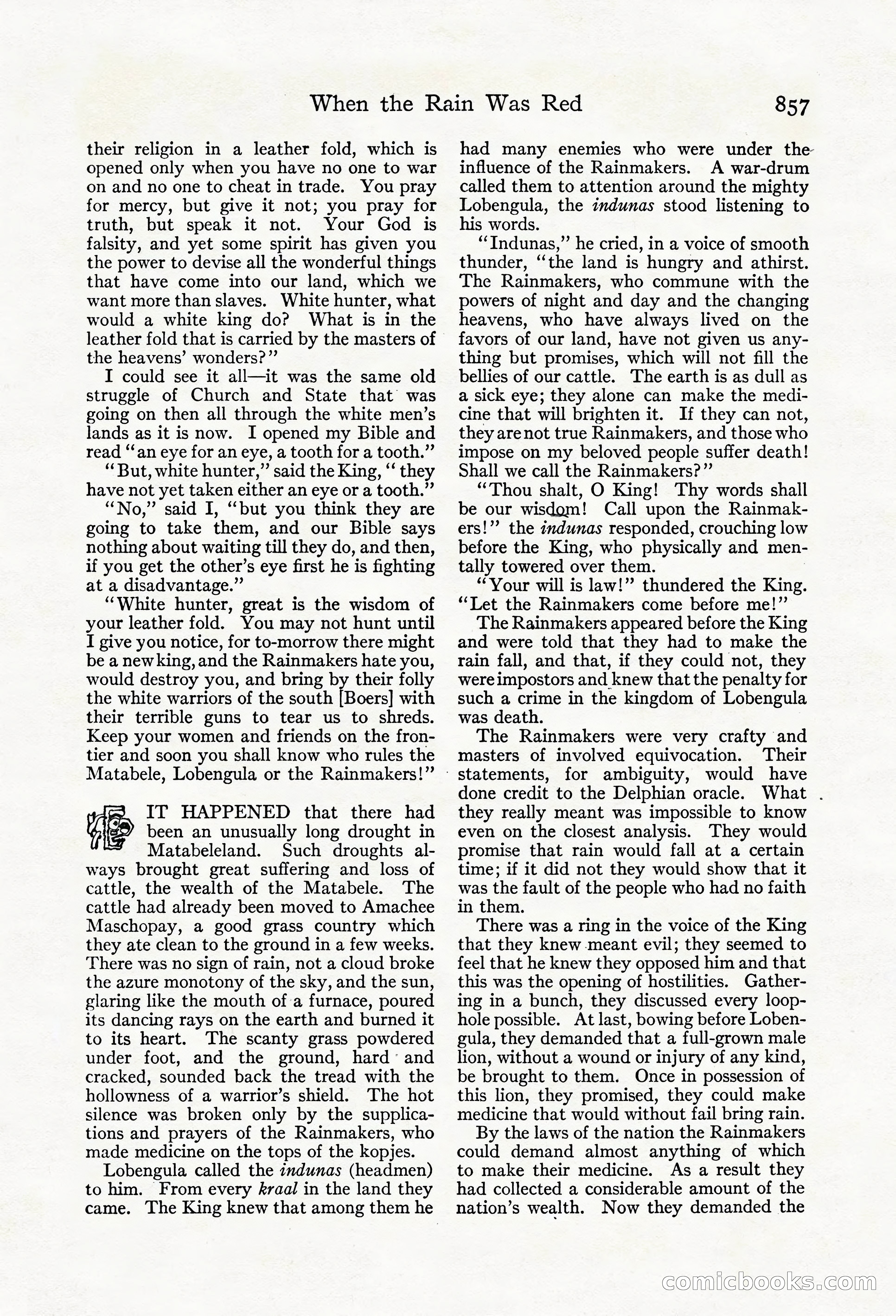
A restored page from Pulp Fiction, 1911. Page through the whole issue in the reader above.
📄 Transcribed text from this page (OCR, searchable)
Machine-transcribed from the original scan — historical spelling and the odd misread are preserved.
When the Rain Was Red their religion in a leather fold, which is opened only when you have no one to war on and no one to cheat in trade. You pray for mercy, but give it not; you pray for truth, but speak it not. Your God is falsity, and yet some spirit has given you the power to devise all the wonderful things that have come into our land, which we want more than slaves. White hunter, what would a white king do? What is in the leather fold that is carried by the masters of the heavens’ wonders?”’ I could see it all—it was the same old struggle of Church and State that was going on then all through the white men’s lands as it is now. I opened my Bible and read “‘an eye for an eye, a tooth for a tooth.” “But, white hunter,” said the King, “‘ they have not yet taken either an eye or a tooth.” “No,” said I, “but you think they are going to take them, and our Bible says nothing about waiting till they do, and then, if you get the other’s eye first he is fighting at a disadvantage.” “White hunter, great is the wisdom of your leather fold. You may not hunt until I give you notice, for to-morrow there might be a newking, and the Rainmakers hate you, would destroy you, and bring by their folly the white warriors of the south [Boers] with their terrible guns to tear us to shreds. Keep your women and friends on the fron- tier and soon you shall know who rules the Matabele, Lobengula or the Rainmakers!” Ae been an unusually long drought in Matabeleland. Such droughts al- ways brought great suffering and loss of cattle, the wealth of the Matabele. The cattle had already been moved to Amachee Maschopay, a good grass country which they ate clean to the ground in a few weeks. There was no sign of rain, not a cloud broke the azure monotony of the sky, and the sun, glaring like the mouth ofa furnace, poured its dancing rays on the earth and burned it to its heart. The scanty grass powdered under foot, and the ground, hard’ and cracked, sounded back the tread with the hollowness of a warrior’s shield. The hot silence was broken only by the supplica- tions and prayers of the Rainmakers, who made medicine on the tops of the kopjes. Lobengula called the indunas (headmen) to him. From every kraal in the land they IT HAPPENED that there had came. The King knew that among them he ' statements, 857 had many enemies who were under the influence of the Rainmakers. A war-drum called them to attention around the mighty Lobengula, the imdunas stood listening to his words. ““Indunas,” he cried, in a voice of smooth thunder, “the land is hungry and athirst. The Rainmakers, who commune with the powers of night and day and the changing heavens, who have always lived on the favors of our land, have not given us any- thing but promises, which will not fill the bellies of our cattle. The earth is as dull as a sick eye; they alone can make the medi- cine that will brighten it. If they can not, they arenot true Rainmakers, and those who impose on my beloved people suffer death! Shall we call the Rainmakers?” “Thou shalt, O King! Thy words shall be our wisdom! Call upon the Rainmak- ers!”’ the indunas responded, crouching low before the King, who physically and men- tally towered over them. “Your will is law!” thundered the King. “Let the Rainmakers come before me!” The Rainmakers appeared before the King and were told that they had to make the rain fall, and that, if they could not, they were Impostors and knew that the penalty for such a crime in the kingdom of Lobengula was death. The Rainmakers were very crafty and masters of involved equivocation. Their for ambiguity, would have done credit to the Delphian oracle. they really meant was impossible to know even on the closest analysis. They would promise that rain would fall at a certain time; if it did not they would show that it was the fault of the people who had no faith in them. There was a ring in the voice of the King that they knew meant evil; they seemed to feel that he knew they opposed him and that this was the opening of hostilities. Gather- ing in a bunch, they discussed every loop- hole possible. At last, bowing before Loben- gula, they demanded that a full-grown male lion, without a wound or injury of any kind, be brought to them. Once in possession of this lion, they promised, they could make medicine that would without fail bring rain. By the laws of the nation the Rainmakers could demand almost anything of which to make their medicine. As a result they had collected a considerable amount of the nation’s wealth. Now they demanded the COmiclbook What . C©