
Pulp Fiction, 1911 · page 95 of 196
Adventure, June 1911 — page 95: what you’re looking at
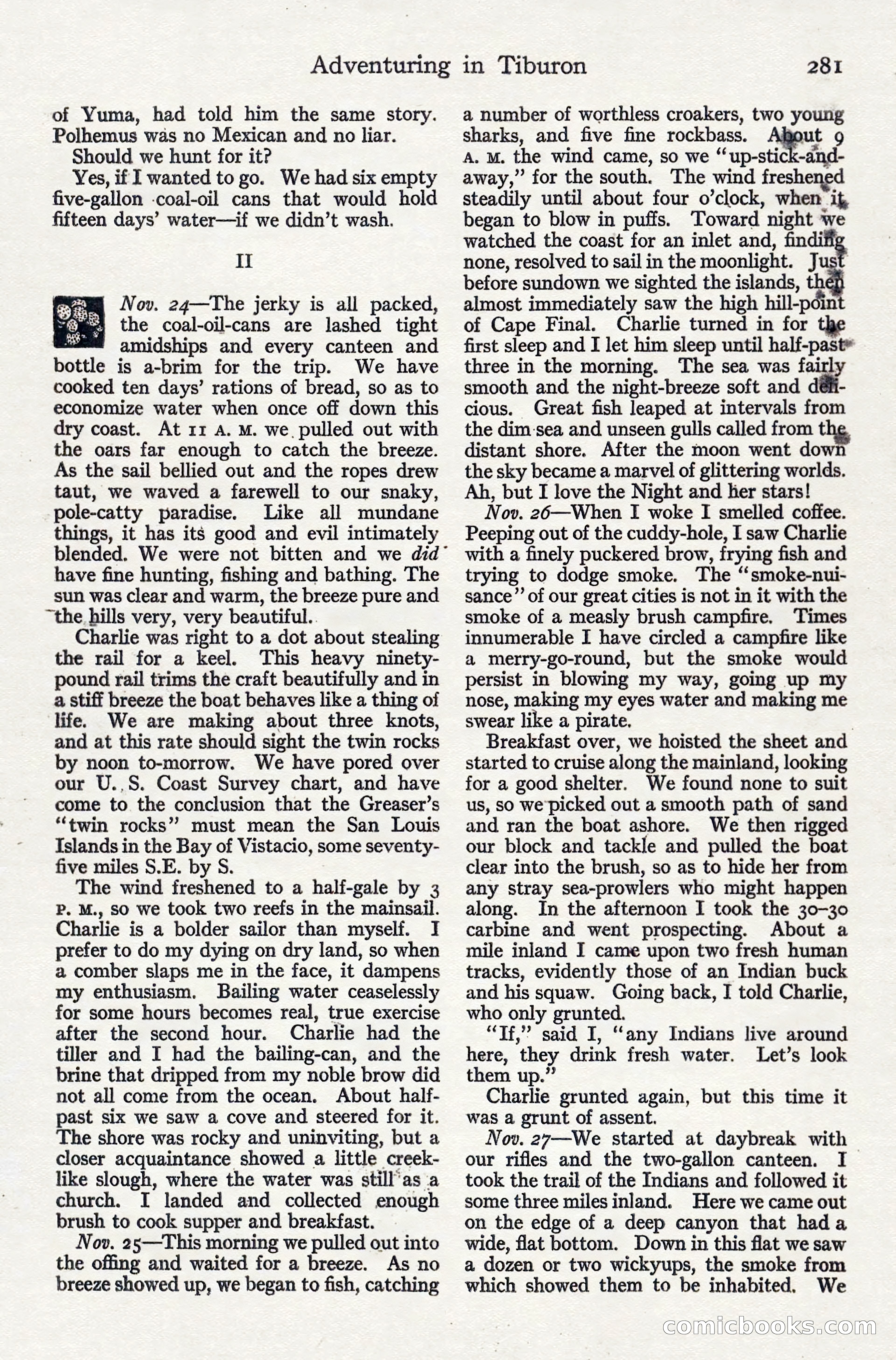
A restored page from Pulp Fiction, 1911. Page through the whole issue in the reader above.
📄 Transcribed text from this page (OCR, searchable)
Machine-transcribed from the original scan — historical spelling and the odd misread are preserved.
Adventuring in Tiburon of Yuma, had told him the same story. Polhemus was no Mexican and no liar. Should we hunt for it? Yes, if I wanted to go. We had six empty five-gallon -coal-oil cans that would hold fifteen days’ water—if we didn’t wash. II Nov. 24—The jerky is all packed, the coal-oil-cans are lashed tight : amidships and every canteen and bottle is a-brim for the trip. We have cooked ten days’ rations of bread, so as to economize water when once off down this dry coast. At rz A. M. we. pulled out with the oars far enough to catch the breeze. As the sail bellied out and the ropes drew taut, we waved a farewell to our snaky, pole-catty paradise. Like all mundane things, it has its good and evil intimately Bie blended. We were not bitten and we did™ have fine hunting, fishing and bathing. The sun was clear and warm, the breeze pure and “the hills very, very beautiful. Charlie was right to a dot about stealing the rail for a keel. This heavy ninety- pound rail trims the craft beautifully and in a stiff breeze the boat behaves like a thing of life. We are making about three knots, and at this rate should sight the twin rocks by noon to-morrow. We have pored over our U.,S. Coast Survey chart, and have come to the conclusion that the Greaser’s “twin rocks”? must mean the San Louis Islands in the Bay of Vistacio, some seventy- five miles S.E. by S. The wind freshened to a half-gale by 3 P. M., so we took two reefs in the mainsail. Charlie is a bolder sailor than myself. I prefer to do my dying on dry land, so when a comber slaps me in the face, it dampens my enthusiasm. Bailing water ceaselessly for some hours becomes real, true exercise after the second hour. Charlie had the tiller and I had the bailing-can, and the brine that dripped from my noble brow did not all come from the ocean. About half- past six we saw a cove and steered for it. The shore was rocky and uninviting, but a closer acquaintance showed a little creek- like slough, where the water was still‘as a church. I landed and collected enough brush to cook supper and breakfast. Nov. 25—This morning we pulled out into the offing and waited for a breeze. As no breeze showed up, we began to fish, catching 281 a number of worthless croakers, two young sharks, and five fine rockbass. ut 9 A. M. the wind came, so we “up-stick-and- away,” for the south. The wind freshened steadily until about four o’clock, when i, began to blow in puffs. Toward niga we watched the coast for an inlet and, fin me none, resolved to sail in the moonlight. Jus before sundown we sighted the islands, th almost immediately saw the high hill-pdin of Cape Final. Charlie turned in for first sleep and I let him sleep until half-past three in the morning. The sea was ia smooth and the night-breeze soft and d cious. Great fish leaped at intervals from the dim-sea and unseen gulls called from t distant shore. After the moon went down the sky became a marvel of glittering worlds. Ah, but I love the Night and her stars! Nov. 26—When I woke I smelled coffee. Peeping out of the cuddy-hole, I saw Charlie with a finely puckered brow, frying fish and trying to dodge smoke. The “smoke-nui- sance”’ of our great cities is not in it with the smoke of a measly brush campfire. Times innumerable I have circled a campfire like a merry-go-round, but the smoke would persist in blowing my way, going up my nose, making my eyes water and making me swear like a pirate, Breakfast over, we hoisted the sheet and started to cruise along the mainland, looking for a good shelter. We found none to suit us, So we picked out a smooth path of sand and ran the boat ashore. We then rigged our block and tackle and pulled the boat clear into the brush, so as to hide her from any stray sea-prowlers who might happen along. In the afternoon I took the 30-30 carbine and went prospecting. About a mile inland I came upon two fresh human tracks, evidently those of an Indian buck and his squaw. Going back, I told Charlie, who only grunted. “Tf,” said I, “any Indians live around here, they drink fresh water. Let’s look them up.” Charlie grunted again, but this time it was a grunt of assent. Nov. 27—We started at daybreak with our rifles and the two-gallon canteen. I took the trail of the Indians and followed it some three miles inland. Here we came out on the edge of a deep canyon that hada wide, flat bottom. Down in this flat we saw a dozen or two wickyups, the smoke from which showed them to be inhabited. We CORNICLO© SHoCO)