
Pulp Fiction, 1911 · page 79 of 196
Adventure, June 1911 — page 79: what you’re looking at
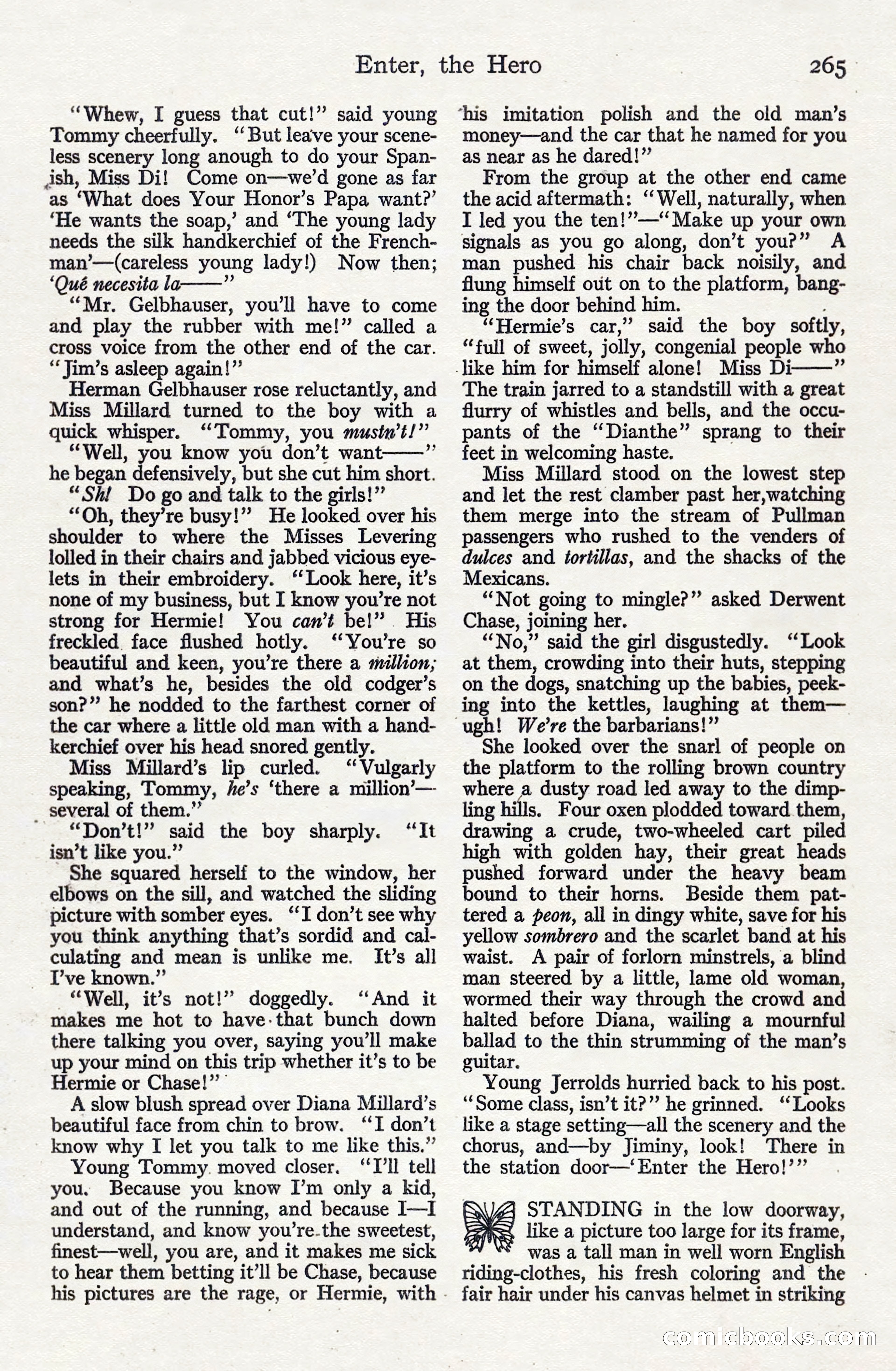
A restored page from Pulp Fiction, 1911. Page through the whole issue in the reader above.
📄 Transcribed text from this page (OCR, searchable)
Machine-transcribed from the original scan — historical spelling and the odd misread are preserved.
Enter, the Hero “Whew, I guess that cut!” said young Tommy cheerfully. “ But leave your scene- less scenery long anough to do your Span- ish, Miss Di! Come on—we’d gone as far as ‘What does Your Honor’s Papa want?’ ‘He wants the soap,’ and “The young lady needs the silk handkerchief of the French- man’—(careless young lady!) Now then; ‘Qué necesita la = “Mr. Gelbhauser, you'll have to come and play the rubber with me!” called a cross voice from the other end of the car. “*Jim’s asleep again!”’ Herman Gelbhauser rose reluctantly, and Miss Millard turned to the boy with a quick whisper. “Tommy, you musiw’t!” “Well, you know you don’t want——”’ he began defensively, but she cut him short. “Sh! Do go and talk to the girls!” “Oh, they’re busy!” He looked over his shoulder to where the Misses Levering lolled in their chairs and jabbed vicious eye- lets in their embroidery. ‘Look here, it’s none of my business, but I know you’re not strong for Hermie! You can’t be!” . His freckled face flushed hotly. ‘‘You’re so beautiful and keen, you’re there a million; and what’s he, besides the old codger’s son?” he nodded to the farthest corner of the car where a little old man with a hand- kerchief over his head snored gently. Miss Millard’s lip curled. © Vulgarly speaking, Tommy, he’s ‘there a million’— _ several of them.” “Don’t!” said the boy sharply. “It isn’t like you.” She squared herself to the window, her elbows on the sill, and watched the sliding picture with somber eyes. ‘‘I don’t see why you think anything that’s sordid and cal- culating and mean is unlike me. It’s all _ [ve known.” “Well, it’s not!” doggedly. “And it makes me hot to have-that bunch down there talking you over, saying you'll make up your mind on this trip whether it’s to be Hermie or Chase!” A slow blush spread over Diana Millard’s beautiful face from chin to brow. “I don’t know why I let you talk to me like this.” Young Tommy. moved closer. ‘‘I’ll tell you. Because you know I’m only a kid, and out of the running, and because EI understand, and know you’re.the sweetest, finest—well, you are, and it makes me sick to hear them betting it’ll be Chase, because his pictures are the rage, or Hermie, with . -like him for himself alone! money—and the car that he named for you as near as he dared!” From the group at the other end came the acid aftermath: ‘Well, naturally, when I led you the ten!”—‘‘ Make up your own signals as you go along, don’t your” A man pushed his chair back noisily, and flung himself out on to the platform, bang- ing the door behind him. ‘““Hermie’s car,’ said the boy softly, “full of sweet, jolly, congenial people who Miss Di——”’ The train jarred to a standstill with a great flurry of whistles and bells, and the occu- pants of the “Dianthe” sprang to their feet in welcoming haste. Miss Millard stood on the lowest step and let the rest clamber past her,watching them merge into the stream of Pullman passengers who rushed to the venders of dulces and tortillas, and the shacks of the Mexicans. “Not going to mingle?” asked Derwent Chase, joining her. “‘No,” said the girl disgustedly. “‘Look at them, crowding into their huts, stepping on the dogs, snatching up the babies, peek- ing into the kettles, laughing at them— ugh! We’re the barbarians!” She looked over the snarl of people on the platform to the rolling brown country where a dusty road led away to the dimp- ling hills. Four oxen plodded toward them, drawing a crude, two-wheeled cart piled high with golden hay, their great heads pushed forward under the heavy beam bound to their horns. Beside them pat- tered a peon, all in dingy white, save for his yellow sombrero and the scarlet band at his waist. A pair of forlorn minstrels, a blind man steered by a little, lame old woman, wormed their way through the crowd and halted before Diana, wailing a mournful ballad to the thin strumming of the man’s guitar. Young Jerrolds hurried back to his post. ‘Some class, isn’t it?’”’ he grinned. ‘‘ Looks like a stage setting—all the scenery and the chorus, and—by Jiminy, look! There in the station door—‘Enter the Hero!’”’ STANDING in the low doorway, like a picture too large for its frame, was a tall man in well worn English riding-clothes, his fresh coloring and the fair hair under his canvas helmet in striking GoOmiGcbdooks (C@ 265 ‘his imitation polish and the old man’s