
Pulp Fiction, 1911 · page 51 of 196
Adventure, June 1911 — page 51: what you’re looking at
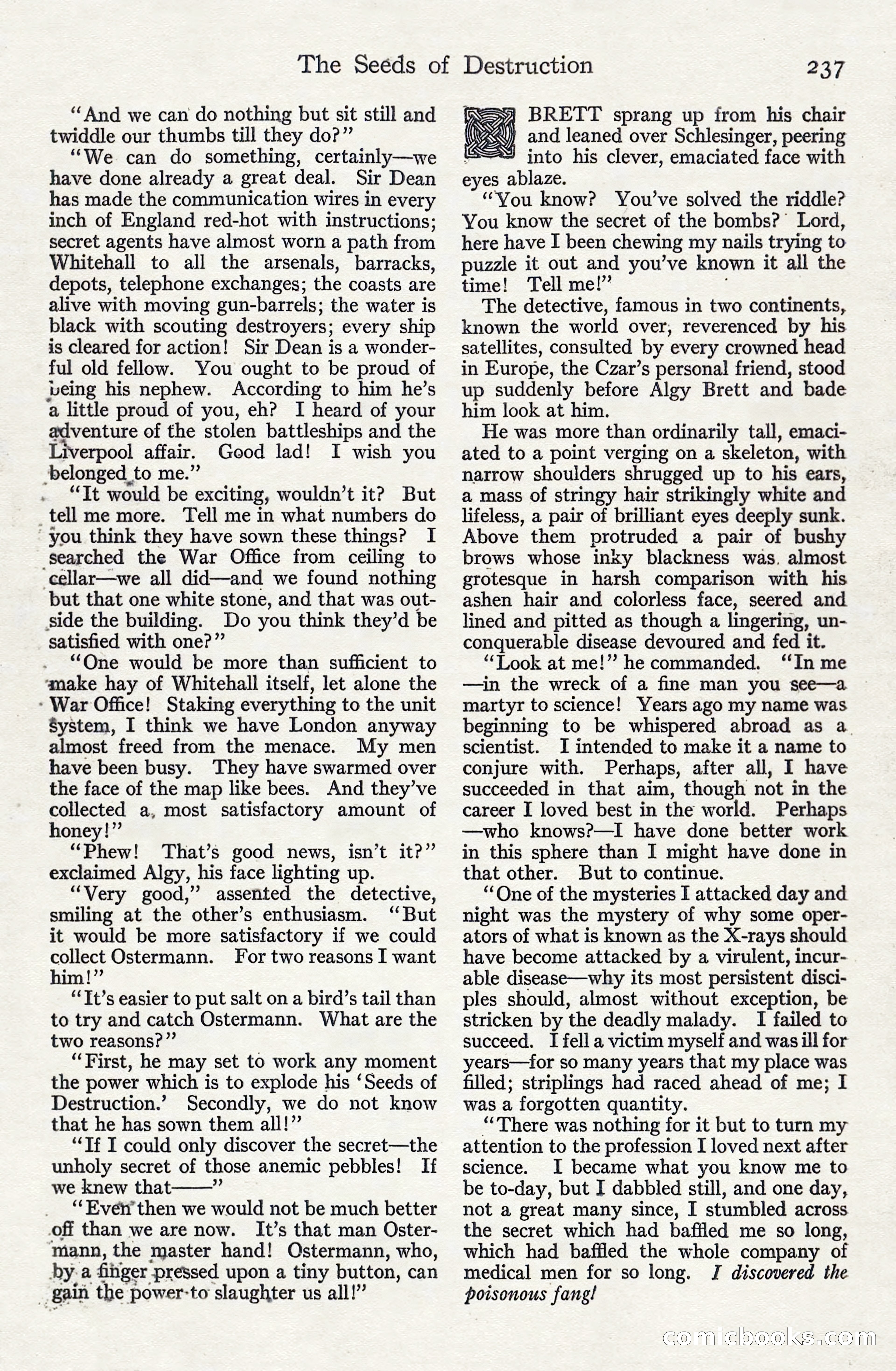
A restored page from Pulp Fiction, 1911. Page through the whole issue in the reader above.
📄 Transcribed text from this page (OCR, searchable)
Machine-transcribed from the original scan — historical spelling and the odd misread are preserved.
The Seéds of Destruction “And we can do nothing but sit still and twiddle our thumbs till they do?” “We can do something, certainly—we have done already a great deal. Sir Dean has made the communication wires in every inch of England red-hot with instructions; secret agents have almost worn a path from Whitehall to all the arsenals, barracks, depots, telephone exchanges; the coasts are alive with moving gun-barrels; the water is black with scouting destroyers; every ship is cleared for action! Sir Dean is a wonder- ful old fellow. You ought to be proud of being his nephew. According to him he’s a little proud of you, eh? I heard of your adventure of the stolen battleships and the Liverpool affair. Good lad! I wish you ‘belonged to me.’ “Tt would be excitg wouldn’t it? But tell me more. Tell me in what numbers do you think they have sown these things? I searched the War Office from ceiling to cellar—we all did—and we found nothing but that one white stone, and that was out- side the building. Do you think they’d be satisfied with one?” “One would be more than sufficient to ‘make hay of Whitehall itself, let alone the ‘War Office! Staking everything to the unit System, I think we have London anyway almost freed from the menace. My men have been busy. They have swarmed over the face of the map like bees. And they’ve collected a, most satisfactory amount of honey!” “Phew! That’s good news, isn’t it?” exclaimed Algy, his face lighting up. “Very good,” assented the detective, smiling at the other’s enthusiasm. “But it would be more satisfactory if we could collect Ostermann. For two reasons I want him!” “It’s easier to put salt on a bird’s tail than to try and catch Ostermann. What are the two reasons?” “First, he may set to work any moment the power which is to explode his ‘Seeds of Destruction.’ Secondly, we do not know that he has sown them all!” “Tf I could only discover the secret—the unholy secret of those anemic pebbles! If we knew that——” “Even then we would not be much better off than we are now. It’s that man Oster- mann, the master hand! Ostermann, who, hy.a fiiger ‘pressed upon a tiny button, can | gain the power-to slaughter us all!” 237 4 BRETT sprang up from his chair VSN) and leaned over Schlesinger, peering t into his clever, emaciated face with eyes ablaze. “You know? You’ve solved the riddle? You know the secret of the bombs? Lord, here have I been chewing my nails trying to puzzle it out and you’ve known it all the time! Tell me!” The detective, famous in two continents, known the world Over, reverenced by his satellites, consulted by every crowned head in Europe, the Czar’s personal friend, stood up suddenly before Algy Brett and bade him look at him. He was more than ordinarily tall, emaci- ated to a point verging on a skeleton, with narrow shoulders shrugged up to his ears, a mass of stringy hair strikingly white and lifeless, a pair of brilliant eyes deeply sunk. Above them protruded a pair of bushy brows whose inky blackness was. almost grotesque in harsh comparison with his ashen hair and colorless face, seered and lined and pitted as though a lingering, un- conquerable disease devoured and fed it. “Look at me!” he commanded. “In me —in the wreck of a fine man you see—a martyr to science! Years ago my name was beginning to be whispered abroad as a. scientist. I intended to make it a name to conjure with. Perhaps, after all, I have succeeded in that aim, though not in the career I loved best in the world. Perhaps —who knows?—I have done better work in this sphere than I might have done in that other. But to continue. ‘“‘One of the mysteries I attacked day and night was the mystery of why some oper- ators of what is known as the X-rays should have become attacked by a virulent, incur- able disease—why its most persistent disci- ples should, almost without exception, be stricken by the deadly malady. I failed to succeed. I fell a victim myself and was ill for years—for so many years that my place was filled; striplings had raced ahead of me; I was a forgotten quantity. “There was nothing for it but to turn my attention to the profession I loved next after science. I became what you know me to be to-day, but I dabbled still, and one day, not a great many since, I stumbled across the secret which had bafiled me so long, which had baffled the whole company of medical men for so long. J discovered the poisonous fangl CORICLO© SoCO