
Pulp Fiction, 1911 · page 21 of 196
Adventure, June 1911 — page 21: what you’re looking at
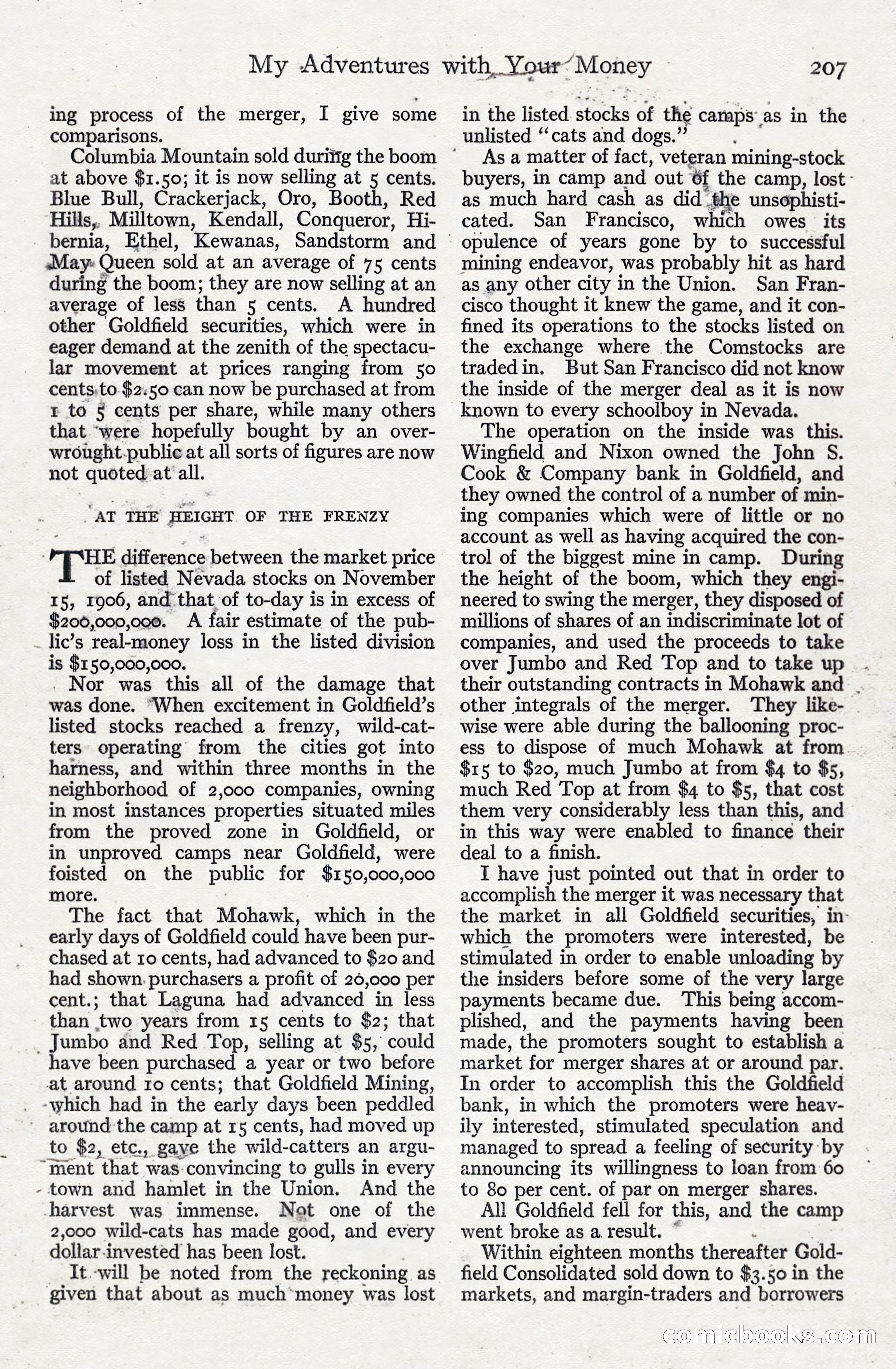
A restored page from Pulp Fiction, 1911. Page through the whole issue in the reader above.
📄 Transcribed text from this page (OCR, searchable)
Machine-transcribed from the original scan — historical spelling and the odd misread are preserved.
—_——— My Adventures with 1. YourMoney : ing process of the merger, I give some comparisons. Columbia Mountain sold duriiig the boom ~ at above $1.50; it is now selling at 5 cents. Blue Bull, Crackerjack, Oro, Booth, Red Hills,, Milltown, Kendall, Conqueror, Hi- _ bernia, Ethel, Kewanas, Sandstorm and ‘May: Queen sold at an average of 75 cents during the boom; they are now selling at an average of less than 5 cents. A hundred other Goldfield securities, which were in eager demand at the zenith of the spectacu- lar movement at prices ranging from jo cents,to.$2.50 can now be purchased at from t to § cents per share, while many others that ‘were hopefully bought by an over- wrought-public at all sorts of figures are now not quoted at all. “AT THE HEIGHT OF THE FRENZY ee difference between the market price of listed Nevada stocks on November 15, 1906, and that of to-day is in excess of $206,000,000. A fair estimate of the pub- _ lic’s real-money loss in the listed division is $150,000,000. . Nor was this all of the damage that was done. “When excitement in Goldfield’s listed stocks reached a frenzy, wild-cat- ters operating from the cities got into harness, and within three months in the neighborhood of 2,000 companies, owning in most instances properties situated miles from the proved zone in Goldfield, or in unproved camps near Goldfield, were foisted on the public for $150,000,000 more. The fact that Mohawk, which in the early days of Goldfield could have been pur- chased at ro cents, had advanced to $20 and had shown. purchasers a profit of 26,000 per cent.; that Laguna had advanced in less than ‘two years from 15 cents to $2; that : Jumbo and Red Top, selling at $5, ‘could have been purchased a year or two before at around ro cents; that Goldfield Mining, . which had in the early days been peddled ' around the camp at 15 cents, had moved up to $2, etc., gave the wild-catters an argu- ment ‘that was convincing to gulls in every - town and hamlet in the Union. And the -harvest was immense. Not one of the 2,000 wild-cats has made good, and every dollar-invested has been lost. It.-will be noted from the reckoning as given that about as much*money was lost 207 in the listed stocks of the camps as in the unlisted ‘‘cats and dogs.” As a matter of fact, veteran mining-stock buyers, in camp and out 6f the camp, lost: as much hard cash as did cated. San Francisco, € unsophisti- which owes its - opulence of years gone by to successful mining endeavor, was probably hit as hard as any other city in the Union. San Fran- cisco thought it knew the game, and it con- fined its operations to the stocks listed on the exchange where the Comstocks are tradedin. But San Francisco did not know the inside of the merger deal as it is now known to every schoolboy in Nevada. The operation on the inside was this. Wingfield and Nixon owned the John S. Cook & Company bank in Goldfield, and they owned the control of a number of min- ing companies which were of little or no account as well as having acquired the con- trol of the biggest mine in camp. During the height of the boom, which they engi- neered to swing the merger, they disposed of millions of shares of an indiscriminate lot of companies, and used the proceeds to take over Jumbo and Red Top and to take up their outstanding contracts in Mohawk and | 7 other integrals of the merger. wise were able during the ballooning proc- ess to dispose of much Mohawk at from $15 to $20, much Jumbo at from $4 to $5, much Red Top at from $4 to $5, that cost them very considerably less than this, and in this way were enabled to finance their deal to a finish. I have just pointed out that in order to accomplish the merger it was necessary that the market in all Goldfield securities, in which the promoters were interested, be stimulated in order to enable unloading by the insiders before some of the very large payments became due. This being accom- plished, and the payments having been made, the promoters sought to establish a market for merger shares at or around par. In order to accomplish this the Goldfield bank, in which the promoters were heav- ily interested, stimulated speculation and managed to spread a feeling of security by announcing its willingness to loan from 60 to 80 per cent. of par on merger shares. All Goldfield fell for this, and the camp went broke as a result. Within eighteen months thereafter Gold- field Consolidated sold down to $3.50 in the markets, and margin-traders and borrowers CORnMICLOO S They like- (C@