
Pulp Fiction, 1911 · page 162 of 196
Adventure, June 1911 — page 162: what you’re looking at
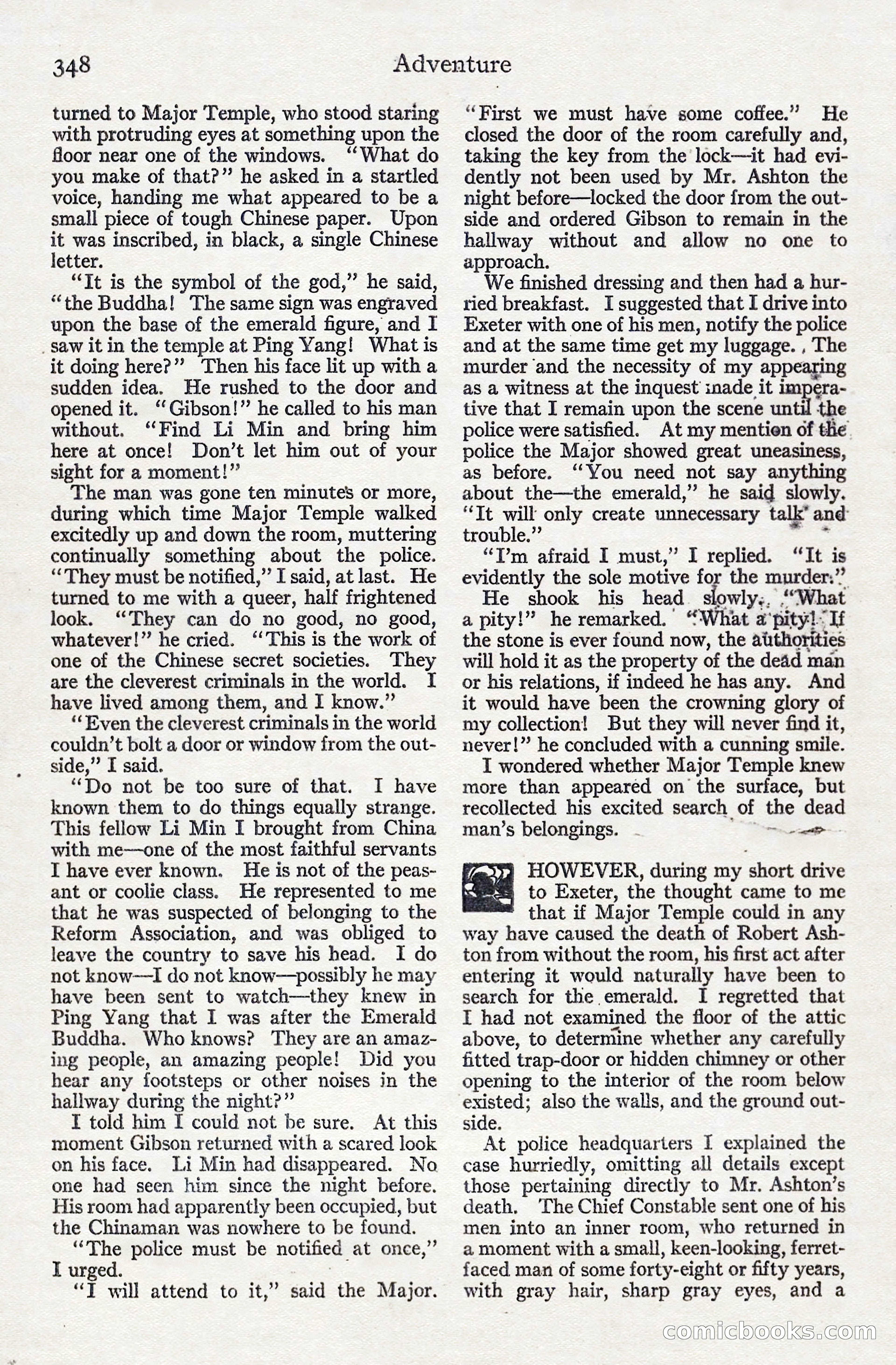
A restored page from Pulp Fiction, 1911. Page through the whole issue in the reader above.
📄 Transcribed text from this page (OCR, searchable)
Machine-transcribed from the original scan — historical spelling and the odd misread are preserved.
348 turned to Major Temple, who stood staring with protruding eyes at something upon the floor near one of the windows. ‘What do you make of that?” he asked in a startled voice, handing me what appeared to be a small piece of tough Chinese paper. Upon it was inscribed, in black, a single Chinese letter. “It is the symbol of the god,” he said, “the Buddha! The same sign was engraved upon the base of the emerald figure, and I _saw it in the temple at Ping Yang! What is it doing here?”’ Then his face lit up with a sudden idea. He rushed to the door and opened it. ‘‘Gibson!”’ he called to his man without. “Find Li Min and bring him here at once! Don’t let him out of your sight for a moment!” The man was gone ten minutes or more, during which time Major Temple walked excitedly up and down the room, muttering continually something about the police. “They must be notified,” I said, at last. He turned to me with a queer, half frightened look. ‘They can do no good, no good, whatever!” he cried. ‘‘This is the work of one of the Chinese secret societies. They are the cleverest criminals in the world. I have lived among them, and I know.” “Even the cleverest criminals in the world couldn’t bolt a door or window from the out- side,” I said. “Do not be too sure of that. I have known them to do things equally strange. This fellow Li Min I brought from China with me—one of the most faithful servants I have ever known. He is not of the peas- ant or coolie class. He represented to me that he was suspected of belonging to the Reform Association, and was obliged to leave the country to save his head. I do not know—I do not know—possibly he may have been sent to watch—they knew in Ping Yang that I was after the Emerald Buddha. Who knows? They are an amaz- ing people, an amazing people! Did you hear any footsteps or other noises in the hallway during the night?” I told him I could not be sure. At this moment Gibson returned with a scared look on his face. Li Min had disappeared. No one had seen him since the night before. His room had apparently been occupied, but the Chinaman was nowhere to be found. “The police must be notified at once,’ I urged. cf will attend to it,” said the Major. Adventure “First we must have some coffee.” He closed the door of the room carefully and, taking the key from the lock—it had evi- dently not been used by Mr. Ashton the night before—locked the door from the out- side and ordered Gibson to remain in the hallway without and allow no one to approach. We finished dressing and then had a hur- ried breakfast. I suggested that I drive into Exeter with one of his men, notify the police and at the same time get my luggage. , The murder and the necessity of my appearing as a witness at the inquest inade it impera- tive that I remain upon the scene until the police were satisfied. At my mentien of the police the Major showed great uneasiness, as before. “You need not say anything about the—the emerald,” he said slowly. “Tt will only create unnecessary talk’ and trouble.” “Ym airaid I must,” I replied. “It is evidently the sole motive for the murder.” He shook his head_ slowly.. “What a pity!” he remarked.’ “What a‘pity!<If the stone is ever found now, the alithorities will hold it as the property of the dead man or his relations, if indeed he has any. And it would have been the crowning glory of my collection! But they will never find it, never!” he concluded with a cunning smile. I wondered whether Major Temple knew more than appeared on the surface, but recollected his excited search of the dead man’s belongings. - > my =. ora te HOWEVER, during my short drive to Exeter, the thought came to me that if Major Temple could in any way have caused the death of Robert Ash- ton from without the room, his first act after entering it would naturally have been to search for the emerald. I regretted that I had not examined the floor of the attic above, to determine whether any carefully fitted trap-door or hidden chimney or other opening to the interior of the room below existed; also the walls, and the ground out- side. At police headquarters I explained the case hurriedly, omitting all details except those pertaining dir ectly to Mr. Ashton’s death. The Chief Constable sent one of his men into an inner room, who returned in a moment with a small, keen-looking, ferret- faced man of some forty-eight or fifty years, with gray hair, sharp gray eyes, and a COMICLOOCkKS. CO