
Pulp Fiction, 1911 · page 146 of 196
Adventure, June 1911 — page 146: what you’re looking at
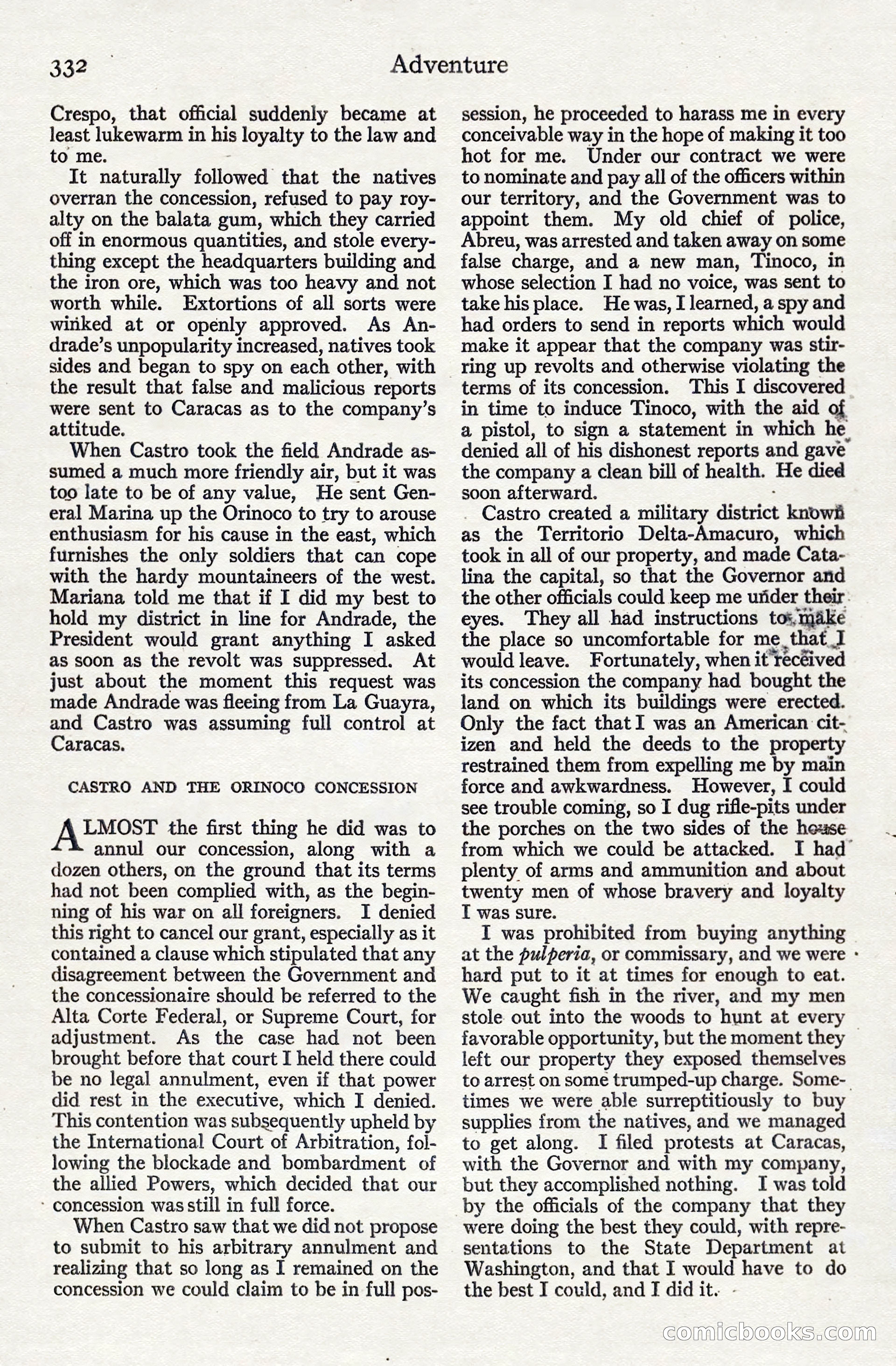
A restored page from Pulp Fiction, 1911. Page through the whole issue in the reader above.
📄 Transcribed text from this page (OCR, searchable)
Machine-transcribed from the original scan — historical spelling and the odd misread are preserved.
332 Crespo, that official suddenly became at least lukewarm in his loyalty to the law and to me. It naturally follewed that the natives overran the concession, refused to pay roy- alty on the balata gum, which they carried off in enormous quantities, and stole every- thing except the headquarters building and the iron ore, which was too heavy and not worth while. Extortions of all sorts were winked at or openly approved. As An- drade’s unpopularity increased, natives took sides and began to spy on each other, with the result that false and malicious reports were sent to Caracas as to the company’s attitude. When Castro took the field Andrade as- sumed a much more friendly air, but it was too late to be of any value, He sent Gen- eral Marina up the Orinoco to try to arouse enthusiasm for his cause in the east, which furnishes the only soldiers that can cope with the hardy mountaineers of the west. Mariana told me that if I did my best to hold my district in line for Andrade, the President would grant anything I asked as soon as the revolt was suppressed. At just about the moment this request was made Andrade was fleeing from La Guayra, and Castro was assuming full control at Caracas. CASTRO AND THE ORINOCO CONCESSION ArMOst the first thing he did was to annul our concession, along with a dozen others, on the ground that its terms had not been complied with, as the begin- ning of his war on all foreigners. I denied this right to cancel our grant, especially as it contained a clause which stipulated that any disagreement between the Government and the concessionaire should be referred to the Alta Corte Federal, or Supreme Court, for adjustment. As the case had not been brought before that court I held there could be no legal annulment, even if that power did rest in the executive, which I denied. This contention was subsequently upheld by the International Court of Arbitration, fol- lowing the blockade and bombardment of the allied Powers, which decided that our * concession was still in full force. When Castro saw that we did not propose to submit to his arbitrary annulment and realizing that so long as I remained on the concession we could claim to be in full pos- Adventure session, he proceeded to harass me in every conceivable way in the hope of making it too hot for me. Under our contract we were to nominate and pay all of the officers within our territory, and the Government was to appoint them. My old chief of police, Abreu, was arrested and taken away on some false charge, and a new man, Tinoco, in whose selection I had no voice, was sent to take his place. He was, I learned, a spy and had orders to send in reports which would make it appear that the company was stir- ring up revolts and otherwise violating the terms of its concession. This I discovered in time to induce Tinoco, with the aid of a pistol, to sign a statement in which he denied all of his dishonest reports and gave the company a clean bill of health. He died soon afterward. _ Castro created a military district knowh as the Territorio Delta-Amacuro, which took in all of our property, and made Cata- lina the capital, so that the Governor and the other officials could keep me urider their. eyes. They all had instructions to:,make the place so uncomfortable for me_that_J would leave. Fortunately, when it"recéived its concession the company had bought the land on which its buildings were erected. Only the fact that I was an American cit- izen and held the deeds to the property restrained them from expelling me by main force and awkwardness. However, I could see trouble coming, so I dug rifle-pits under the porches on the two sides of the heuse from which we could be attacked. I had plenty of arms and ammunition and about twenty men of whose bravery and loyalty T was sure. I was prohibited from buying anything at the pulperia, or commissary, and we were - hard put to it at times for enough to eat. We caught fish in the river, and my men stole out into the woods to hunt at every favorable opportunity, but the moment they — left our property they exposed themselves to arrest on some trumped-up charge. Some- times we were able surreptitiously to buy supplies from the natives, and we managed to get along. I filed protests at Caracas, with the Governor and with my company, but they accomplished nothing. I was told by the officials of the company that they were doing the best they could, with repre- sentations to the State Department at Washington, and that I would have to do the best I could, and I did it. COMMICLOOO© SoCO)