
Pulp Fiction, 1911 · page 140 of 196
Adventure, June 1911 — page 140: what you’re looking at
A restored page from Pulp Fiction, 1911. Page through the whole issue in the reader above.
📄 Transcribed text from this page (OCR, searchable)
Machine-transcribed from the original scan — historical spelling and the odd misread are preserved.
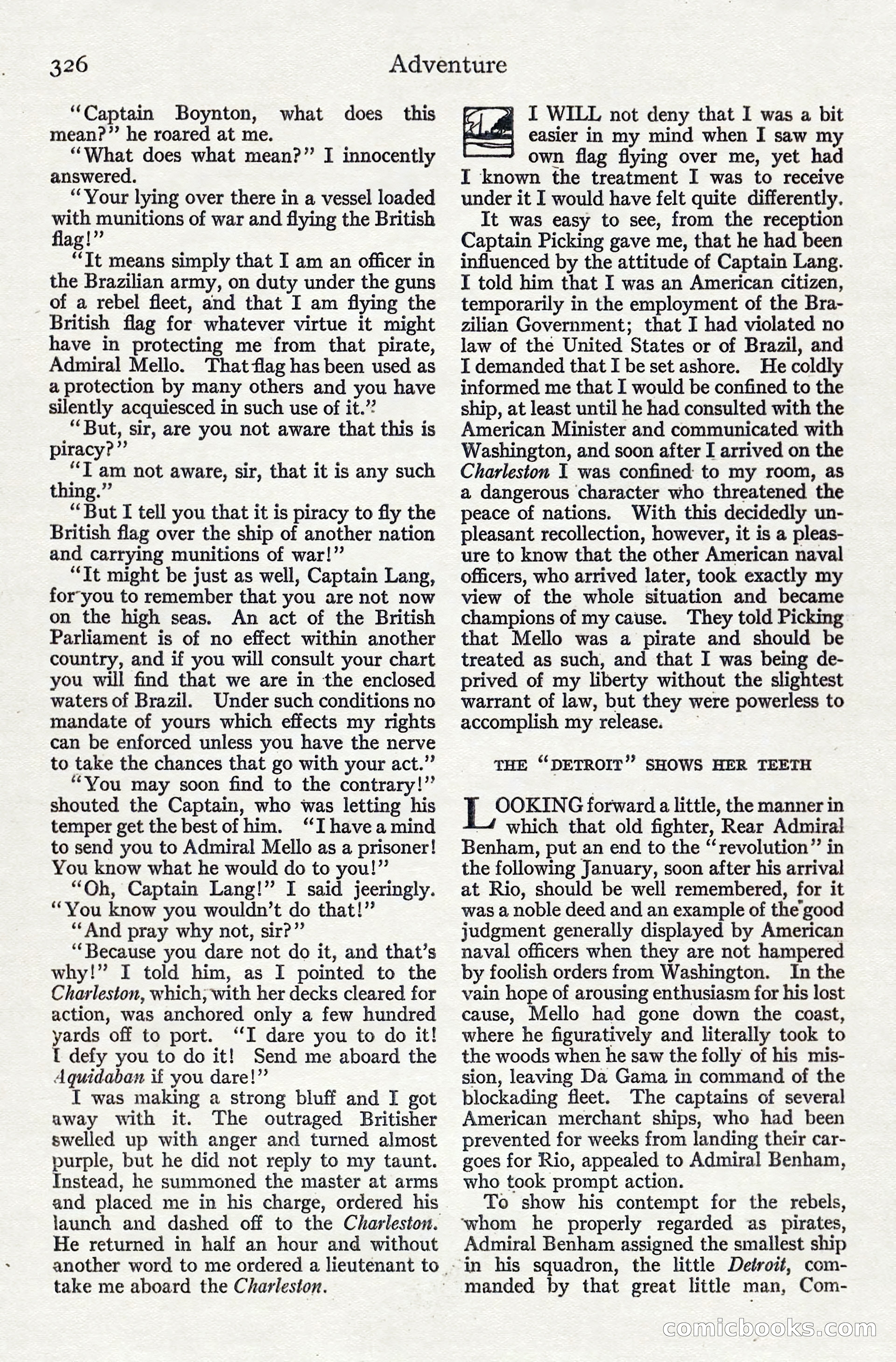
326 “Captain Boynton, what does this mean?” he roared at me. “What does what mean?” I innocently answered. “Your lying over there in a vessel loaded es munitions of war and flying the British ag! “It means simply that I am an officer in the Brazilian army, on duty under the guns of a rebel fleet, and that I am flying the British flag for whatever virtue it might have in protecting me from that pirate, Admiral Mello. Thatflag has been used as a protection by many others and you have silently acquiesced in such use of it.”? “But, sir, are you not aware that this is piracy?” “T am not aware, sir, that it is any such thing.” “But I tell you that it is piracy to fly the British flag over the ship of another nation and carrying munitions of war!” “Tt might be just as well, Captain Lang, for-you to remember that you are not now on the high seas. An act of the British Parliament is of no effect within another country, and if you will consult your chart you will find that we are in the enclosed waters of Brazil. Under such conditions no mandate of yours which effects my rights can be enforced unless you have the nerve to take the chances that go with your act.” ‘You may soon find to the contrary!”’ shouted the Captain, who was letting his temper get the best of him. “Ihave a mind to send you to Admiral Mello as a prisoner! You know what he would do to you!” “Oh, Captain Lang!” I said jeeringly. “You know you wouldn’t do that!” ‘And pray why not, sir?” ‘Because you dare not do it, and that’s why!” I told him, as I pointed to the Charleston, which; with her decks cleared for action, was anchored only a few hundred yards off to port. “I dare you to do it! { defy you to do it! Send me aboard the Aguidaban if you dare!” I was making a strong bluff and I got away with it. The outraged Britisher swelled up with anger and turned almost purple, but he did not reply to my taunt. Instead, he summoned the master at arms and placed me in his charge, ordered his launch and dashed off to the Charleston. He returned in half an hour and without another word to me ordered a lieutenant to - take me aboard the Charleston. Adventure | I WILL not deny that I was a bit Adel} easier in my mind when I saw my —— own flag flying over me, yet had I known the treatment I was to receive under it I would have felt quite differently. It was easy to see, from the reception Captain Picking gave me, that he had been influenced by the attitude of Captain Lang. I told him that I was an American citizen, temporarily in the employment of the Bra- zilian Government; that I had violated no law of the United States or of Brazil, and I demanded that I be set ashore. He coldly informed me that I would be confined to the ship, at least until he had consulted with the American Minister and communicated with Washington, and soon after I arrived on the Charleston I was confined to my room, as a dangerous character who threatened the peace of nations. With this decidedly un- pleasant recollection, however, it is a pleas- ure to know that the other American naval officers, who arrived later, took exactly my view of the whole situation and became champions of my cause. They told Picking that Mello was a pirate and should be treated as such, and that I was being de- prived of my liberty without the slightest warrant of law, but they were powerless to accomplish my release. THE “DETROIT” SHOWS HER TEETH OOKING forward a little, the manner in —4 which that old fighter, Rear Admiral Benham, put an end to the “revolution” in the following January, soon after his arrival at Rio, should be well remembered, for it was a noble deed and an example of the good judgment generally displayed by American naval officers when they are not hampered by foolish orders from Washington. In the vain hope of arousing enthusiasm for his lost cause, Mello had gone down the coast, where he figuratively and literally took to the woods when he saw the folly of his mis- sion, leaving Da Gama in command of the blockading fleet. The captains of several American merchant ships, who had been prevented for weeks from landing their car- goes for Rio, appealed to Admiral Benham, who took prompt action. To show his contempt for the rebels, ‘whom he properly regarded as pirates, Admiral Benham assigned the smallest ship ‘in his squadron, the little Detroit, com- manded by that great little man, Com- CONMIG DOOKS. EO