
Pulp Fiction, 1911 · page 137 of 196
Adventure, June 1911 — page 137: what you’re looking at
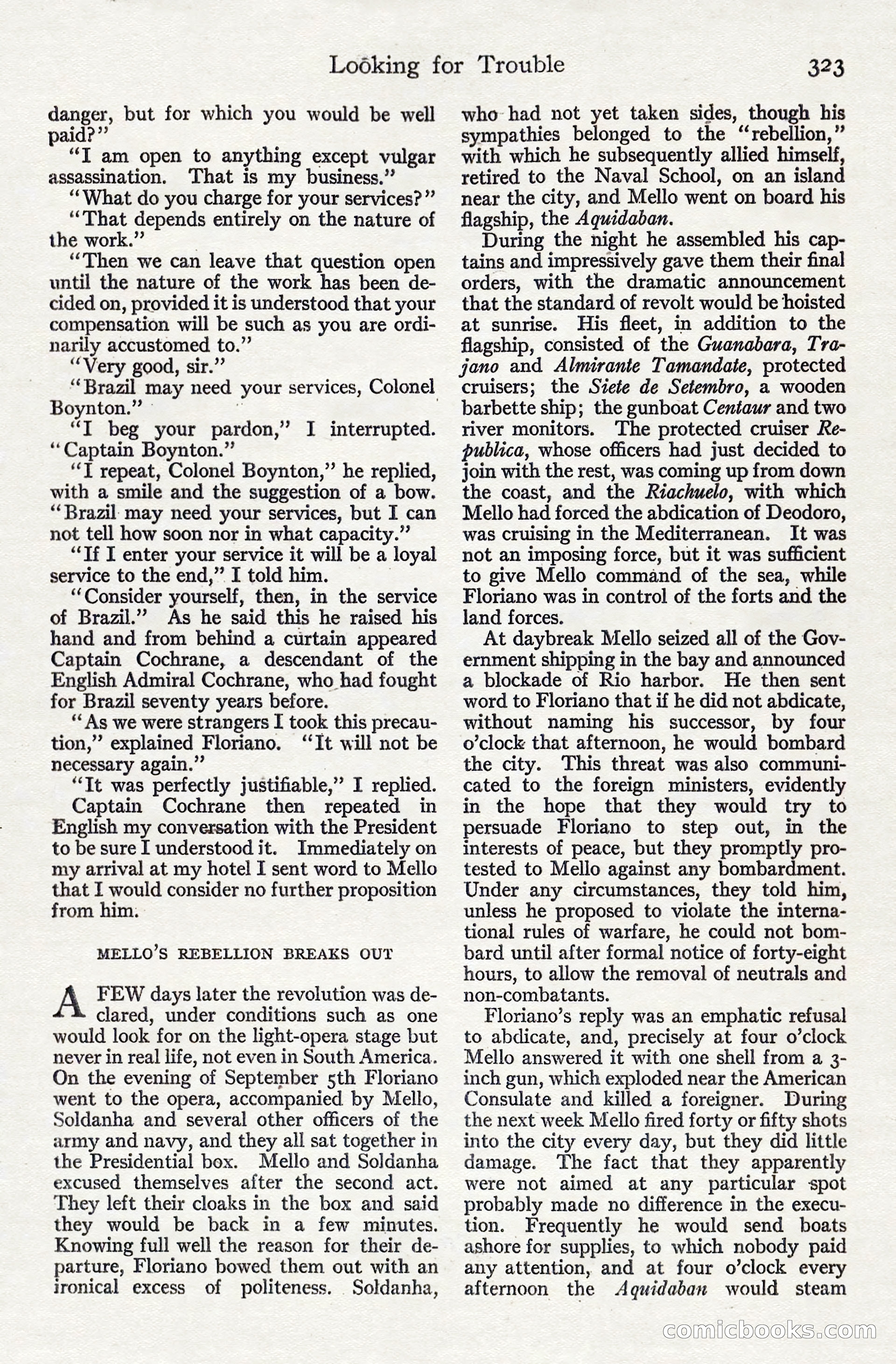
A restored page from Pulp Fiction, 1911. Page through the whole issue in the reader above.
📄 Transcribed text from this page (OCR, searchable)
Machine-transcribed from the original scan — historical spelling and the odd misread are preserved.
Looking for Trouble danger, but for which you would be well paid?” “T am open to anything except vulgar assassination. ‘That is my business.” ‘What do you charge for your services?” ‘That depends entirely on the nature of the work.” | ‘Then we can leave that question open until the nature of the work has been de- cided on, provided it is understood that your compensation will be such as you are ordi- narily accustomed to.” “Very good, sir.” ‘Brazil may need your services, Colonel Boynton.” “IT beg your pardon,” I interrupted. “Captain Boynton.” ‘“T repeat, Colonel Boynton,” he replied, with a smile and the suggestion of a bow. “Brazil may need your services, but I can not tell how soon nor in what capacity.” “Tf I enter your service it will be a loyal service to the end,” I told him. 3 “Consider yourself, then, in the service of Brazil.” As he said this he raised his hand and from behind a curtain appeared Captain Cochrane, a descendant of the English Admiral Cochrane, who had fought for Brazil seventy years before. “As we were strangers I took this precau- tion,” explained Floriano. ‘It will not be necessary again.” “Tt was perfectly justifiable,” I replied. Captain Cochrane then repeated in English my conversation with the President to be sure I understood it. Immediately on my arrival at my hotel I sent word to Mello that I would consider no further proposition from him. MELLO’S REBELLION BREAKS OUT A FEW days later the revolution was de- clared, under conditions such as one would look for on the light-opera stage but never in real life, not even in South America. On the evening of September 5th Floriano went to the opera, accompanied by Mello, Soldanha and several other officers of the army and navy, and they all sat together in the Presidential box. Mello and Soldanha excused themselves after the second act. They left their cloaks in the box and said they would be back in a few minutes. Knowing full well the reason for their de- parture, Floriano bowed them out with an ironical excess of politeness. Soldanha, 323 who had not yet taken sides, though his sympathies belonged to the “rebellion,” with which he subsequently allied himself, retired to the Naval School, on an island near the city, and Mello went on board his flagship, the Aquidaban. During the night he assembled his cap- tains and impressively gave them their final orders, with the dramatic announcement that the standard of revolt would be hoisted at sunrise. His fleet, in addition to the flagship, consisted of the Guanabara, Tra- jano and Almirante Tamandate, protected cruisers; the Siete de Setembro, a wooden barbette ship; the gunboat Centaur and two river monitors. The protected cruiser Re- publica, whose officers had just decided to join with the rest, was coming up from down the coast, and the Riachuelo, with which Mello had forced the abdication of Deodoro, was cruising in the Mediterranean. It was not an imposing force, but it was sufficient to give Mello command of the sea, while Floriano was in control of the forts and the land forces. At daybreak Mello seized all of the Gov- ernment shipping in the bay and announced a blockade of Rio harbor. He then sent word to Floriano that if he did not abdicate, without naming his successor, by four o’clock that afternoon, he would bombard the city. This threat was also communi- cated to the foreign ministers, evidently in the hope that they would try to persuade Floriano to step out, in the interests of peace, but they promptly pro- tested to Mello against any bombardment. Under any circumstances, they told him, unless he proposed to violate the interna- tional rules of warfare, he could not bom- bard until after formal notice of forty-eight hours, to allow the removal of neutrals and non-combatants. Floriano’s reply was an emphatic refusal to abdicate, and, precisely at four o’clock Mello answered it with one shell from a 3- inch gun, which exploded near the American Consulate and killed a foreigner. During the next week Mello fired forty or fifty shots into the city every day, but they did little damage. The fact that they apparently were not aimed at any particular spot probably made no difference in the execu- tion. Frequently he would send boats ashore for supplies, to which nobody paid any attention, and at four o’clock every afternoon the Aguidaban would steam Go JOO AMG SoC