
Pulp Fiction, 1911 · page 135 of 196
Adventure, June 1911 — page 135: what you’re looking at
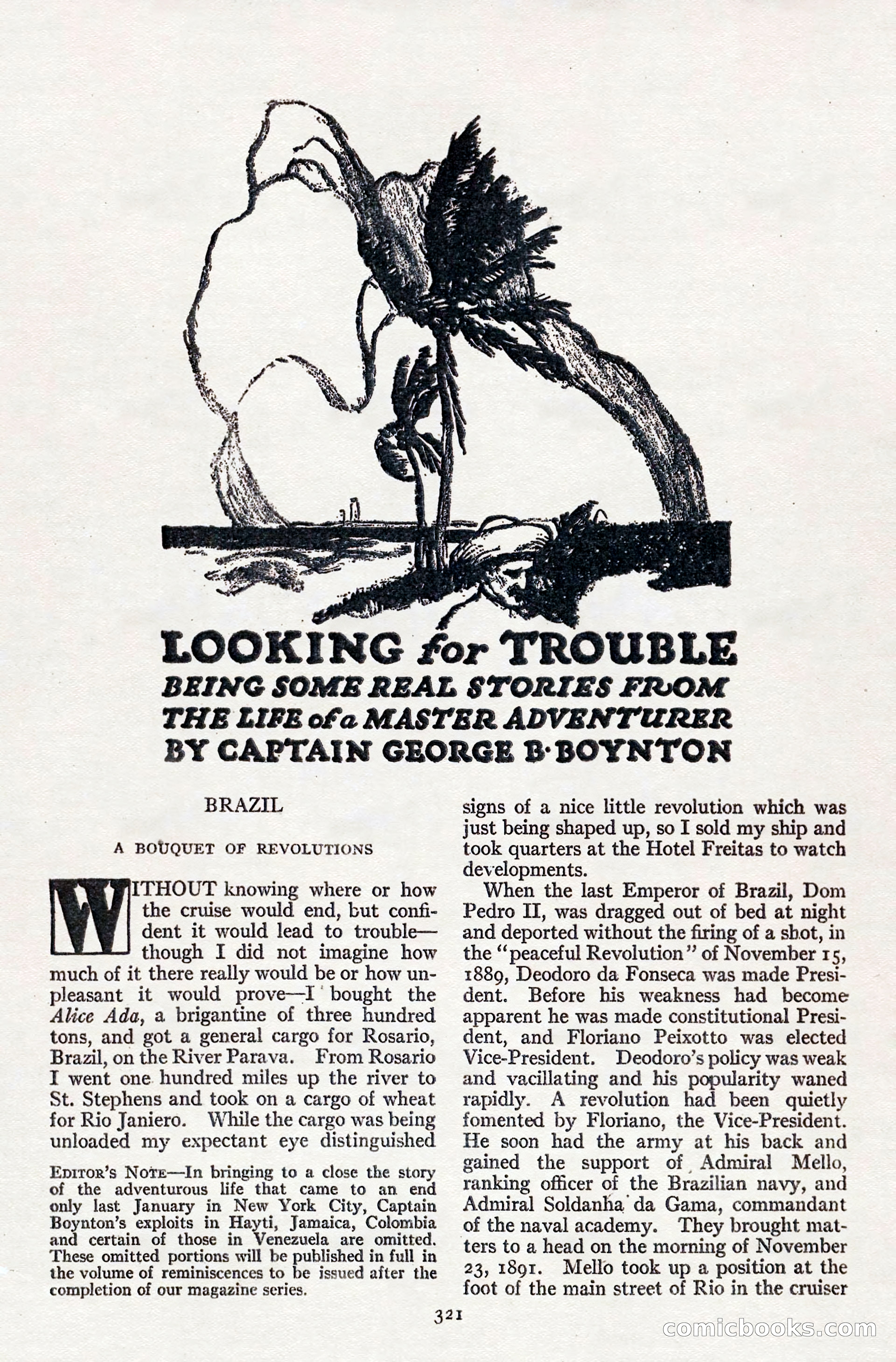
A restored page from Pulp Fiction, 1911. Page through the whole issue in the reader above.
📄 Transcribed text from this page (OCR, searchable)
Machine-transcribed from the original scan — historical spelling and the odd misread are preserved.
. « 5 ; AW h , hey : v me % 24%! : “ wa , 4 a e 4 f " Ps 7% 7 ? am? ors 4 /, 2 rg io 5 *. ’, walaon ° é : (P< pi o4 Sen ° a , v . : . ‘ . ys & ¢ . . , ‘e - r ? ’ 3e LOOKING for TROUBLE BEING SOME REAL STORIES FRLOM THE LIFE ofa MASTER ADVENTURER BY CAPTAIN GEORGE B- BOYNTON BRAZIL A BOUQUET OF REVOLUTIONS ITHOUT knowing where or how the cruise would end, but confi- dent it would lead to trouble— though I did not imagine how much of it there really would be or how un- pleasant it would prove—I bought the Alice Ada, a brigantine of three hundred tons, and got a general cargo for Rosario, Brazil, on the River Parava. From Rosario I went one hundred miles up the river to St. Stephens and took on a cargo of wheat for Rio Janiero. While the cargo was being unloaded my expectant eye distinguished Epiror’s Note—In bringing to a close the story of the adventurous life that came to an end only last January in New York City, Captain Boynton’s exploits in Hayti, Jamaica, Colombia and certain of those in Venezuela are omitted. These omitted portions will be published in full in the volume of reminiscences to be issued after the completion of our magazine series. 321 signs of a nice little revolution which was just being shaped up, so I sold my ship and took quarters at the Hotel Freitas to watch developments. When the last Emperor of Brazil, Dom Pedro II, was dragged out of bed at night and deported without the firing of a shot, in the “‘peaceful Revolution” of November 15, 1889, Deodoro da Fonseca was made Presi- dent. Before his weakness had become apparent he was made constitutional Presi- dent, and Floriano Peixotto was elected Vice-President. Deodoro’s policy was weak and vacillating and his popularity waned rapidly. A revolution had been quietly fomented by Floriano, the Vice-President. He soon had the army at his back and gained the support of Admiral Mello, ranking officer of the Brazilian navy, and Admiral Soldanha da Gama, commandant of the naval academy. They brought mat- ters to a head on the morning of November 23, 1891. Mello took up a position at the foot of the main street of Rio in the cruiser GOMmIGIOOKSEEO 5}