
Pulp Fiction, 1911 · page 127 of 196
Adventure, June 1911 — page 127: what you’re looking at
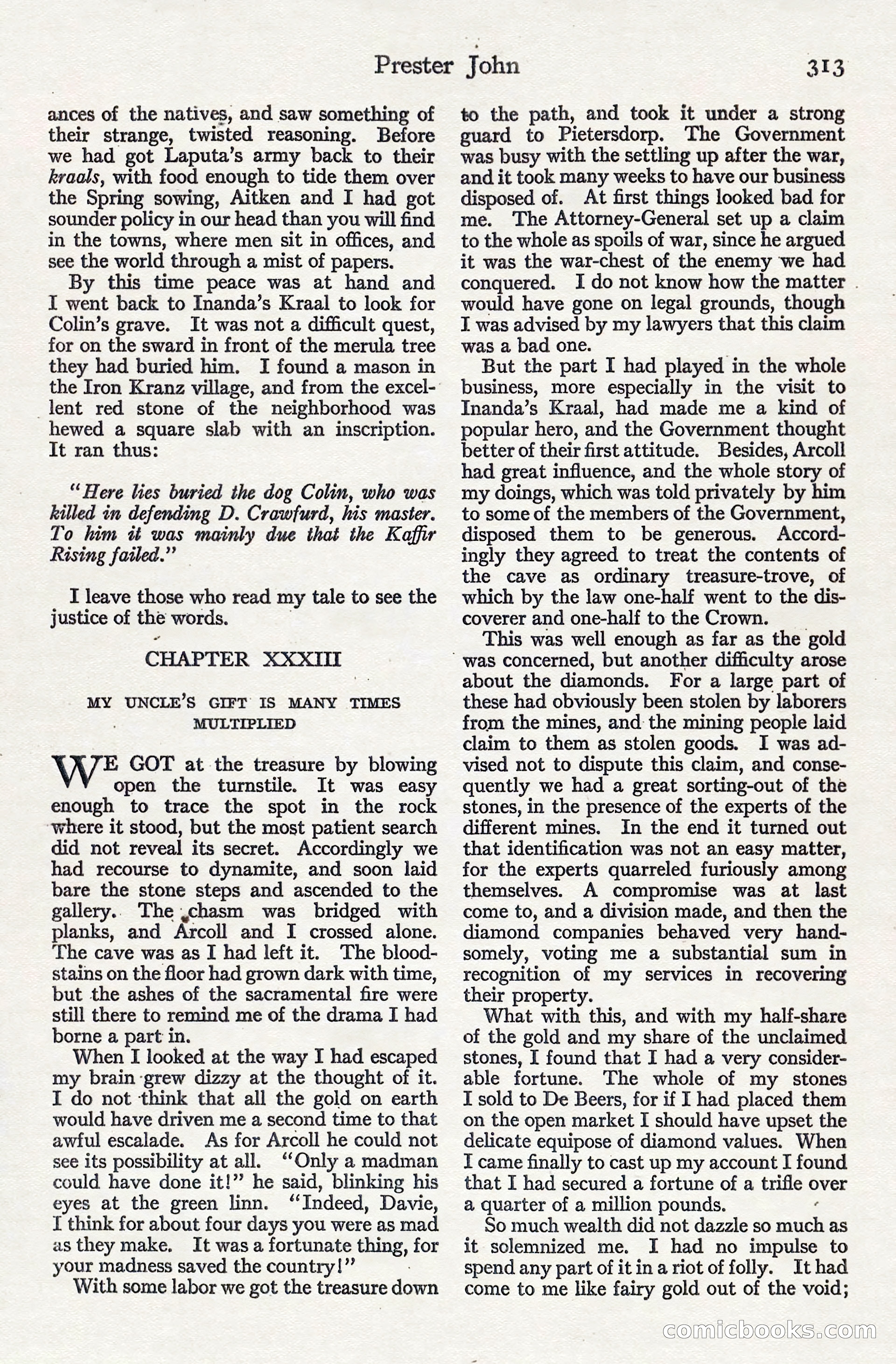
A restored page from Pulp Fiction, 1911. Page through the whole issue in the reader above.
📄 Transcribed text from this page (OCR, searchable)
Machine-transcribed from the original scan — historical spelling and the odd misread are preserved.
Prester John ances of the natives, and saw something of their strange, twisted reasoning. Before we had got Laputa’s army back to their kraals, with food enough to tide them over the Spring sowing, Aitken and I had got sounder policy in our head than you will find in the towns, where men sit in offices, and see the world through a mist of papers. By this time peace was at hand and I went back to Inanda’s Kraal to look for Colin’s grave. It was not a difficult quest, for on the sward in front of the merula tree they had buried him. I found a mason in the Iron Kranz village, and from the excel- lent red stone of the neighborhood was hewed a square slab with an inscription. It ran thus: “Here lies buried the dog Colin, who was killed in defending D. Crawfurd, his master. To him it was mainly due that the Kaffir Rising failed.” I leave those who read my tale to see the justice of the words. CHAPTER SOOT MY UNCLE’S GIFT IS MANY TIMES MULTIPLIED WE GOT at the treasure by blowing open the turnstile. It was easy enough to trace the spot in the rock where it stood, but the most patient search did not reveal its secret. Accordingly we had recourse to dynamite, and soon laid bare the stone steps and ascended to the gallery.. The .chasm was bridged with planks, and Arcoll and I crossed alone. The cave was as I had left it. The blood- stains on the floor had grown dark with time, but the ashes of the sacramental fire were still there to remind me of the drama I had borne a part in. When I looked at the way I had escaped my brain grew dizzy at the thought of it. I do not think that all the gold on earth would have driven me a second time to that awful escalade. As for Arcoll he could not see its possibility at all. ‘Only a madman could have done it!”’ he said, blinking his eyes at the green linn. “Indeed, Davie, I think for about four days you were as mad as they make. It was a fortunate oo for your madness saved the country!”’ With some labor we got the treasure down 313 to the path, and took it under a strong guard to Pietersdorp. The Government was busy with the settling up after the war, and it took many weeks to have our business disposed of. At first things looked bad for me. The Attorney-General set up a claim to the whole as spoils of war, since he argued it was the war-chest of the enemy we had conquered. I do not know how the matter . would have gone on legal grounds, though I was advised by my lawyers that this claim was a bad one. | But the part I had played in the whole business, more especially in the visit to Inanda’s Kraal, had made me a kind of popular hero, and the Government thought better of their first attitude. Besides, Arcoll had great influence, and the whole story of my doings, which was told privately by him to some of the members of the Government, disposed them to be generous. Accord- ingly they agreed to treat the contents of the cave as ordinary treasure-trove, of which by the law one-half went to the dis- coverer and one-half to the Crown. This was well enough as far as the gold was concerned, but another difficulty arose about the diamonds. For a large part of these had obviously been stolen by laborers from the mines, and the mining people laid claim to them as stolen goods. I was ad- vised not to dispute this claim, and conse- quently we had a great sorting-out of the stones, in the presence of the experts of the different mines. In the end it turned out that identification was not an easy matter, for the experts quarreled furiously among themselves. A compromise was at last come to, and a division made, and then the diamond companies behaved very hand- somely, voting me a substantial sum in recognition of my services in recovering their property. What with this, and with my half-share of the gold and my share of the unclaimed stones, I found that I had a very consider- able fortune. The whole of my stones I sold to De Beers, for if I had placed them on the open market I should have upset the delicate equipose of diamond values. When I came finally to cast up my account I found that I had secured a fortune of a trifle over a quarter of a million pounds. So much wealth did not dazzle so ue as it solemnized me. I had no impulse to spend any part of itinariot of folly. Ithad come to me like fairy gold out of the void; CORnNICLO© SCO