
Pulp Fiction, 1911 · page 92 of 196
Adventure Magazine Cover — page 92: what you’re looking at
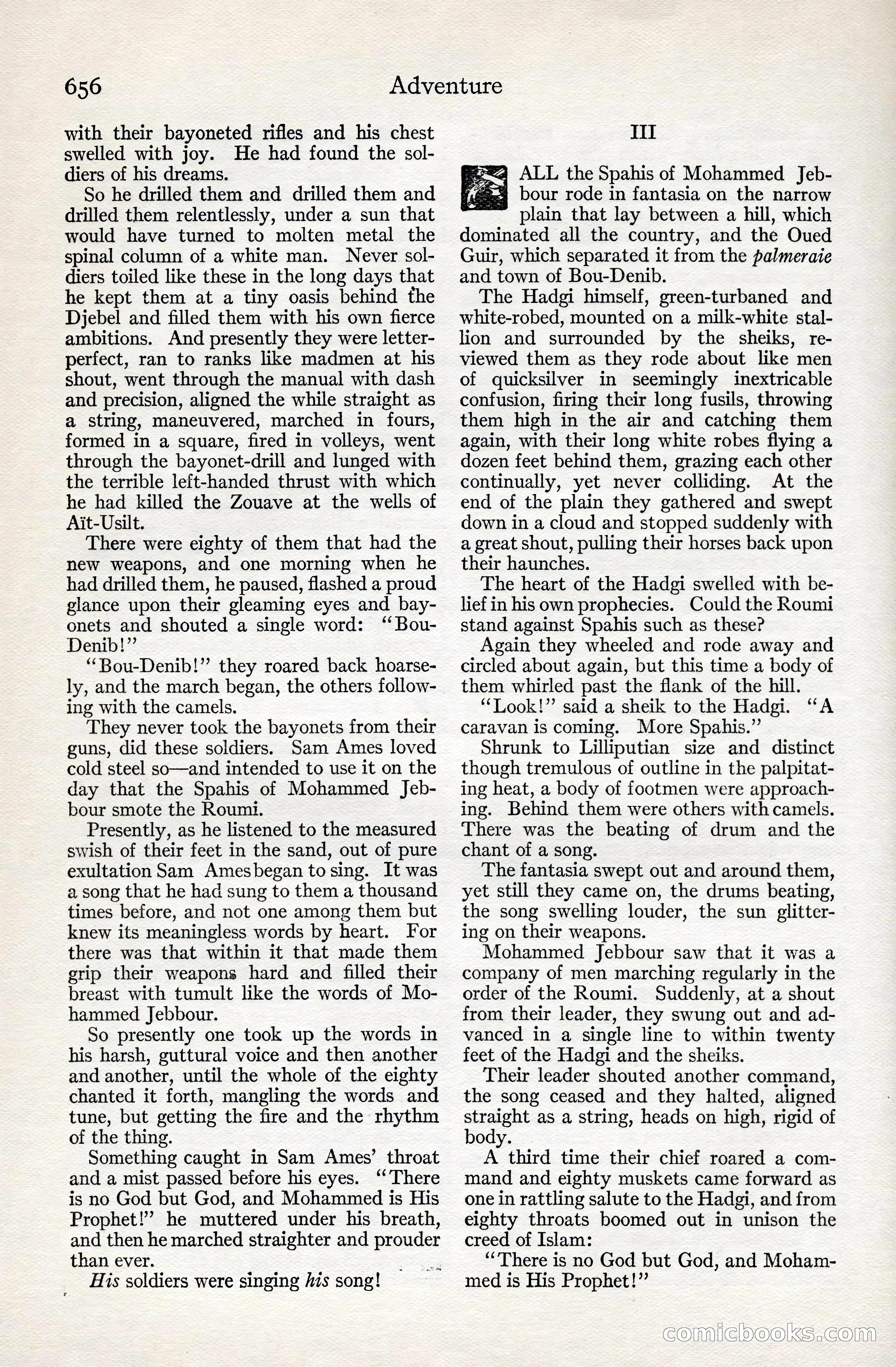
A restored page from Pulp Fiction, 1911. Page through the whole issue in the reader above.
📄 Transcribed text from this page (OCR, searchable)
Machine-transcribed from the original scan — historical spelling and the odd misread are preserved.
656 with their bayoneted rifles and his chest swelled with joy. He had found the sol- diers of his dreams. So he drilled them and drilled them and drilled them relentlessly, under a sun that would have turned to molten metal the spinal column of a white man. Never sol- diers toiled like these in the long days that he kept them at a tiny oasis behind the Djebel and filled them with his own fierce ambitions. And presently they were letter- perfect, ran to ranks like madmen at his shout, went through the manual with dash and precision, aligned the while straight as a string, maneuvered, marched in fours, formed in a square, fired in volleys, went through the bayonet-drill and lunged with the terrible left-handed thrust with which he had killed the Zouave at the wells of Ait-Usilt. There were eighty of them that had the new weapons, and one morning when he had drilled them, he paused, flashed a proud glance upon their gleaming eyes and bay- onets and shouted a single word: “ Bou- Denib!”’ ““Bou-Denib!” they roared back hoarse- ly, and the march began, the others follow- ing with the camels. They never took the bayonets from their guns, did these soldiers. Sam Ames loved cold steel so—and intended to use it on the day that the Spahis of Mohammed Jeb- bour smote the Roum. Presently, as he listened to the measured swish of their feet in the sand, out of pure exultation Sam Amesbegan to sing. It was a song that he had sung to them a thousand times before, and not one among them but knew its meaningless words by heart. For there was that within it that made them grip their weapons hard and filled their breast with tumult like the words of Mo- hammed Jebbour. So presently one took up the words in his harsh, guttural voice and then another and another, until the whole of the eighty chanted it forth, mangling the words and tune, but getting the fire and the rhythm of the thing. Something caught in Sam Ames’ throat and a mist passed before his eyes. “There is no God but God, and Mohammed is His Prophet!’ he muttered under his breath, and then he marched straighter and prouder than ever. His soldiers were singing iis song! Adventure II <2 ALL the Spahis of Mohammed Jeb- éaeq bour rode in fantasia on the narrow z plain that lay between a hill, which dominated all the country, and the Oued Guir, which separated it from the palmeraie and town of Bou-Denib. The Hadgi himself, green-turbaned and white-robed, mounted on a milk-white stal- lion and surrounded by the sheiks, re- viewed them as they rode about like men of quicksilver in seemingly inextricable confusion, firing their long fusils, throwing them high in the air and catching them again, with their long white robes flying a dozen feet behind them, grazing each other continually, yet never colliding. At the end of the plain they gathered and swept down in a cloud and stopped suddenly with a great shout, pulling their horses back upon their haunches. The heart of the Hadgi swelled with be- lief in his own prophecies. Could the Roumi stand against Spahis such as these? Again they wheeled and rode away and circled about again, but this time a body of them whirled past the flank of the hill. “Look!” said a sheik to the Hadgi. “A caravan is coming. More Spahis.”’ Shrunk to Lilliputian size and distinct though tremulous of outline in the palpitat- ing heat, a body of footmen were approach- ing. Behind them were others with camels. There was the beating of drum and the chant of a song. The fantasia swept out and around them, yet still they came on, the drums beating, the song swelling louder, the sun glitter- ing on their weapons. Mohammed Jebbour saw that it was a company of men marching regularly in the order of the Roumi. Suddenly, at a shout from their leader, they swung out and ad- vanced in a single line to within twenty feet of the Hadgi and the sheiks. Their leader shouted another command, the song ceased and they halted, aligned straight as a string, heads on high, rigid of body. A third time their chief roared a com- mand and eighty muskets came forward as one in rattling salute to the Hadgi, and from eighty throats boomed out in unison the creed of Islam: “There is no God but God, and Moham- med is His Prophet!” CoOnnicoooks (C@