
Pulp Fiction, 1911 · page 83 of 196
Adventure Magazine Cover — page 83: what you’re looking at
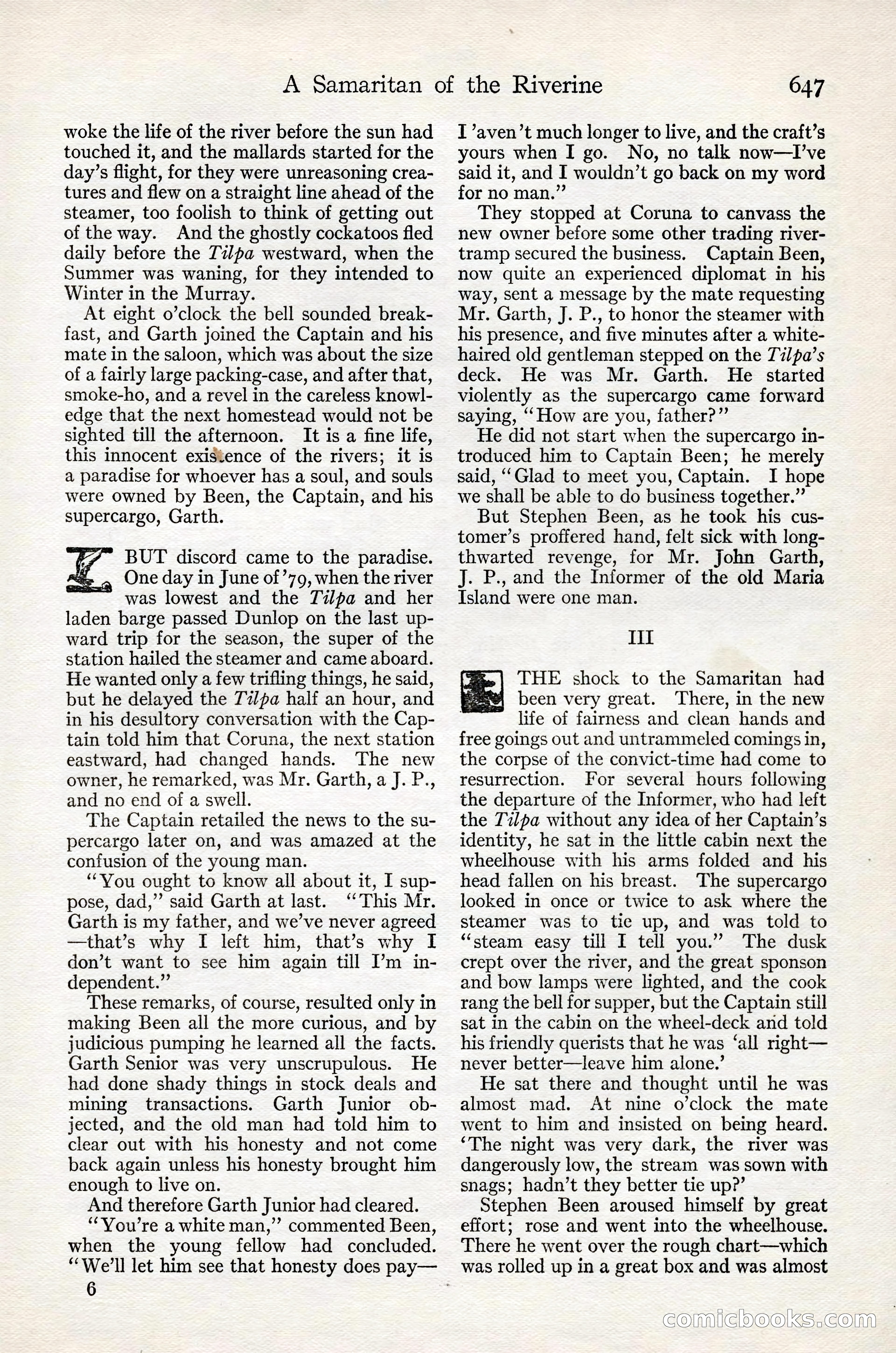
A restored page from Pulp Fiction, 1911. Page through the whole issue in the reader above.
📄 Transcribed text from this page (OCR, searchable)
Machine-transcribed from the original scan — historical spelling and the odd misread are preserved.
A Samaritan of the Riverine woke the life of the river before the sun had touched it, and the mallards started for the day’s flight, for they were unreasoning crea- tures and flew on a straight line ahead of the steamer, too foolish to think of getting out of the way. And the ghostly cockatoos fled daily before the Tilpa westward, when the Summer was waning, for they intended to Winter in the Murray. At eight o’clock the bell sounded break- fast, and Garth joined the Captain and his mate in the saloon, which was about the size of a fairly large packing-case, and after that, smoke-ho, and a revel in the careless knowl- edge that the next homestead would not be sighted till the afternoon. It is a fine life, this innocent existence of the rivers; it is a paradise for whoever has a soul, and souls were owned by Been, the Captain, and his supercargo, Garth. BUT discord came to the paradise. One day in June of ’79, when the river ~ was lowest and the Tilpa and her laden barge passed Dunlop on the last up- ward trip for the season, the super of the station hailed the steamer and came aboard. He wanted only a few trifling things, he said, but he delayed the 7z/pa half an hour, and in his desultory conversation with the Cap- tain told him that Coruna, the next station eastward, had changed hands. The new owner, he remarked, was Mr. Garth, a J. P., and no end of a swell. The Captain retailed the news to the su- percargo later on, and was amazed at the confusion of the young man. “You ought to know all about it, I sup- pose, dad,” said Garth at last. “This Mr. Garth is my father, and we’ve never agreed —that’s why I left him, that’s why I don’t want to see him again till I’m in- dependent.” These remarks, of course, resulted only in making Been all the more curious, and by judicious pumping he learned all the facts. Garth Senior was very unscrupulous. He had done shady things in stock deals and mining transactions. Garth Junior ob- jected, and the old man had told him to clear out with his honesty and not come back again unless his honesty brought him enough to live on. And therefore Garth Junior had cleared. ‘““You’re a white man,”’ commented Been, when the young fellow had concluded. 6 “We'll let him see that honesty does pay— 647 I ’aven’t much longer to live, and the craft’s yours when I go. No, no talk now—l’ve said it, and I wouldn’t go back on my word for no man.” They stopped at Coruna to canvass the new owner before some other trading river- tramp secured the business. Captain Been, now quite an experienced diplomat in his way, sent a message by the mate requesting Mr. Garth, J. P., to honor the steamer with his presence, and five minutes after a white- haired old gentleman stepped on the T7lpa’s deck. He was Mr. Garth. He started violently as the supercargo came forward saying, “How are you, father?”’ He did not start when the supercargo in- troduced him to Captain Been; he merely said, “Glad to meet you, Captain. I hope we shall be able to do business together.” But Stephen Been, as he took his cus- tomer’s proffered hand, felt sick with long- thwarted revenge, for Mr. John Garth, J. P., and the Informer of the old Maria Island were one man. Ill ae) THE shock to the Samaritan had Ets been very great. There, in the new life of fairness and clean hands and free goings out and untrammeled comings in, the corpse of the convict-time had come to resurrection. For several hours following the departure of the Informer, who had left the Tzl/pa without any idea of her Captain’s identity, he sat in the little cabin next the wheelhouse with his arms folded and his head fallen on his breast. The supercargo looked in once or twice to ask where the steamer was to tie up, and was told to “steam easy till I tell you.” The dusk crept over the river, and the great sponson and bow lamps were lighted, and the cook rang the bell for supper, but the Captain still sat in the cabin on the wheel-deck and told his friendly querists that he was ‘all right— never better—leave him alone.’ He sat there and thought until he was almost mad. At nine o’clock the mate went to him and insisted on being heard. ‘The night was very dark, the river was dangerously low, the stream was sown with snags; hadn’t they better tie up?’ Stephen Been aroused himself by great effort; rose and went into the wheelhouse. There he went over the rough chart—which was rolled up in a great box and was almost GoOmichdooksEeo