
Pulp Fiction, 1911 · page 42 of 196
Adventure Magazine Cover — page 42: what you’re looking at
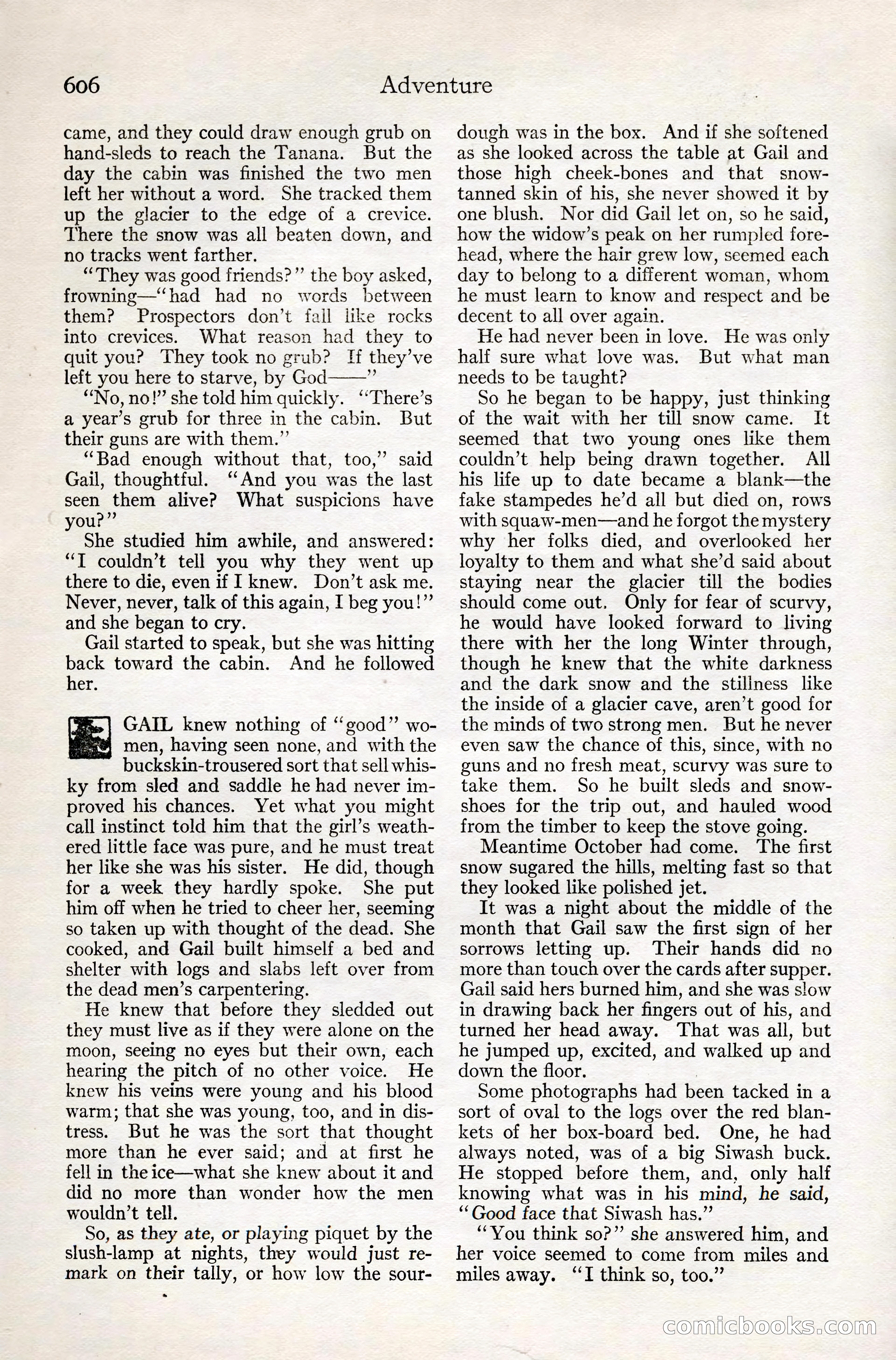
A restored page from Pulp Fiction, 1911. Page through the whole issue in the reader above.
📄 Transcribed text from this page (OCR, searchable)
Machine-transcribed from the original scan — historical spelling and the odd misread are preserved.
606 came, and they could draw enough grub on hand-sleds to reach the Tanana. But the day the cabin was finished the two men left her without a word. She tracked them up the glacier to the edge of a crevice. There the snow was all beaten down, and no tracks went farther. “They was good friends?” the boy asked, frowning—“‘had had no words between them? Prospectors don’t fail like rocks into crevices. What reason had they to quit your They took no grub? [Hf they’ve left you here to starve, by God = “No, no!” she told him quickly. ‘‘There’s a year’s grub for three in the cabin. But their guns are with them.” “Bad enough without that, too,” said Gail, thoughtful. “And you was the last seen them alive? What suspicions have your” She studied him awhile, and answered: “T couldn’t tell you why they went up there to die, even if I knew. Don’t ask me. Never, never, talk of this again, I beg you!” and she began to cry. Gail started to speak, but she was hitting back toward the cabin. And he followed her. ee | GAIL knew nothing of “good” wo- ee) men, having seen none, and with the 3 buckskin-trousered sort that sell whis- ky from sled and saddle he had never im- proved his chances. Yet what you might call instinct told him that the girl’s weath- ered little face was pure, and he must treat her like she was his sister. He did, though for a week they hardly spoke. She put him off when he tried to cheer her, seeming so taken up with thought of the dead. She cooked, and Gail built himself a bed and shelter with logs and slabs left over from the dead men’s carpentering. He knew that before they sledded out they must live as if they were alone on the moon, seeing no eyes but their own, each hearing the pitch of no other voice. He knew his veins were young and his blood warm; that she was young, too, and in dis- tress. But he was the sort that thought more than he ever said; and at first he fell in the ice—what she knew about it and did no more than wonder how the men wouldn’t tell. So, as they ate, or playing piquet by the slush-lamp at nights, they would just re- mark on their tally, or how low the sour- Adventure dough was in the box. And if she softened as she looked across the table at Gail and those high cheek-bones and that snow- tanned skin of his, she never showed it by one blush. Nor did Gail let on, so he said, how the widow’s peak on her rumpled fore- head, where the hair grew low, seemed each day to belong to a different woman, whom he must learn to know and respect and be decent to all over again. He had never been in love. He was only half sure what love was. But what man needs to be taught? So he began to be happy, just thinking of the wait with her till snow came. It seemed that two young ones like them couldn’t help being drawn together. All his life up to date became a blank—the fake stampedes he’d all but died on, rows with squaw-men—and he forgot the mystery why her folks died, and overlooked her loyalty to them and what she’d said about staying near the glacier till the bodies should come out. Only for fear of scurvy, he would have looked forward to living there with her the long Winter through, though he knew that the white darkness and the dark snow and the stiliness lke the inside of a glacier cave, aren’t good for the minds of two strong men. But he never even saw the chance of this, since, with no guns and no fresh meat, scurvy was sure to take them. So he built sleds and snow- shoes for the trip out, and hauled wood from the timber to keep the stove going. Meantime October had come. The first snow sugared the hills, melting fast so that they looked like polished jet. It was a night about the middle of the month that Gail saw the first sign of her sorrows letting up. Their hands did no more than touch over the cards after supper. Gail said hers burned him, and she was s!ow in drawing back her fingers out of his, and turned her head away. That was all, but he jumped up, excited, and walked up and down the floor. | Some photographs had been tacked in a sort of oval to the logs over the red blan- kets of her box-board bed. One, he had always noted, was of a big Siwash buck. He stopped before them, and, only half knowing what was in his mind, he said, ‘‘Good face that Siwash has.” ‘You think so?” she answered him, and her voice seemed to come from miles and miles away. “TI think so, too.” cConnicloooks (C@ 5}