
Pulp Fiction, 1911 · page 29 of 196
Adventure Magazine Cover — page 29: what you’re looking at
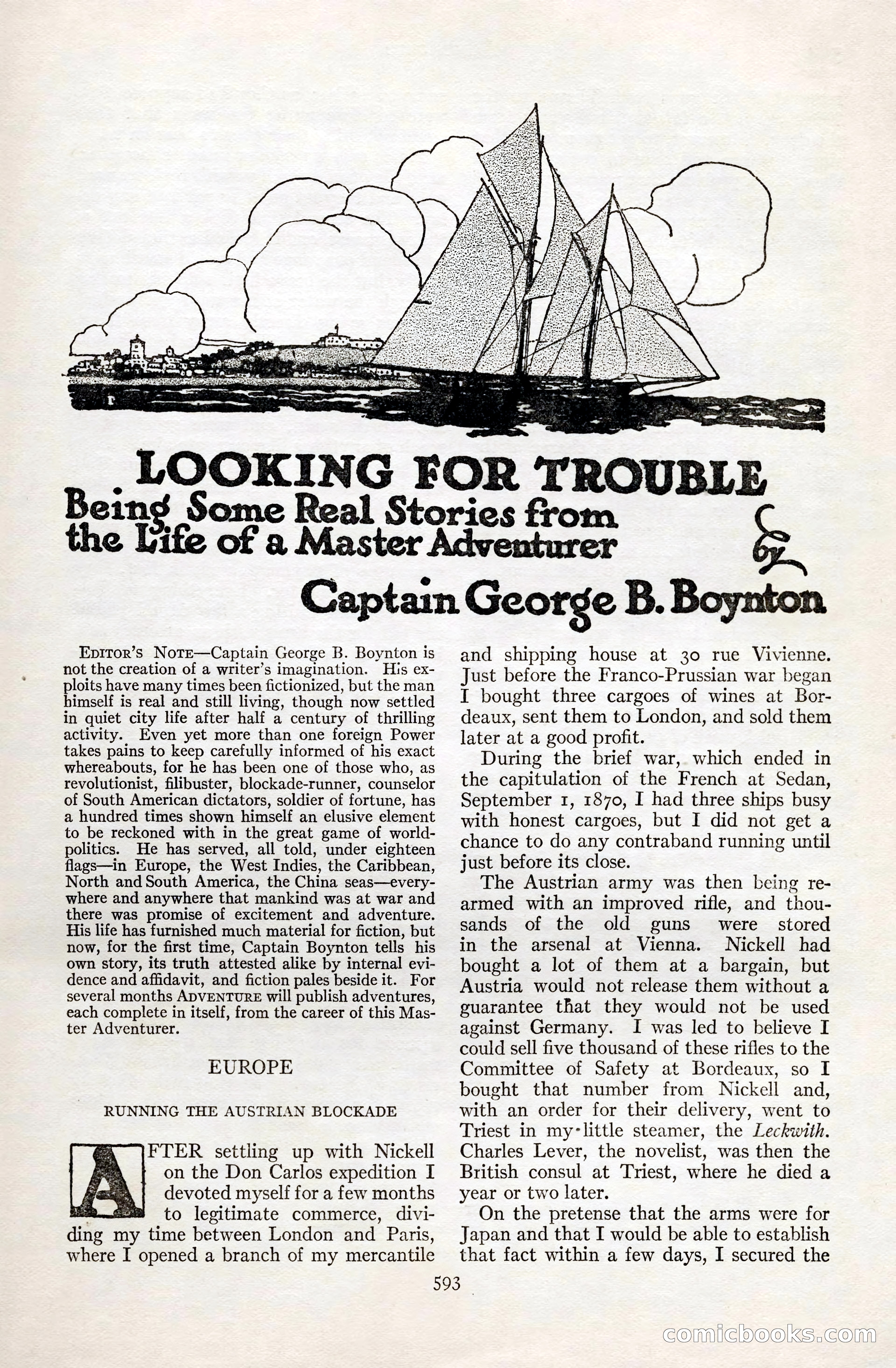
A restored page from Pulp Fiction, 1911. Page through the whole issue in the reader above.
📄 Transcribed text from this page (OCR, searchable)
Machine-transcribed from the original scan — historical spelling and the odd misread are preserved.
LOOKIN G FOR TROUBLE iene. = Real St £3 fa Mater Mie ho enturer Captain George B. Boynton Epitor’s Note—Captain George B. Boynton is not the creation of a writer’s imagination. His ex- ploits have many times been fictionized, but the man himself is real and still living, though now settled In quiet city life after half a century of thrilling activity. Even yet more than one foreign Power takes pains to keep carefully informed of his exact whereabouts, for he has been one of those who, as revolutionist, filibuster, blockade-runner, counselor of South American dictators, soldier of fortune, has a hundred times shown himself an elusive element to be reckoned with in the great game of world- politics. He has served, all told, under eighteen flags—in Europe, the West Indies, the Caribbean, North and South America, the China seas—every- where and anywhere that mankind was at war and there was promise of excitement and adventure. His life has furnished much material for fiction, but now, for the first time, Captain Boynton tells his own story, its truth attested alike by internal evi- dence and affidavit, and fiction pales beside it. For several months ADVENTURE will publish adventures, each complete in itself, from the career of this Mas- ter Adventurer. EUROPE RUNNING THE AUSTRIAN BLOCKADE FTER settling up with Nickell on the Don Carlos expedition I devoted myself for a few months 28 to legitimate commerce, divi- atte my time between London and Paris, where I opened a branch of my mercantile and shipping house at 30 rue Vivienne. Just before the Franco-Prussian war began I bought three cargoes of wines at Bor- deaux, sent them to London, and sold them later at a good profit. During the brief war, which ended in the capitulation of the French at Sedan, September 1, 1870, I had three ships busy with honest cargoes, but I did not get a chance to do any contraband running until just before its close. The Austrian army was then being re- armed with an improved rifle, and thou- sands of the old guns’ were stored in the arsenal at Vienna. Nickell had bought a lot of them at a bargain, but Austria would not release them without a guarantee that they would not be used against Germany. I was led to believe I could sell five thousand of these rifles to the Committee of Safety at Bordeaux, so I bought that number from Nickell and, with an order for their delivery, went to Triest in myvlittle steamer, the Leckwith. Charles Lever, the novelist, was then the British consul at Triest, where he died a year or two later. On the pretense that the arms were for Japan and that I would be able to establish that fact within a few days, I secured the 503 COMICLOOCKKS. ECO