
Pulp Fiction, 1911 · page 190 of 196
Adventure Magazine Cover — page 190: what you’re looking at
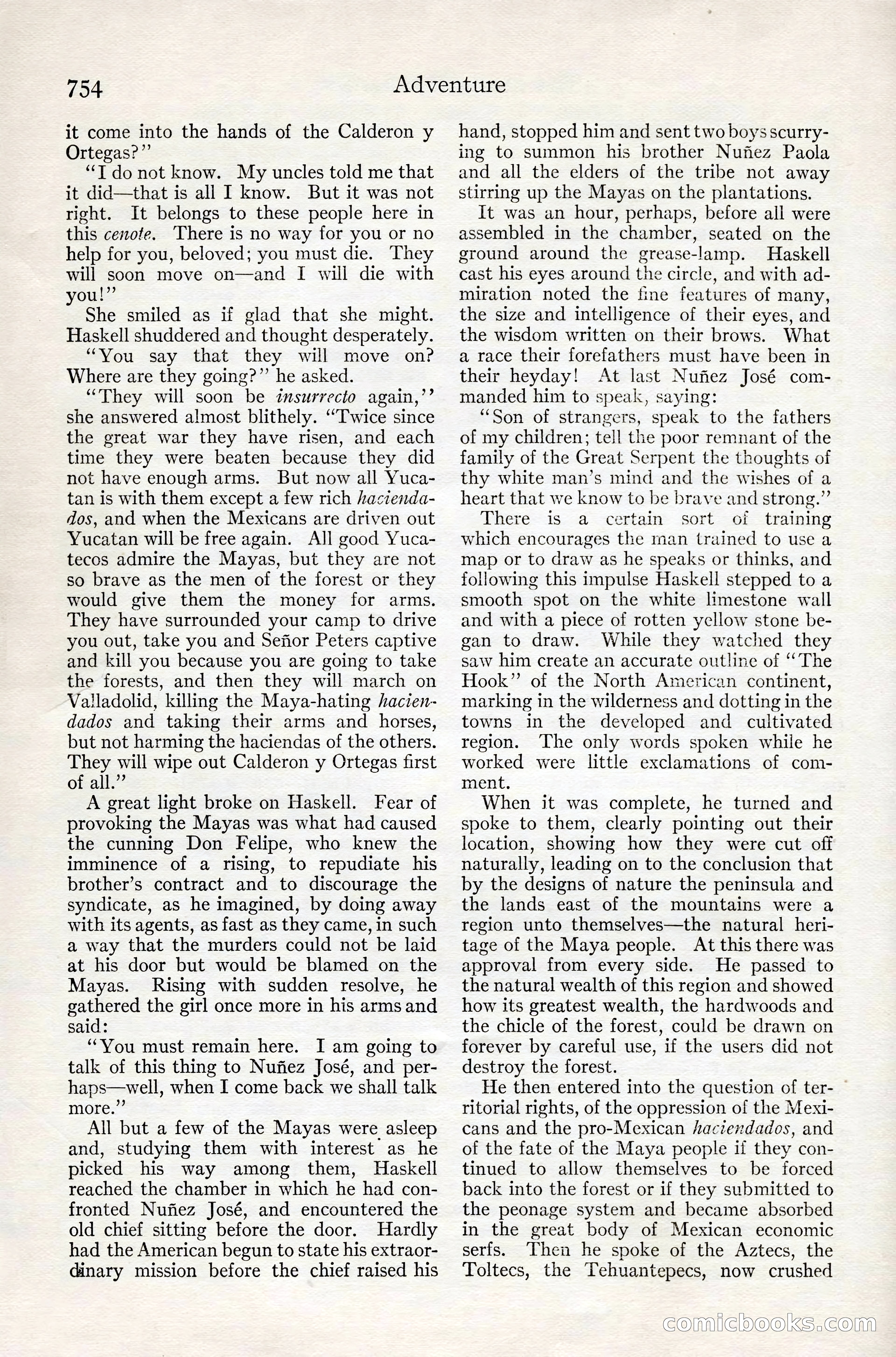
A restored page from Pulp Fiction, 1911. Page through the whole issue in the reader above.
📄 Transcribed text from this page (OCR, searchable)
Machine-transcribed from the original scan — historical spelling and the odd misread are preserved.
754 it come into the hands of the Calderon y Ortegas?”’ “T do not know. My uncles told me that it did—that is all I know. But it was not right. It belongs to these people here in this cenofe. There is no way for you or no help for you, beloved; you must die. They will soon move on—and I will die with ou!”’ She smiled as if glad that she might. Haskell shuddered and thought desperately. “You say that they will move one Where are they going?” he asked. “They will soon be insurrecio again,’’ she answered almost blithely. ‘“Twice since the great war they have risen, and each time they were beaten because they did not have enough arms. But now all Yuca- tan is with them except a few rich hacienda- dos, and when the Mexicans are driven out Yucatan will be free again. All good Yuca- tecos admire the Mayas, but they are not so brave as the men of the forest or they would give them the money for arms. They have surrounded your camp to drive you out, take you and Sefior Peters captive and kill you because you are going to take the forests, and then they will march on Valladolid, killing the Maya-hating hacien- dados and taking their arms and horses, but not harming the haciendas of the others. They will wipe out Calderon y Ortegas first of all.” A great light broke on Haskell. Fear of provoking the Mayas was what had caused the cunning Don Felipe, who knew the imminence of a rising, to repudiate his brother’s contract and to discourage the syndicate, as he imagined, by doing away with its agents, as fast as they came, in such a way that the murders could not be laid at his door but would be blamed on the Mayas. Rising with sudden resolve, he gathered the girl once more in his arms and said: “You must remain here. I am going to talk of this thing to Nufiez José, and per- haps—well, when I come back we shall talk more.” All but a few of the Mayas were asleep and, studying them with interest as he picked his way among them, Haskell reached the chamber in which he had con- fronted Nufiez José, and encountered the old chief sitting before the door. Hardly had the American begun to state his extraor- dinary mission before the chief raised his Adventure hand, stopped him and sent two boys scurry- ing to summon his brother Nufiez Paola and all the elders of the tribe not away stirring up the Mayas on the plantations. It was an hour, perhaps, before all were assembled in the chamber, seated on the ground around the grease-lamp. Haskell cast his eyes around the circle, and with ad- miration noted the fine features of many, the size and intelligence of their eyes, and the wisdom written on their brows. What a race their forefathers must have been in their heyday! At last Nufiez José com- manded him to speak, saying: “Son of strangers, speak to the fathers of my children; tell the poor remnant of the family of the Great Serpent the thoughts of thy white man’s mind and the wishes of a heart that we know to be brave and strong.” There is a certain sort of training which encourages the man trained to use a map or to draw as he speaks or thinks, and following this impulse Haskell stepped to a smooth spot on the white limestone wall and with a piece of rotten yellow stone be- gan to draw. While they watched they saw him create an accurate outline of ‘‘The Hook” of the North American continent, marking in the wilderness and dotting in the towns in the developed and cultivated region. The only words spoken while he worked were little exclamations of com- ment. When it was complete, he turned and spoke to them, clearly pointing out their location, showing how they were cut off naturally, leading on to the conclusion that by the designs of nature the peninsula and the lands east of the mountains were a region unto themselves—the natural heri- tage of the Maya people. At this there was approval from every side. He passed to the natural wealth of this region and showed how its greatest wealth, the hardwoods and the chicle of the forest, could be drawn on forever by careful use, if the users did not destroy the forest. He then entered into the question of ter- | ritorial rights, of the oppression of the Mexi- cans and the pro-Mexican haciendadeos, and of the fate of the Maya people if they con- tinued to allow themselves to be forced back into the forest or if they submitted to the peonage system and became absorbed in the great body of Mexican economic serfs. Then he spoke of the Aztecs, the Toltecs, the Tehuantepecs, now crushed COMICLOOCKS. EO