
Pulp Fiction, 1911 · page 18 of 196
Adventure Magazine Cover — page 18: what you’re looking at
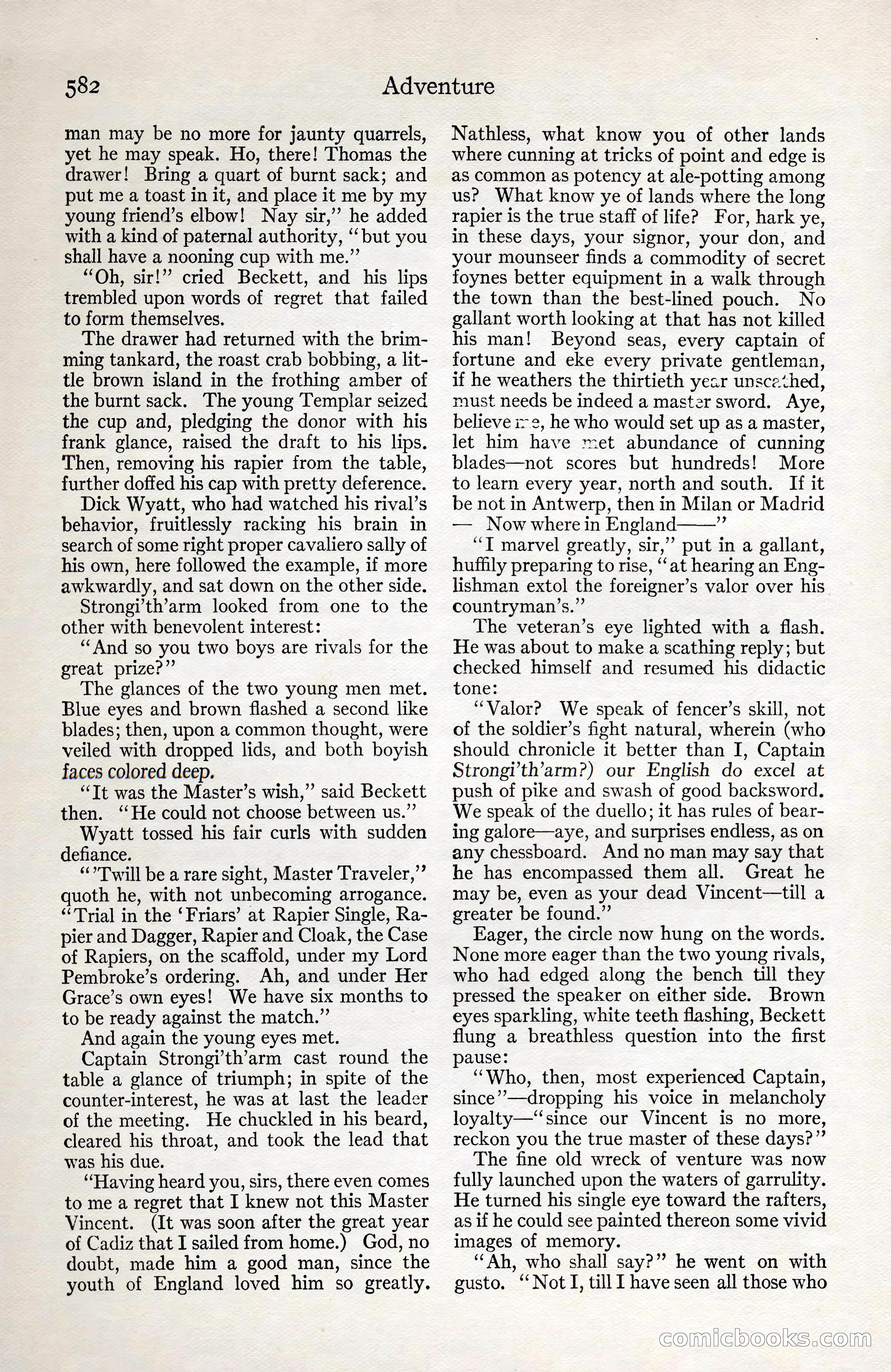
A restored page from Pulp Fiction, 1911. Page through the whole issue in the reader above.
📄 Transcribed text from this page (OCR, searchable)
Machine-transcribed from the original scan — historical spelling and the odd misread are preserved.
582 man may be no more for jaunty quarrels, yet he may speak. Ho, there! Thomas the drawer! Bring a quart of burnt sack; and put me a toast in it, and place it me by my young friend’s elbow! Nay sir,’’ he added with a kind of paternal authority, ‘‘ but you shall have a nooning cup with me.” “Oh, sir!” cried Beckett, and his lips trembled upon words of regret that failed to form themselves. The drawer had returned with the brim- ming tankard, the roast crab bobbing, a lit- tle brown island in the frothing amber of the burnt sack. The young Templar seized the cup and, pledging the donor with his frank glance, raised the draft to his lips. Then, removing his rapier from the table, further doffed his cap with pretty deference. Dick Wyatt, who had watched his rival’s behavior, fruitlessly racking his brain in search of some right proper cavaliero sally of his own, here followed the example, if more awkwardly, and sat down on the other side. Strongi’th’arm looked from one to the other with benevolent interest: ‘“‘And so you two boys are rivals for the great prize?”’ The glances of the two young men met. Blue eyes and brown flashed a second like blades; then, upon a common thought, were veiled with dropped lids, and both boyish faces colored deep. “Tt was the Master’s wish,” said Beckett then. “He could not choose between us.” Wyatt tossed his fair curls with sudden defiance. “Twill be a rare sight, Master Traveler,’’ quoth he, with not unbecoming arrogance. “Trial in the ‘Friars’ at Rapier Single, Ra- pier and Dagger, Rapier and Cloak, the Case of Rapiers, on the scaffold, under my Lord Pembroke’s ordering. Ah, and under Her Grace’s own eyes! We have six months to to be ready against the match.” And again the young eyes met. Captain Strongi’th’arm cast round the table a glance of triumph; in spite of the counter-interest, he was at last the leader of the meeting. He chuckled in his beard, cleared his throat, and took the lead that was his due. ‘Having heard you, sirs, there even comes to me a regret that I knew not this Master Vincent. (It was soon after the great year of Cadiz that I sailed from home.) God, no doubt, made him a good man, since the youth of England loved him so greatly. Adventure Nathless, what know you of other lands where cunning at tricks of point and edge is as common as potency at ale-potting among us? What know ye of lands where the long rapier is the true staff of life? For, hark ye, in these days, your signor, your don, and your mounseer finds a commodity of secret foynes better equipment in a walk through the town than the best-lined pouch. No gallant worth looking at that has not killed his man! Beyond seas, every captain of fortune and eke every private gentleman, if he weathers the thirtieth year unscethed, must needs be indeed a master sword. Aye, believe xe, he who would set up as a master, let him have met abundance of cunning blades—not scores but hundreds! More to learn every year, north and south. If it be not in Antwerp, then in Milan or Madrid — Now where in England % ‘““T marvel greatly, sir,’ put in a gallant, huffily preparing to rise, ‘‘at hearing an Eng- lishman extol the foreigner’s valor over his countryman’s.” The veteran’s eye lighted with a flash. He was about to make a scathing reply; but checked himself and resumed his didactic tone: ‘Valor? We speak of fencer’s skill, not of the soldier’s fight natural, wherein (who should chronicle it better than I, Captain Strongi’th’arm?) our English do excel at push of pike and swash of good backsword. We speak of the duello; it has rules of bear- ing galore—aye, and surprises endless, as on any chessboard. And no man may say that he has encompassed them all. Great he may be, even as your dead Vincent—till a greater be found.” Eager, the circle now hung on the words. None more eager than the two young rivals, who had edged along the bench till they pressed the speaker on either side. Brown eyes sparkling, white teeth flashing, Beckett flung a breathless question into the first ause: ‘Who, then, most experienced Captain, since’’—dropping his voice in melancholy loyalty—“‘since our Vincent is no more, reckon you the true master of these days?” The fine old wreck of venture was now fully launched upon the waters of garrulity. He turned his single eye toward the rafters, as if he could see painted thereon some vivid images of memory. ‘Ah, who shall say?” he went on with gusto. “Not I, till I have seen all those who GoOmiGcdooksEeo