
Pulp Fiction, 1911 · page 157 of 196
Adventure Magazine Cover — page 157: what you’re looking at
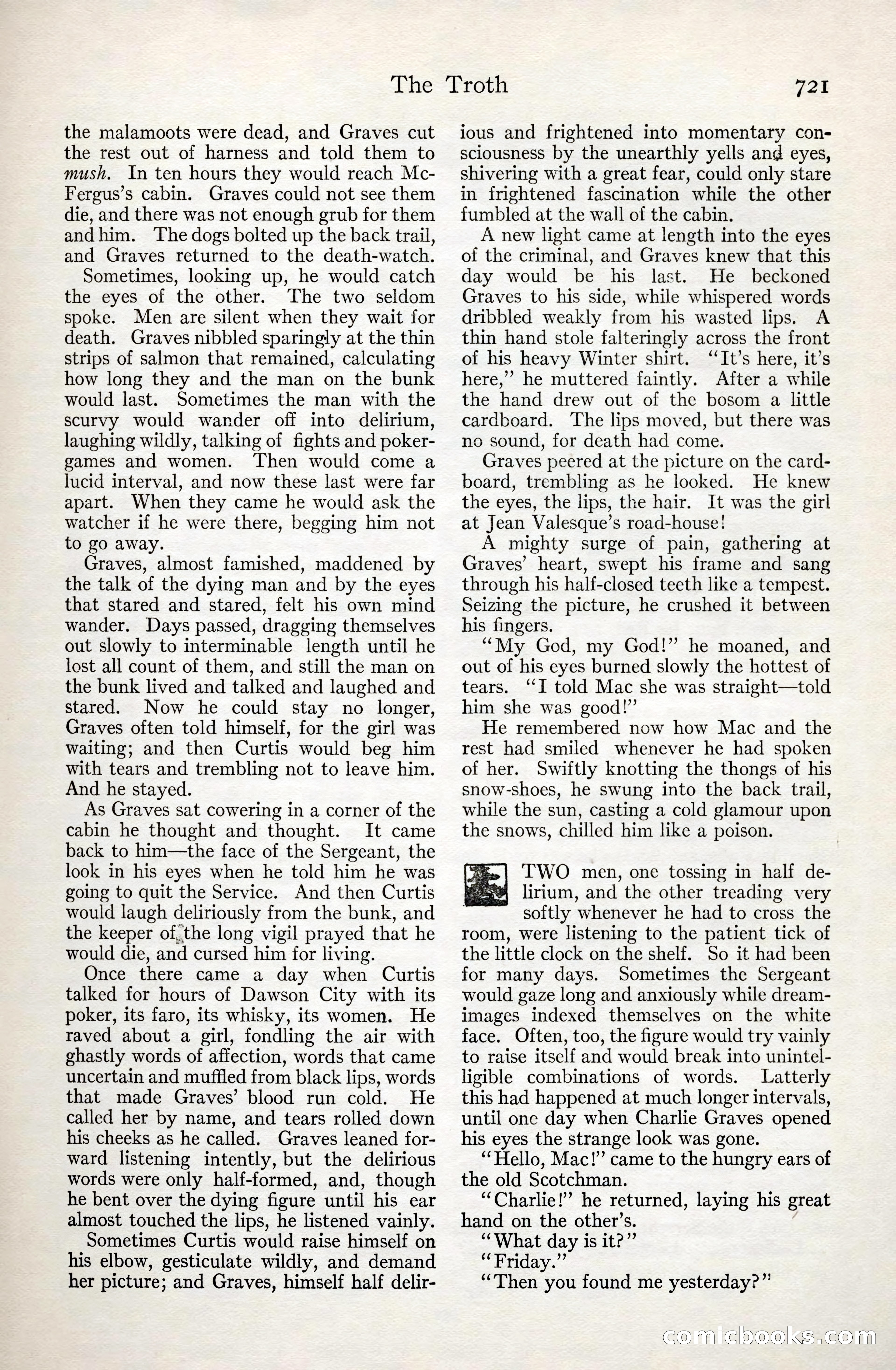
A restored page from Pulp Fiction, 1911. Page through the whole issue in the reader above.
📄 Transcribed text from this page (OCR, searchable)
Machine-transcribed from the original scan — historical spelling and the odd misread are preserved.
The Troth the malamoots were dead, and Graves cut the rest out of harness and told them to mush. In ten hours they would reach Mc- Fergus’s cabin. Graves could not see them die, and there was not enough grub for them andhim. ‘The dogs bolted up the back trail, and Graves returned to the death-watch. Sometimes, looking up, he would catch the eyes of the other. The two seldom spoke. Men are silent when they wait for death. Graves nibbled sparingly at the thin strips of salmon that remained, calculating how long they and the man on the bunk would last. Sometimes the man with the scurvy would wander off into delirium, laughing wildly, talking of fights and poker- games and women. Then would come a lucid interval, and now these last were far apart. When they came he would ask the watcher if he were there, begging him not to go away. Graves, almost famished, maddened by the talk of the dying man and by the eyes that stared and stared, felt his own mind wander. Days passed, dragging themselves out slowly to interminable length until he lost all count of them, and still the man on the bunk lived and talked and laughed and stared. Now he could stay no longer, Graves often told himself, for the girl was waiting; and then Curtis would beg him with tears and trembling not to leave him. And he stayed. As Graves sat cowering in a corner of the cabin he thought and thought. It came back to him—the face of the Sergeant, the look in his eyes when he told him he was going to quit the Service. And then Curtis would laugh deliriously from the bunk, and the keeper of, the long vigil prayed that he would die, and cursed him for living. Once there came a day when Curtis talked for hours of Dawson City with its poker, its faro, its whisky, its women. He raved about a girl, fondling the air with ghastly words of affection, words that came uncertain and muffled from black lips, words that made Graves’ blood run cold. He called her by name, and tears rolled down his cheeks as he called. Graves leaned for- ward listening intently, but the delirious words were only half-formed, and, though he bent over the dying figure until his ear almost touched the lips, he listened vainly. Sometimes Curtis would raise himself on his elbow, gesticulate wildly, and demand her picture; and Graves, himself half delir- 721 ious and frightened into momentary con- sciousness by the unearthly yells and eyes, shivering with a great fear, could only stare in frightened fascination while the other fumbled at the wall of the cabin. A new light came at length into the eyes of the criminal, and Graves knew that this day would be his last. He _ beckoned Graves to his side, while whispered words dribbled weakly from his wasted lips. A thin hand stole falteringly across the front of his heavy Winter shirt. “It’s here, it’s here,’ he muttered faintly. After a while the hand drew out of the bosom a little cardboard. The lips moved, but there was no sound, for death had come. Graves peered at the picture on the card- board, trembling as he looked. He knew the eyes, the lips, the hair. It was the girl at Jean Valesque’s road-house! A mighty surge of pain, gathering at Graves’ heart, swept his frame and sang through his half-closed teeth like a tempest. Seizing the picture, he crushed it between his fingers. “My God, my God!” he moaned, and out of his eyes burned slowly the hottest of tears. “I told Mac she was straight—told him she was good!’ He remembered now how Mac and the rest had smiled whenever he had spoken of her. Swiftly knotting the thongs of his snow-shoes, he swung into the back trail, while the sun, casting a cold glamour upon the snows, chilled him like a poison. f.»| TWO men, one tossing in half de- v0 lirium, and the other treading very softly whenever he had to cross the room, were listening to the patient tick of the little clock on the shelf. So it had been for many days. Sometimes the Sergeant would gaze long and anxiously while dream- images indexed themselves on the white face. Often, too, the figure would try vainly to raise itself and would break into unintel- ligible combinations of words. Latterly this had happened at much longer intervals, until one day when Charlie Graves opened his eyes the strange look was gone. “Hello, Mac!’ came to the hungry ears of the old Scotchman. “Charlie!” he returned, laying his great hand on the other’s. ‘What day is it?” “Friday.” “Then you found me yesterday?” COMMICLOOCKKS. EO 5}