
Pulp Fiction, 1911 · page 138 of 196
Adventure Magazine Cover — page 138: what you’re looking at
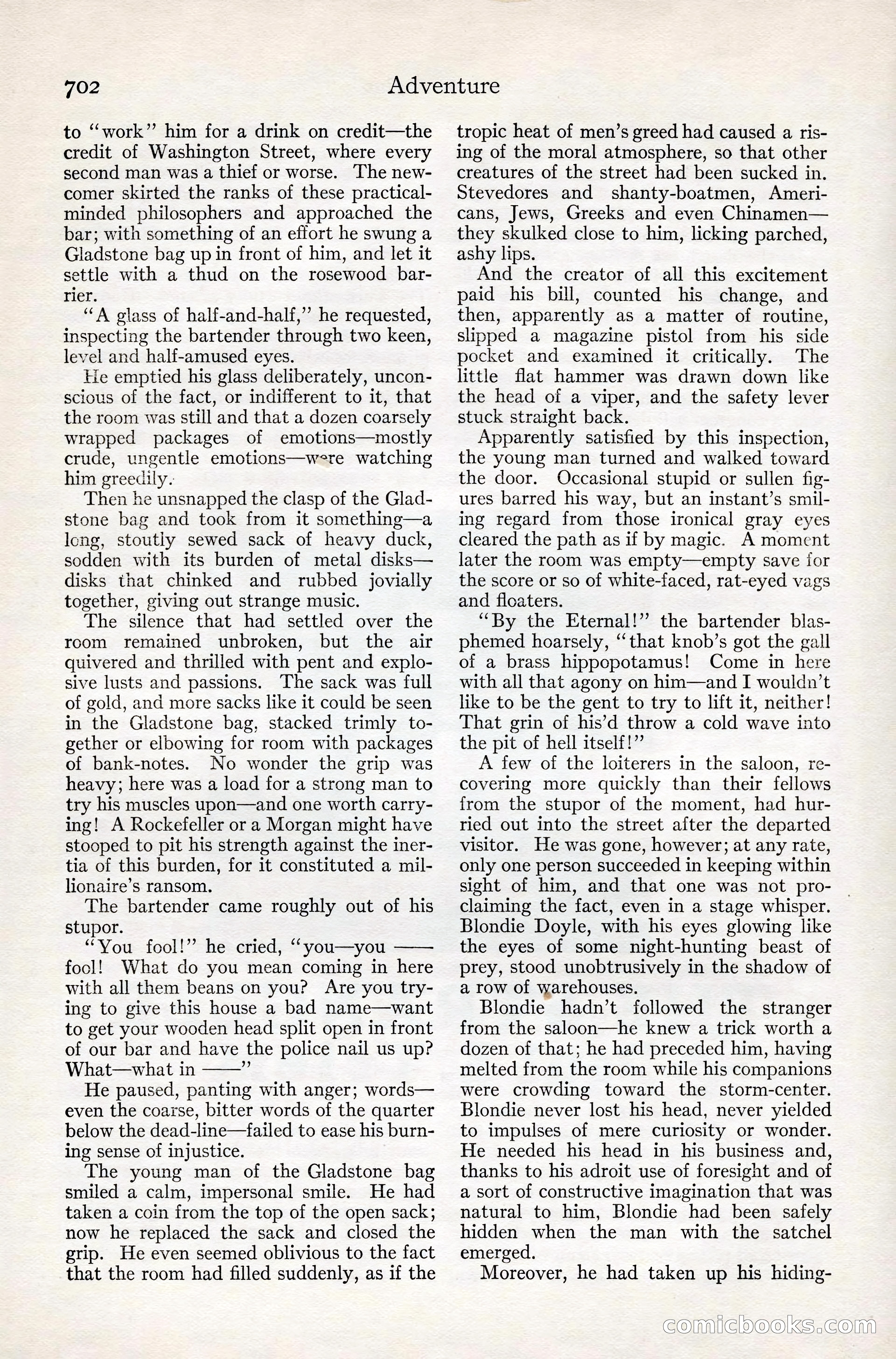
A restored page from Pulp Fiction, 1911. Page through the whole issue in the reader above.
📄 Transcribed text from this page (OCR, searchable)
Machine-transcribed from the original scan — historical spelling and the odd misread are preserved.
702 to ‘‘work”’ him for a drink on credit—the credit of Washington Street, where every second man was a thief or worse. The new- comer skirted the ranks of these practical- minded philosophers and approached the bar; with something of an effort he swung a Gladstone bag up in front of him, and let it settle with a thud on the rosewood bar- rier. ‘“A glass of half-and-half,’ he requested, inspecting the bartender through two keen, level and half-amused eyes. tie emptied his glass deliberately, uncon- scious of the fact, or indifferent to it, that the room was still and that a dozen coarsely wrapped packages of emotions—mostly crude, ungentle emotions—were watching him greedily. Then he unsnapped the clasp of the Glad- stone bag and took from it something—a long, stoutly sewed sack of heavy duck, sodden with its burden of metal disks— disks that chinked and rubbed jovially together, giving out strange music. The silence that had settled over the room remained unbroken, but the air quivered and thrilled with pent and explo- sive lusts and passions. The sack was full of gold, and more sacks like it could be seen in the Gladstone bag, stacked trimly to- gether or elbowing for room with packages of bank-notes. No wonder the grip was heavy; here was a load for a strong man to try his muscles upon—and one worth carry- ing! A Rockefeller or a Morgan might have stooped to pit his strength against the iner- tia of this burden, for it constituted a mil- lionaire’s ransom. The bartender came roughly out of his stupor. “You fool!” he cried, ‘““you—you fool! What do you mean coming in here with all them beans on you? Are you try- ing to give this house a bad name—want to get your wooden head split open in front of our bar and have the police nail us up? What—what in a? He paused, panting with anger; words— even the coarse, bitter words of the quarter below the dead-line—failed to ease his burn- ing sense of injustice. The young man of the Gladstone bag smiled a calm, impersonal smile. He had taken a coin from the top of the open sack; now he replaced the sack and closed the grip. He even seemed oblivious to the fact that the room had filled suddenly, as if the Adventure tropic heat of men’s greed had caused a ris- ing of the moral atmosphere, so that other creatures of the street had been sucked in. Stevedores and shanty-boatmen, Ameri- cans, Jews, Greeks and even Chinamen— they skulked close to him, licking parched, ashy lips. And the creator of all this excitement paid his bill, counted his change, and then, apparently as a matter of routine, slipped a magazine pistol from his side pocket and examined it critically. The little flat hammer was drawn down like the head of a viper, and the safety lever stuck straight back. Apparently satisfied by this inspection, the young man turned and walked toward the door. Occasional stupid or sullen fig- ures barred his way, but an instant’s smil- ing regard from those ironical gray eyes cleared the path as if by magic. A moment later the room was empty—empty save {or the score or so of white-faced, rat-eyed vags and floaters. “By the Eternal!” the bartender blas- phemed hoarsely, “that knob’s got the gall of a brass hippopotamus! Come in here with all that agony on him—and I wouldn’t like to be the gent to try to lift it, neither! That grin of his’d throw a cold wave into the pit of hell itself!” A few of the loiterers in the saloon, re- covering more quickly than their fellows {from the stupor of the moment, had hur- ried out into the street after the departed visitor. He was gone, however; at any rate, only one person succeeded in keeping within sight of him, and that one was not pro- claiming the fact, even in a stage whisper. Blondie Doyle, with his eyes glowing like the eyes of some night-hunting beast of prey, stood unobtrusively in the shadow of a row of warehouses. Blondie hadn’t followed the stranger from the saloon—he knew a trick worth a dozen of that; he had preceded him, having melted from the room while his companions were crowding toward the storm-center. Blondie never lost his head, never yielded to impulses of mere curiosity or wonder. He needed his head in his business and, thanks to his adroit use of foresight and of a sort of constructive imagination that was natural to him, Blondie had been safely hidden when the man with the satchel emerged. Moreover, he had taken up his hiding- COmMMICMOOCKKS.CO