
Pulp Fiction, 1911 · page 104 of 196
Adventure Magazine Cover — page 104: what you’re looking at
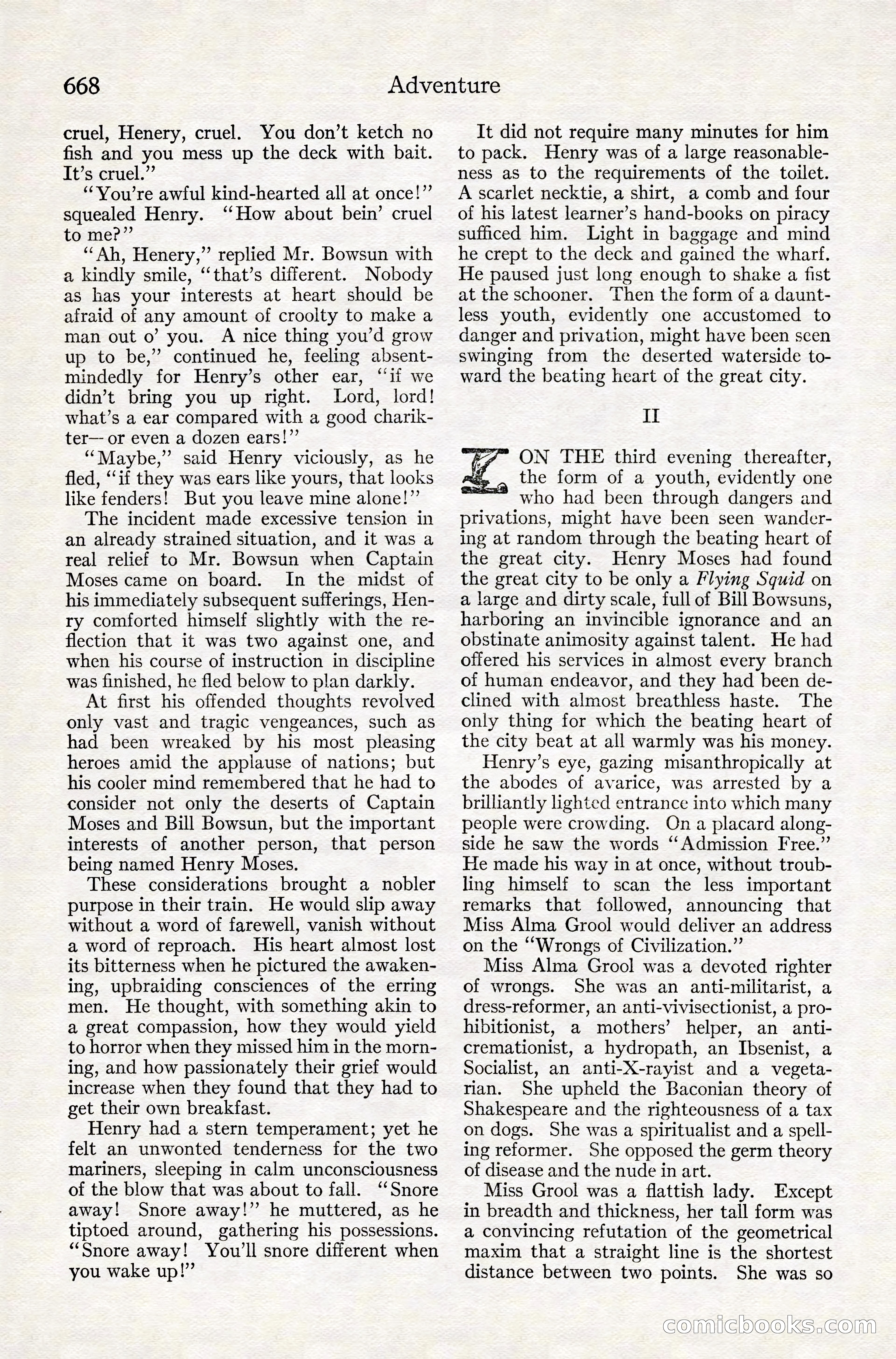
A restored page from Pulp Fiction, 1911. Page through the whole issue in the reader above.
📄 Transcribed text from this page (OCR, searchable)
Machine-transcribed from the original scan — historical spelling and the odd misread are preserved.
668 cruel, Henery, cruel. You don’t ketch no fish and you mess up the deck with bait. It’s cruel.” “You're awful kind-hearted all at once!” squealed Henry. ‘‘How about bein’ cruel to me?”’ ‘Ah, Henery,” replied Mr. Bowsun with a kindly smile, ‘‘that’s different. Nobody as has your interests at heart should be afraid of any amount of croolty to make a man out o’ you. A nice thing you’d grow up to be,” continued he, feeling absent- mindedly for Henry’s other ear, “ii we didn’t bring you up right. Lord, lord! what’s a ear compared with a good charik- ter— or even a dozen ears!”’ “Maybe,” said Henry viciously, as he fled, ‘‘if they was ears like yours, that looks like fenders! But you leave mine alone!” The incident made excessive tension in an already strained situation, and it was a real relief to Mr. Bowsun when Captain Moses came on board. In the midst of his immediately subsequent sufferings, Hen- ry comforted himself slightly with the re- flection that it was two against one, and when his course of instruction in discipline was finished, he fled below to plan darkly. At first his offended thoughts revolved only vast and tragic vengeances, such as had been wreaked by his most pleasing heroes amid the applause of nations; but his cooler mind remembered that he had to consider not only the deserts of Captain Moses and Bill Bowsun, but the important interests of another person, that person being named Henry Moses. These considerations brought a nobler purpose in their train. He would slip away without a word of farewell, vanish without a word of reproach. His heart almost lost its bitterness when he pictured the awaken- ing, upbraiding consciences of the erring men. He thought, with something akin to a great compassion, how they would yield to horror when they missed him in the morn- ing, and how passionately their grief would increase when they found that they had to get their own breakfast. Henry had a stern temperament; yet he felt an unwonted tenderness for the two mariners, sleeping in calm unconsciousness of the blow that was about to fall. “Snore away! Snore away!” he muttered, as he tiptoed around, gathering his possessions. “Snore away! You'll snore different when you wake up!’ Adventure It did not require many minutes for him to pack. Henry was of a large reasonable- ness aS to the requirements of the toilet. A scarlet necktie, a shirt, a comb and four of his latest learner’s hand-books on piracy sufficed him. Light in baggage and mind he crept to the deck and gained the wharf. He paused just long enough to shake a fist at the schooner. Then the form of a daunt- less youth, evidently one accustomed to danger and privation, might have been scen swinging from the deserted waterside to- ward the beating heart of the great city. II cf ON THE third evening thereafter, the form of a youth, evidently one who had been through dangers and privations, might have been seen wander- ing at random through the beating heart of the great city. Henry Moses had found the great city to be only a Flying Squid on a large and dirty scale, full of Bill Bowsuns, harboring an invincible ignorance and an obstinate animosity against talent. He had offered his services in almost every branch of human endeavor, and they had been de- clined with almost breathless haste. The only thing for which the beating heart of the city beat at all warmly was his money. Henry’s eye, gazing misanthropically at the abodes of avarice, was arrested by a brilliantly lighted entrance into which many people were crowding. On a placard along- side he saw the words “Admission Free.” He made his way in at once, without troub- ling himself to scan the less important remarks that followed, announcing that Miss Alma Grool would deliver an address on the “Wrongs of Civilization.” Miss Alma Grool was a devoted righter of wrongs. She was an anti-militarist, a dress-reformer, an anti-vivisectionist, a pro- hibitionist, a mothers’ helper, an anti- cremationist, a hydropath, an Ibsenist, a Socialist, an anti-X-rayist and a vegeta- rian. She upheld the Baconian theory of Shakespeare and the righteousness of a tax on dogs. She was a spiritualist and a spell- ing reformer. She opposed the germ theory of disease and the nude in art. Miss Grool was a flattish lady. Except in breadth and thickness, her tall form was a convincing refutation of the geometrical maxim that a straight line is the shortest distance between two points. She was so GOMIGDOOKSEEO