
Pulp Fiction, 1922 · page 68 of 196
Adventure, February 20, 1922 — page 68: what you’re looking at
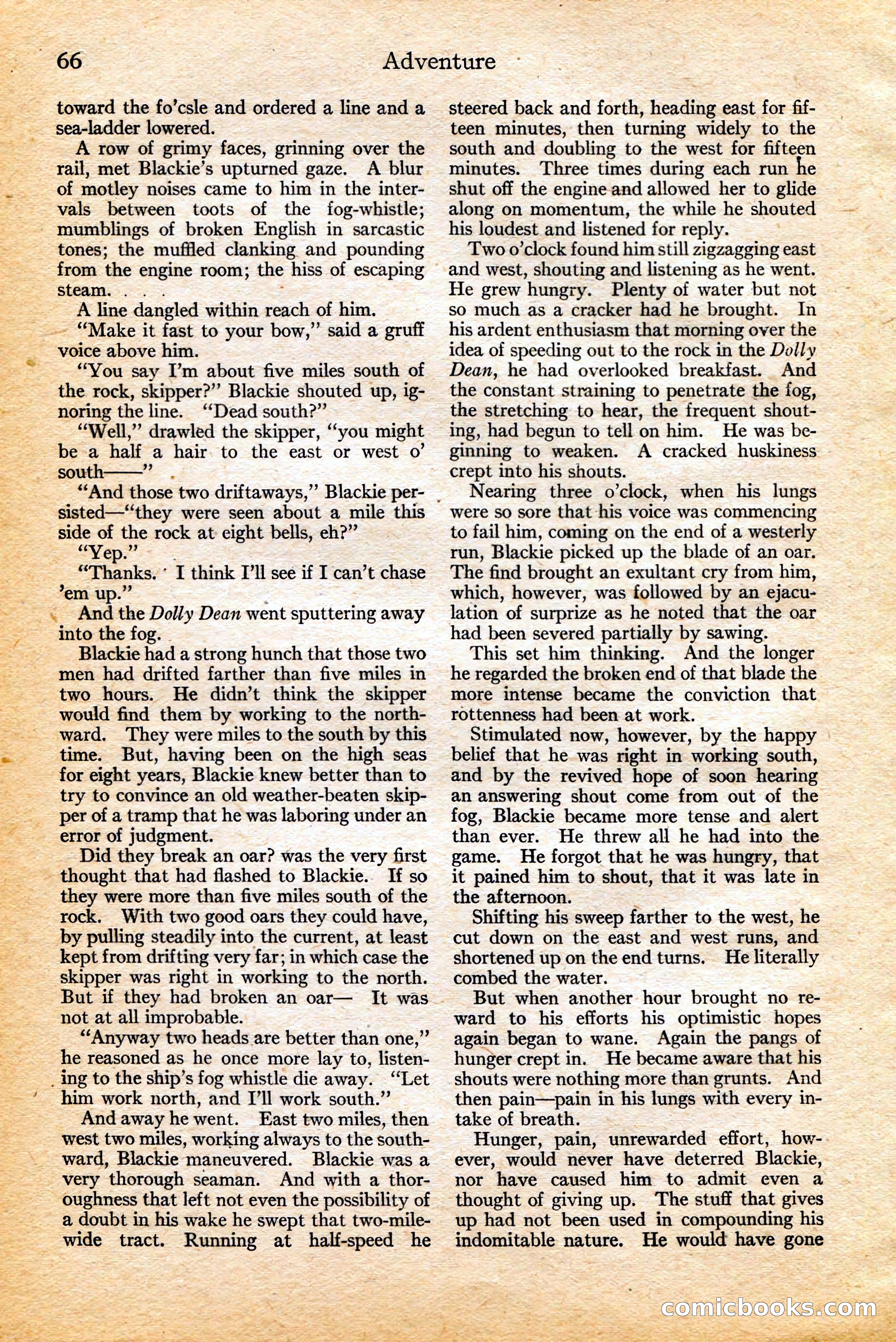
A restored page from Pulp Fiction, 1922. Page through the whole issue in the reader above.
📄 Transcribed text from this page (OCR, searchable)
Machine-transcribed from the original scan — historical spelling and the odd misread are preserved.
thought that had flashed to Blackie. _ ing to the ship’s fog whistle die away. - wide tract. toward the fo’csle and ordered a line and a sea-ladder lowered. A row of grimy faces, grinning over the rail, met Blackie’s upturned gaze. A blur of motley noises came to him in the inter- vals between toots of the fog-whistle; - mumblings of broken English in sarcastic tones; the muffled clanking and pounding from the engine room; the hiss of escaping steam. .. A line dangled within reach of him. ~ “Make it fast to your bow,” said a gruff voice above him. “You say I’m about five miles south of the rock, skipper?” Blackie shouted up, ig- noring the line. ‘Dead south?” “Well,”’ drawled the skipper, “you might be a half a hair to the east or west 0’ south——” “And those two driftaways,”’ Blackie per- | sisted—“they were seen about a mile this side of the rock at eight bells, eh?” é 'Y ep. ) “Thanks. ’em up.” . And the Dolly Dean went sputtering away into the fog. - Blackie had a strong hunch that those two men had drifted farther than five miles in two hours. He didn’t think the skipper would find them by working to the north- ward. They were miles to the south by this time. But, having been on the high seas for eight years, Blackie knew better than to try to convince an old weather-beaten skip- per of a tramp that he was laboring under an error of judgment. Did they break an oar? was the very first If so they were more than five miles south of the - I think I’ll see if I can’t chase — rock. With two good oars they could have, by pulling steadily into the current, at least kept from drifting very far; in which case the skipper was right in working to the north. But if they had broken an oar— not at all improbable. “Anyway two heads are better than one,” he reasoned as he once more lay to, listen- “Let him work north, and I'll work south.” And away he went. East two miles, then west two miles, working always to the south- ward, Blackie maneuvered. Blackie was a very ‘thorough seaman. And with a thor- oughness that left not even the possibility of a doubt in his wake he swept that two-mile- Running at half-speed he It was . -— 66 | Adventure steered back and forth, heading east for fif- teen minutes, then turning widely to the south and doubling to the west for fifteen minutes. Three times during each run he shut off the engine and allowed her to glide along on momentum, the while he shouted his loudest and listened for reply. Two o’clock found him still zigzagging east and west, shouting and listening as he went. He grew hungry. Plenty of water but not so much as a cracker had he brought. In his ardent enthusiasm that morning over the idea of speeding out to the rock in the Dolly Dean, he had overlooked breakfast. And the constant straining to penetrate the fog, the stretching to hear, the frequent shout- ing, had begun to tell on him. He was be- ginning to weaken. A cracked huskiness crept into his shouts. Nearing three o’clock, when his lungs were so sore that his voice was commencing to fail him, coming on the end of a westerly run, Blackie picked up the blade of an oar. The find brought an exultant cry from him, which, however, was followed by an ejacu- lation of surprize as he noted that the oar had been severed partially by sawing. This set him thinking. And the longer he regarded the broken end of that blade the more intense became the conviction that rottenness had been at work. Stimulated now, however, by the happy belief that he was right in working south, and by the revived hope of soon hearing an answering shout come from out of the fog, Blackie became more tense and alert than ever. He threw all he had into the game. He forgot that he was hungry, that it pained him to shout, that it was late in the afternoon. z Shifting his sweep farther to the west, he cut down on the east and west runs, and shortened up on the end turns. He literally combed the water. But when another hour brought no re- ward to his efforts his optimistic hopes again began to wane. Again the pangs of hunger crept in. He became aware that his shouts were nothing more than grunts. And then pain—pain in his lungs with every in- take of breath. Hunger, pain, unrewarded effort, how-. ever, would never have deterred Blackie, nor “have caused him to admit even a thought of giving up. The stuff that gives up had not been used in compounding his indomitable nature. He would have gone Comircbooks.ico