
Pulp Fiction, 1922 · page 53 of 196
Adventure, February 20, 1922 — page 53: what you’re looking at
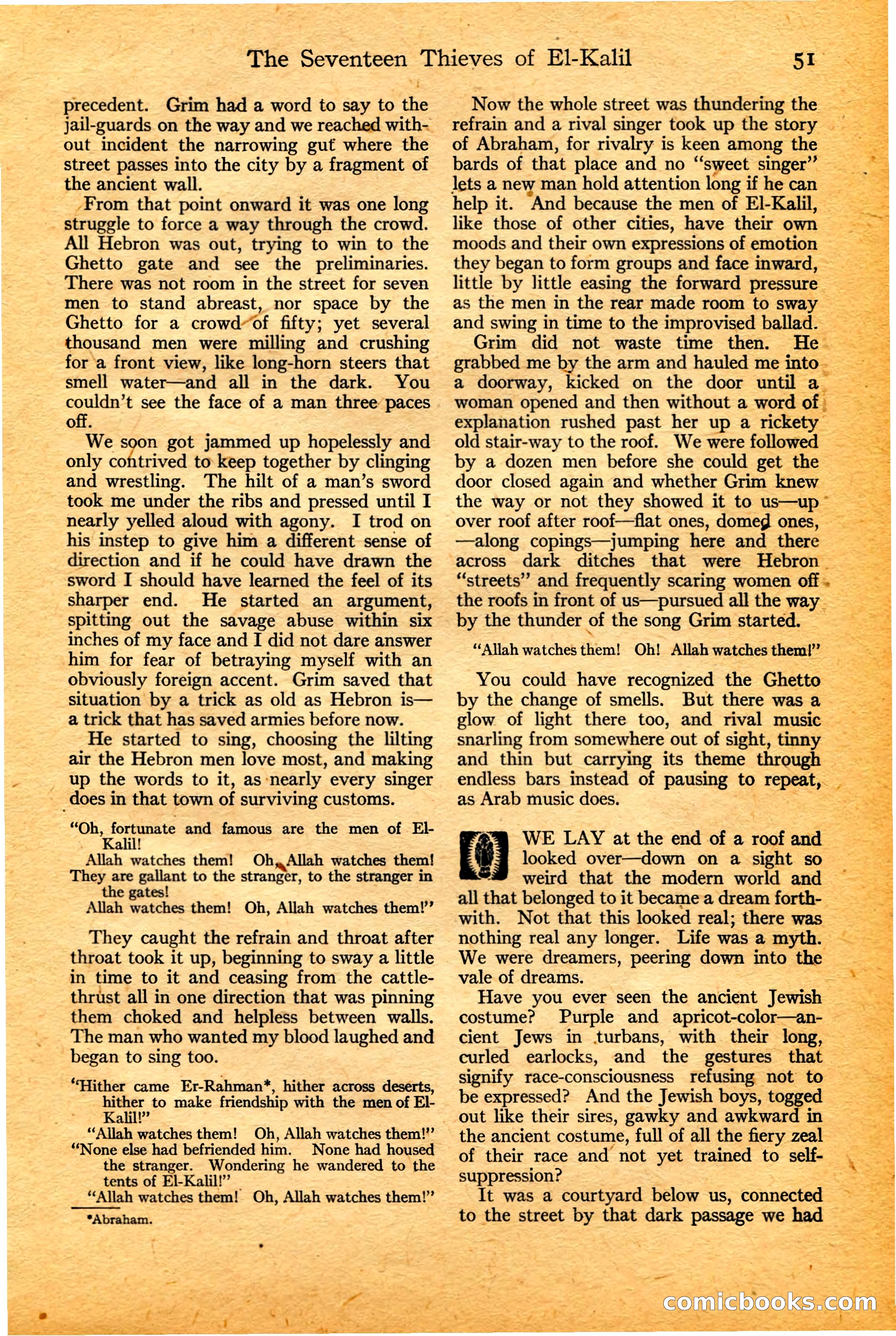
A restored page from Pulp Fiction, 1922. Page through the whole issue in the reader above.
📄 Transcribed text from this page (OCR, searchable)
Machine-transcribed from the original scan — historical spelling and the odd misread are preserved.
The Seventeen Thieves of El-Kalil 51 precedent. Grim had a word to say to the jail-guards on the way and we reached with- out incident the narrowing gut where the street passes into the city by a fragment of the ancient wall. -From that point onward it was one long struggle to force a way through the crowd. All Hebron was out, trying to win to the Ghetto gate and see the preliminaries. There was not room in the street for seven men to stand abreast, nor space by the Ghetto for a crowd”of fifty; yet several thousand men were milling and crushing for a front view, like long-horn steers that smell water—and all in the dark. You couldn’t see the face of a man three paces ar fs ie got jammed up hopelessly and ante cohtrived to keep together by clinging and wrestling. The hilt of a man’s sword took me under the ribs and pressed until I nearly yelled aloud with agony. I trod on his instep to give him a different sense of direction and if he could have drawn the sword I should have learned the feel of its sharper end. He started an argument, spitting out the savage abuse within six inches of my face and I did not dare answer him for fear of betraying myself with an obviously foreign accent. Grim saved that situation by a trick as old as Hebron is— a trick that has saved armies before now. He started to sing, choosing the lilting air the Hebron men love most, and making up the words to it, as nearly every singer does in that town of surviving customs. “Oh, _fortunate and famous are the men of El- alil! Allah watches them! Oh, Allah watches them! They are gallant to the stranger, to the stranger in the gates! Allah watches them! Oh, Allah watches them!’’ They caught the refrain and throat after throat took it up, beginning to sway a little in time to it and ceasing from the cattle- thrust all in one direction that was pinning them choked and helpless between walls. The man who wanted my blood laughed and began to sing too. “Hither came Er-Rahman*, hither across deserts, ee to make friendship with the men of El Ka 7 “Allah watches them! Oh, Allah watches them!’’ “None else had befriended him. None had housed the stranger. Wondering he wandered to the tents of El-Kalil!’”’ “Allah watches them! Oh, Allah watches them!” *Abraham. _ out like their sires, gawky and awkward in Now the whole street was thundering the refrain and a rival singer took up the story | : ae of Abraham, for rivalry is keen among the bards of that place and no “sweet singer” lets a new man hold attention long if he can help it. “And because the men of El-Kalil, like those of other cities, have their own | moods and their own expressions of emotion — they began to form groups and face inward, — little by little easing the forward pressure Soa as the men in the rear made room to sway > and swing in time to the improvised ballad. Grim did not waste time then. He | grabbed me by the arm and hauled me into_ ee a doorway, kicked on the door until a woman opened and then without a word of. explanation rushed past her up a rickety old stair-way to the roof. We were followed by a dozen men before she could get the door closed again and whether Grim knew the way or not they showed it to us—up~ over roof after roof—flat ones, domeg ones, — —along copings—jumping here and there across dark ditches that were Hebron — “streets” and frequently scaring women off. the roofs in front of us—pursued all the way. by the thunder of the song Grim started. “Allah watches hem! Oh! Allah watches them!” You could have recognized the Ghetto by the change of smells. But there was a = glow of light there too, and rival music snarling from somewhere out of sight, tinny — and thin but carrying its theme eh endless bars instead of pausing to repeat, as Arab music does. WE LAY atthe end of aroofand © [¢} looked over—down on a sight so 2. weird that the modern world and = all that belonged to it became a dream forth- with. Not that this looked real; there was _ a nothing real any longer. Life was a myth. We were dreamers, peering down into the ae vale of dreams. Have you ever seen the ancient Jewish | costume? Purple and apricot-color—an- cient Jews in turbans, with their long, curled earlocks, and the gestures that — signify race-consciousness refusing not to be expressed? And the Jewish boys, togged the ancient costume, full of all the fiery zeal of their race and not yet trained to self- suppression? It was a courtyard below us, connected to the street by that dark passage we had ©