
Pulp Fiction, 1922 · page 34 of 196
Adventure, February 20, 1922 — page 34: what you’re looking at
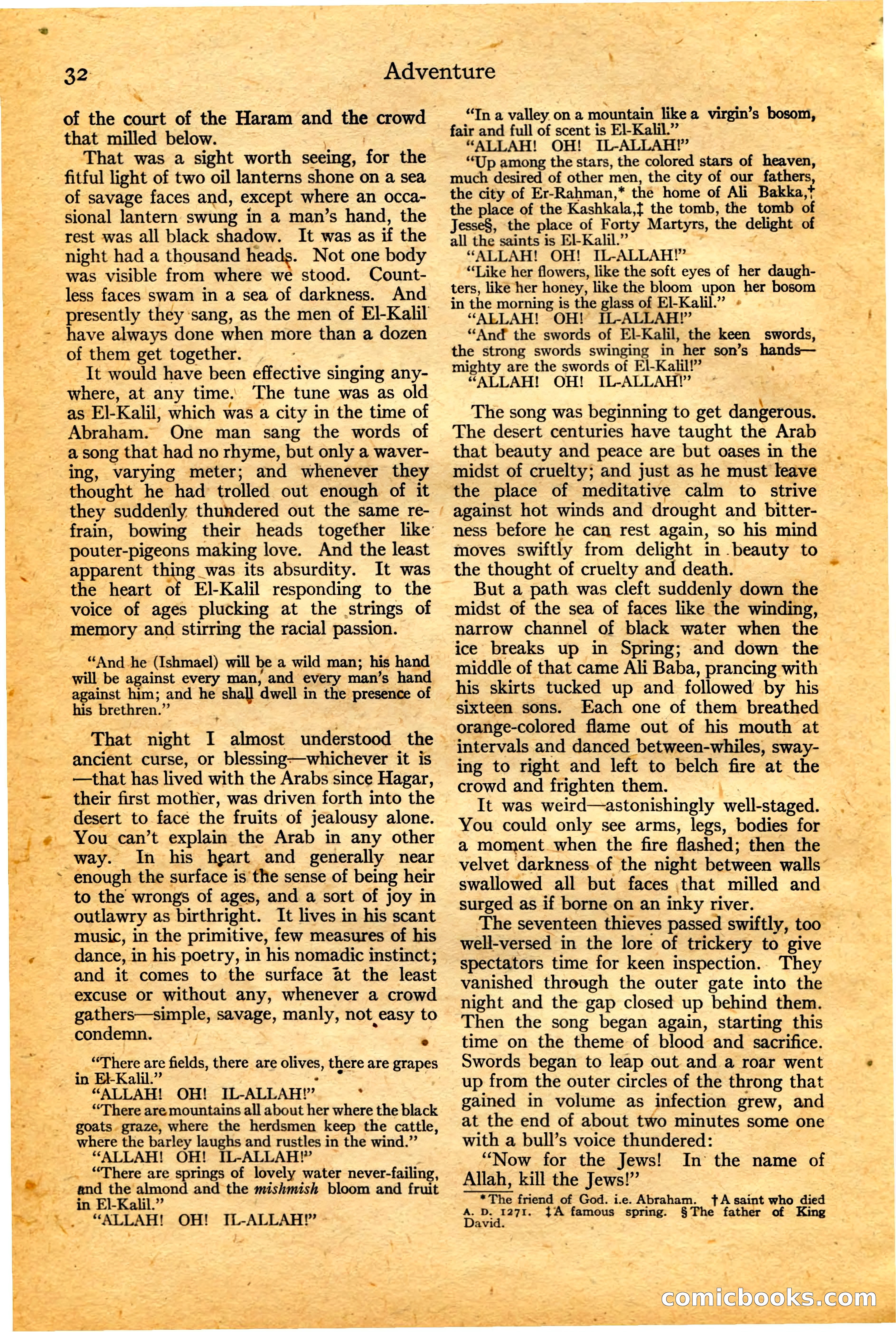
A restored page from Pulp Fiction, 1922. Page through the whole issue in the reader above.
📄 Transcribed text from this page (OCR, searchable)
Machine-transcribed from the original scan — historical spelling and the odd misread are preserved.
a . ~ i 32 Adventure % of the court of the Haram and the crowd “In a valley on a mountain like a virgin’s bosom, that milled below fair and full of scent is El-Kalil. : “ALLAH! OH! IL-ALLAH!” That was a sight worth seeing, for the fitful light of two oil lanterns shone on a sea of savage faces and, except where an occa- sional lantern swung in a man’s hand, the rest was all black shadow. It was as if the night had a thousand hea Not one body was visible from where we stood. Count- less faces swam in a sea of darkness. And presently they ‘sang, as the men of El-Kalil have always done when more than a dozen of them get together. It would have been effective singing any- where, at any time. The tune was as old as El-Kalil, which was a city in the time of Abraham. One man sang the words of a song that had no rhyme, but only a waver- ing, varying meter; and whenever they thought he had trolled out enough of it they suddenly thundered out the same re- / - frain, bowing their heads together like pouter-pigeons making love. And the least apparent thing was its absurdity. It was the heart of El-Kalil responding to the voice of ages plucking at the strings of memory and stirring the racial passion. 1 es ™ 4 : . ‘ ase J % ye a axe “a E70 pea F + J - . - . eS) - a, s 5 a | e : . In “And_-he (Ishmael) will be a wild man; his hand will be against every man, and every man’s hand against him; and he shall dwell in the presence of his brethren.” That night I almost understood the > ancient curse, or blessing—whichever it is —that has lived with the Arabs since Hagar, their first mother, was driven forth into the desert to face the fruits of jealousy alone. You can’t explain the Arab in any other way. In his heart and generally near enough the surface is’ the sense of being heir to the wrongs of ages, and a sort of joy in outlawry as birthright. It lives in his scant music, in the primitive, few measures of his dance, in his poetry, in his nomadic instinct; and it comes to the surface at the least excuse or without any, whenever a crowd gathers—simple, savage, manly, not easy to condemn. : “There are fields, there are olives, there are grapes in E}-Kalil.” : | “ALLAH! OH! IL-ALLAH?!’ : PS . Sole ° pa ad ie ii i ” } Ps - x — en" “There are mountains all about her where the black goats. graze, where the herdsmen keep the cattle, where the barley laughs and rustles in the wind.” “ALLAH! OH! IL-ALLAH!” . “There are springs of lovely water never-failing, and the almond and the mishmish bloom and fruit in E]-Kalil.” OH! IL-ALLAH!” - Cd sixteen sons. 4 A. = +. - Ot ae — ~ 2 ae “Up among the stars, the colored stars of heaven, much desired of other men, the city of our fathers, - the city of Er-Rahman,* the home of Ali Bakka,* - the place of the Kashkala,} the tomb, the tomb of Jesse§, the place of Forty Martyrs, the delight of all the saints is El-Kalil.” “ALLAH! OH! IL-ALLAH!” “Tike her flowers, like the soft eyes of her daugh- ters, like her honey, like the bloom upon her bosom in the morning is the glass of El-Kalil.” + “ALLAH! OH! IL-ALLAH!” “And the swords of El-Kalil, the keen swords, the strong swords swinging in her son’s hands— mighty are the swords of El-Kalil!” , “ALLAH! OH! IL-ALLAH!” ~ ; The song was beginning to get dangerous. The desert centuries have taught the Arab that beauty and peace are but oases in the midst of cruelty; and just as he must leave the place of meditative calm to strive against hot winds and drought and bitter- ness before he can rest again, so his mind moves swiftly from delight in beauty to the thought of cruelty and death, But a path was cleft suddenly down the midst of the sea of faces like the winding, narrow channel of black water when the ice breaks up in Spring; and down the > middle of that came Ali Baba, prancing with his skirts tucked up and followed by his Each one of them breathed orange-colored flame out of his mouth at intervals and danced between-whiles, sway- ing to right and left to belch fire at the crowd and frighten them. | It was weird—astonishingly You could only see arms, legs, bodies for a moment. when the fire flashed; then the velvet darkness. of the night between walls” swallowed all but faces that milled and surged as if borne on an inky river. : The seventeen thieves passed swiftly, too well-versed in the lore of trickery to give spectators time for keen inspection.. They vanished through the outer gate into the night and the gap closed up behind them. Then the song began again, starting this time on the theme of blood and sacrifice. Swords began to leap out and a roar went up from the outer circles of the throng that gained in volume as infection grew, and at the end of about two minutes some one with a bull’s voice thundered: ‘“‘Now for the Jews! In the name of Allah, kill the Jews!” *The friend of God. i.e. Abraham. fA saint who gic A. D. 1271. YA famous spring. § The father of David. ; chook (E(0) well-staged. *