
Pulp Fiction, 1922 · page 191 of 196
Adventure, February 20, 1922 — page 191: what you’re looking at
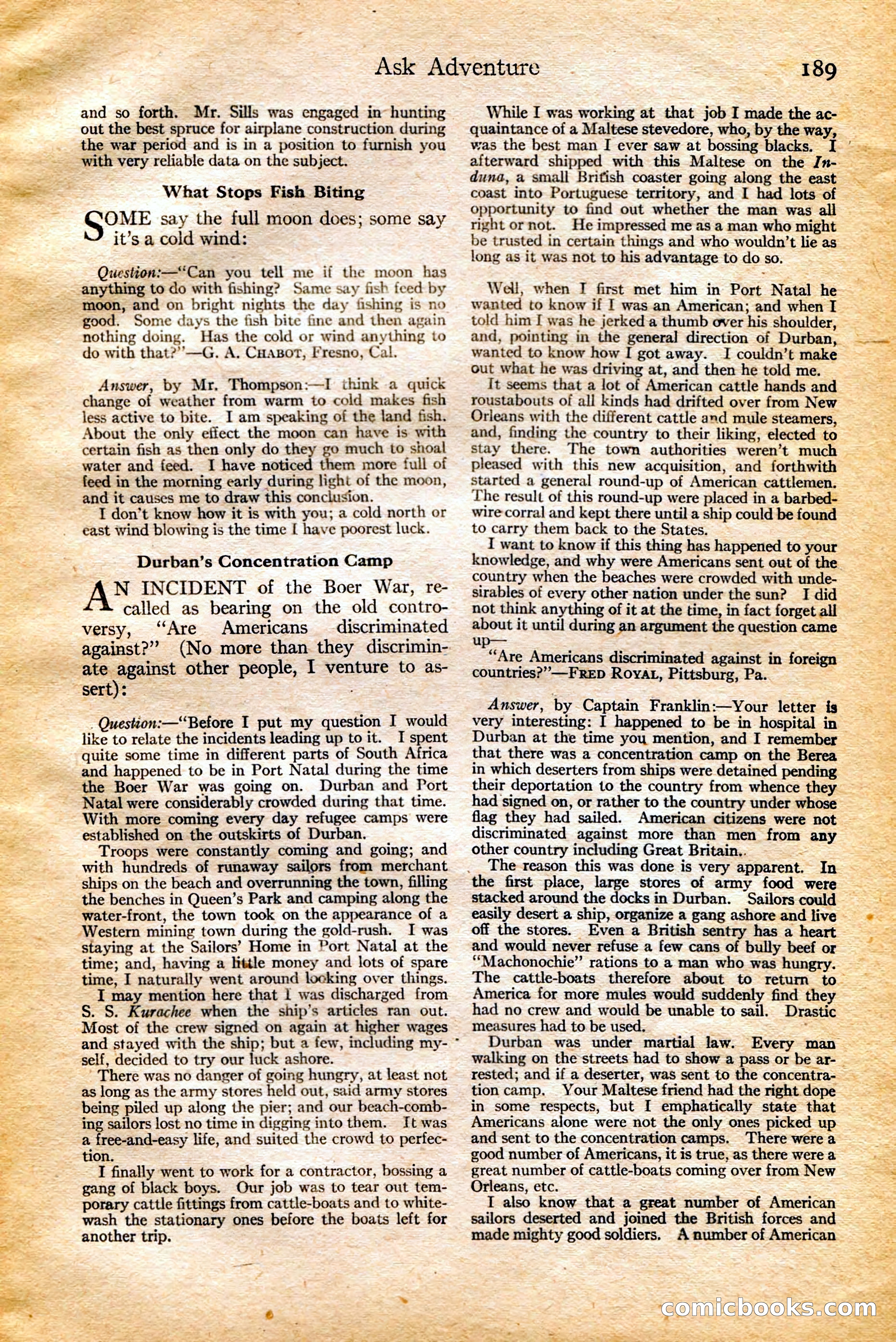
A restored page from Pulp Fiction, 1922. Page through the whole issue in the reader above.
📄 Transcribed text from this page (OCR, searchable)
Machine-transcribed from the original scan — historical spelling and the odd misread are preserved.
and so forth. Mr. Sills was engaged in hunting out the best spruce for airplane construction during the war period and is in a position to furnish you o> - with very reliable data on the subject. me = a -. ate against other people, I venture to as- se ae “* , ) ° ‘ a » 4» aye, the a ._~__ = > a = wer What Stops Fish Biting SOME say the full moon does; some say it’s a cold wind: Question: —“Can you tell me if the moon has anything to do with fishing? Same say fish feed by _. moon, and on bright nights the day fishing is no good. Some days the fish bite fine and then again nothing doing. Has the cold or wind anything to do with that?’’-—G. A. Cuasort, Fresno, Cal. Answer, by Mr, Thompson:—I think a quick change of weather from warm to cold makes fish less active to bite. I am speaking of the land fish. About the only effect the moon can have is with certain fish as then only do they go much to shoal water and feed. I have noticed them more full of feed in the morning early during light of the moon, and it causes me to draw this conclusion. I don’t know how it is with you; a cold north or east wind blowing is the time [ have poorest luck. . Durban’s Concentration Camp N INCIDENT of the Boer War, re- called as bearing on the old contro- versy, “Are Americans _ discriminated against?” (No more than they discrimin- “sert): . Question:—“Before I put my question I would like to relate the incidents leading up to it. I spent quite some time in different parts of South Africa and happened to be in Port Natal during the time the Boer War was going on. Durban and Port Natal were considerably crowded during that time. With more coming every day refugee camps were established on the outskirts of Durban. _ Troops were constantly coming and going; and with hundreds of runaway sailors from merchant ships on the beach and overrunning the town, filling the benches in Queen’s Park and camping along the water-front, the town took on the appearance of a Western mining town during the gold-rush. I was staying at the Sailors’ Home in Port Natal at the time; and, having a little money and lots of spare time, I naturally went around locking over things. I may mention here that I was discharged from S. S. Kurachee when the ship’s articles ran out. ‘Most of the crew signed on again at higher wages and stayed with the ship; but a few, including my- * self, decided to try our luck ashore. There was no danger of going hungry, at least not as long as the army stores held out, said army stores being piled up along the pier; and our beach-comb- ing sailors lost no time in digging into them. It was a free-and-easy life, and suited the crowd to perfec- tion. I finally went to work for a contractor, bossing a gang of black boys. Our job was to tear out tem- porary cattle fittings from cattle-boats and to white- wash the stationary ones before the boats left for another trip. | Ask Adventure the first place, large stores of army food were —> _ 189 i While I was working at that job I made theac- quaintance of a Maltese stevedore, who, by the way, = was the best man I ever saw at bossing blacks. I ~~ afterward shipped with this Maltese on the Jn- duna, a small British coaster going along the east _ coast into Portuguese territory, and I had lots of = opportunity to find out whether the man was all right ornot. He impressed me as a man who might a be trusted in certain things and who wouldn’t lie as long as it was not to his advantage to do so. WF ‘ ; Vi : : be es »! ‘A 4 “ee, Abe i vat ye Well, when I first met him in Port Natal he wanted to know if I was an American; and when I S told him I was he jerked.a thumb over his shoulder, and, pointing in the general direction of Durban, ~~ wanted to know how I got away. I couldn’t make out what he was driving at, and then he told me. — ~ It seems that a lot of American cattle hands and roustabouts of all kinds had drifted over from New 7 Orleans with the different cattle and mule steamers, and, finding the country to their liking, elected to stay there. The town authorities weren’t much pleased with this new acquisition, and forthwith started a general round-up of American cattlemen. The result of this round-up were placed in a barbed- wire corral and kept there until a ship could be found to carry them back to the States. o I want to know if this thing has happened to your knowledge, and why were Americans sent out of the country when the beaches were crowded with unde- was sirables of every other nation under the sun? I did = not think anything of it at the time, in fact forget all 9 about it until during an argument the question came es up— “Are Americans discriminated against in foreign countries?”’—FRED RoyAL, Pittsburg, Pa. Answer, by. Captain Franklin:—Your letter ig very interesting: I happened to be in hospital in = Durban at the time you mention, and I remember __ that there was a concentration camp on the Berea in which deserters from ships were detained pending —— their deportation to the country from whence they had signed on, or rather to the country under whose Ss flag they had sailed. American citizens were not —~> discriminated against more than men from any other country including Great Britain.. . The reason this was done is very apparent. In — stacked around the docks in Durban. Sailorscould easily desert a ship, organize a gang ashore and live © x off the stores. Even a British sentry has a heart — and would never refuse a few cans of bully beef or ‘““Machonochie”’ rations to a man who was hungry. ~_— The cattle-boats therefore about to return to — America for more mules would suddenly find they aot had no crew and would be unable to sail. Drastic 5 os measures had to be used, | | oS Durban was under martial law. Every man - — walking on the streets had to show a pass or be ar- rested; and if a deserter, was sent to the concentra- tion camp. Your Maltese friend had the right dope __ in some respects, but I emphatically state that . Americans alone were not the only ones picked up a and sent to the concentration camps. There were a good number of Americans, it is true, as there were a great number of cattle-boats coming over from New = : Orleans, etc. = = I also know that a great number of American = sailors deserted and joined the British forces and =e made mighty good soldiers. AmumberofAmerican : COmiGvook: