
Pulp Fiction, 1922 · page 182 of 196
Adventure, February 20, 1922 — page 182: what you’re looking at
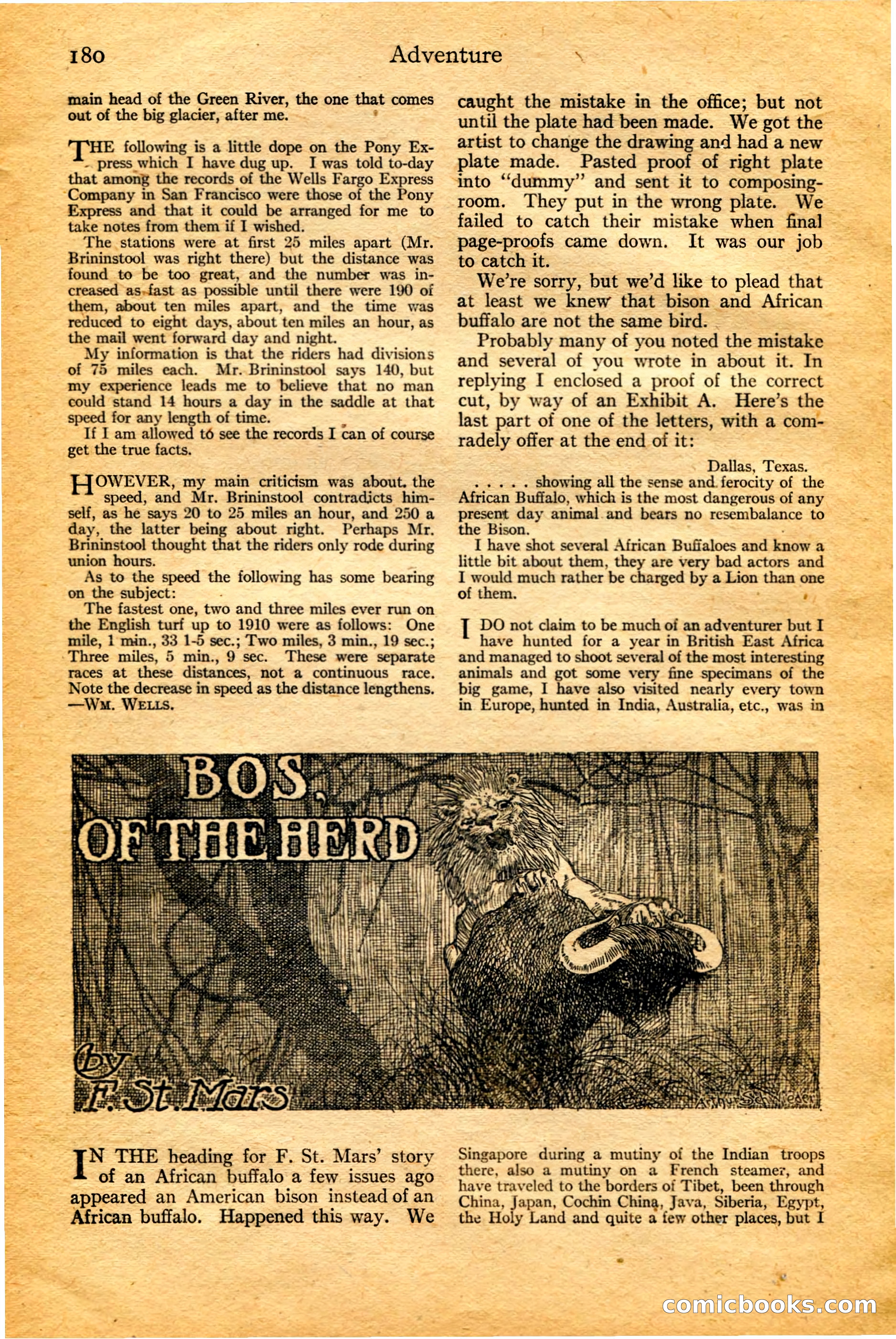
A restored page from Pulp Fiction, 1922. Page through the whole issue in the reader above.
📄 Transcribed text from this page (OCR, searchable)
Machine-transcribed from the original scan — historical spelling and the odd misread are preserved.
NT PU ane a <a 3 os re -_— — eae - - - »= ~~" - & o> - =- ate r, : Pm , * " Sp -* _ ae “ yy wis id Hh} t iN) Ue NE Mt \ ) f { byv { = I we =n = “ert. OT 4 ‘ rer ney Ve Pt me | 7 yp THE heading for F. St. Mars’ story 180 main head of the Green River, the one out of the big glacier, after me. "THE following is a little dope on the Pony Ex- - press which I have dug up. I was told to-day that among the records of the Wells Fargo Express ‘Company in San Francisco were those of the Pony Express and that it could be arranged for me to take notes from them if I wished. The stations were at first 25 miles apart (Mr. Brininstool was right there) but the distance was found to be too great, and the number was in- creased as-fast as possible until there were 190 of them, about ten miles apart, and the time was reduced to eight days, about ten miles an hour, as the mail went forward day and night. My information is that the riders had divisions of 75 miles each. Mr. Brininstool says 140, but my experience leads me to believe that no man could stand 14 hours a day in the saddle at that speed for any length of time. $ If I am allowed t6 see the records I can of course get the true facts. HOWEVER, my main criticism was about. the speed, and Mr. Brininstool contradicts him- self, as he says 20 to 25 miles an hour, and 250 a day, the latter being about right. Perhaps Mr. Bnininstool thought that the riders only rode during union hours. As to the speed the following has some bearing on the subject: The fastest one, two and three miles ever run on the English turf up to 1910 were as follows: One mile, 1 min., 33 1-5 sec.; Two miles, 3 min., 19 sec.; -Three miles, 5 min., 9 sec. These were separate races at these distances, not a continuous race. Note the decrease in speed as the distance lengthens. —Wm. WELLS. that comes ® of an African buffalo a few issues ago appeared an American bison instead of an African buffalo. Happened this way. We Adventure ‘ 4 caught the mistake in the office; but not _ until the plate had been made. We got the artist to change the drawing and had a new | plate made. Pasted proof of right plate ‘into “dummy” and sent it to composing- room. They put in the wrong plate. We failed to catch their mistake when final — page-proofs came down. to catch it. We're sorry, but we'd like to plead that at least we knew that bison and African buffalo are not the same bird. - Probably many of you noted the mistake and several of you wrote in about it. In replying I enclosed a proof of the correct cut, by way of an Exhibit A. Here’s the last part of one of the letters, with a com- radely offer at the end of it: It was our job Dallas, Texas. . +... Showing all the sense and ferocity of the African Buffalo, which is the most dangerous of any present day animal and bears no resembalance to the Bison. I have shot several African Bufialoes and know a little bit about them, they are very bad actors and uae much rather be charged by a Lion than one of them. , ‘ I DO not claim to be much of an adventurer but I have hunted for a year in British East Africa and managed to shoot several of the most interesting animals and got some very fine specimans of the big game, I have also visited nearly every town in Europe, hunted in India, Australia, etc., was in Singapore during a mutiny of the Indian troops there, also a mutiny on a French steamez, and have traveled to the borders of Tibet, been through China, Japan, Cochin China, Java, Siberia, Egypt, the Holy Land and quite a few other places, but I x ~ > ae ne oYoYo)