
Pulp Fiction, 1922 · page 177 of 196
Adventure, February 20, 1922 — page 177: what you’re looking at
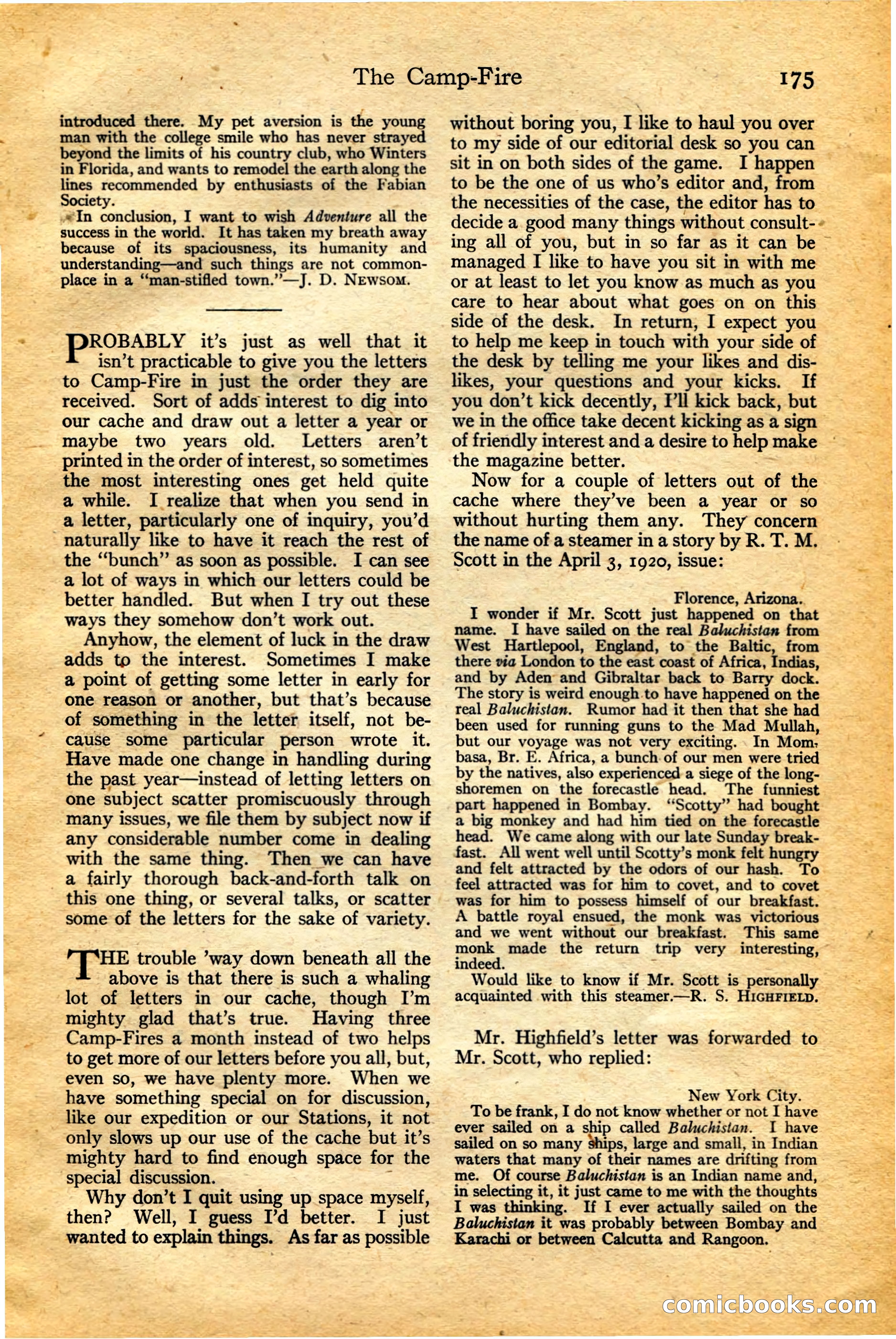
A restored page from Pulp Fiction, 1922. Page through the whole issue in the reader above.
📄 Transcribed text from this page (OCR, searchable)
Machine-transcribed from the original scan — historical spelling and the odd misread are preserved.
aa, The Camp-Fire introduced there. My pet aversion is the young man with the college smile who has never strayed beyond the limits of his country club, who Winters in Florida, and wants to remodel the earth along the lines recommended by enthusiasts of the Fabian Society. “In conclusion, I want to wish Adventure all the success in the world. It has taken my breath away because of its spaciousness, its humanity and understanding—and such things are not common- place in a “man-stifled town.”—J. D. NEwsom. ROBABLY it’s just as well that it isn’t practicable to give you the letters to Camp-Fire in just the order they are received. Sort of adds interest to dig into our cache and draw out a letter a year or maybe two years old. Letters aren’t printed in the order of interest, so sometimes the most interesting ones get held quite a while. I realize that when you send in a letter, particularly one of inquiry, you’d naturally like to have it reach the rest of the “‘bunch” as soon as possible. I can see a lot of ways in which our letters could be better handled. But when I try out these ways they somehow don’t work out. Anyhow, the element of luck in the draw adds to the interest. Sometimes I make a point of getting some letter in early for one reason or another, but that’s because of something in the letter itself, not be- cause some particular person wrote it. Have made one change in handling during the past year—instead of letting letters on one subject scatter promiscuously through many issues, we file them by subject now if any considerable number come in dealing with the same thing. Then we can have a fairly thorough back-and-forth talk on this one thing, or several talks, or scatter some of the letters for the sake of variety. PRE trouble ’way down beneath all the above is that there is such a whaling lot of letters in our cache, though I’m mighty glad that’s true. Having three Camp-Fires a month instead of two helps to get more of our letters before you all, but, even so, we have plenty more. When we have something special on for discussion, _ like our expedition or our Stations, it not only slows up our use of the cache but it’s mighty hard to find enough space for the ‘special discussion. Why don’t I quit using up space myself, then? Well, I guess I’d better. I just wanted to explain things. As far as possible 175 without boring you, I like to haul you over to my side of our editorial desk so you can sit in on both sides of the game. I happen to be the one of us who’s editor and, from the necessities of the case, the editor has to decide a. good many things without consult- ing all of you, but in so far as it can be ~ managed I like to have you sit in with me or at least to let you know as much as you care to hear about what goes on on this side of the desk. In return, I expect you to help me keep in touch with your side of the desk by telling me your likes and dis- likes, your questions and your kicks. If you don’t kick decently, Pll kick back, but we in the office take decent kicking as a sign of friendly interest and a desire to col make the magazine better. Now for a couple of letters out of the cache where they’ve been a year or so without hurting them any. They concern the name of a steamer in a story by R. T. M. Scott in the April 3, 1920, issue: Florence, Arizona: I wonder if Mr. Scott just happened on that name. I have sailed on the real Baluchistan from West Hartlepool, England, to the Baltic, from there via London to the east coast of Africa, Indias, and by Aden and Gibraltar back to Barry dock. The story is weird enough to have happened on the real Baluchistan. Rumor had it then that she had been used for running guns to the Mad Mullah, but our voyage was not very exciting. In Mom: basa, Br. E. Africa, a bunch. of our men were tried by the natives, also experienced a siege of the long- shoremen on the forecastle head. The funniest part happened in Bombay. “Scotty” had bought a big monkey and had him tied on the forecastle head. We came along with our late Sunday break- fast. All went well until Scotty’s monk felt hungry and felt attracted by the odors of our hash. To. feel attracted was for him to covet, and to covet — was for him to possess himself of our breakfast. A battle royal ensued, the monk was victorious and we went without our breakfast. This same monk made the return trip very interesting, indeed. Would like to know if Mr. Scott is personally acquainted with this steamer.—R. S. HIGHFIELD. Mr. Highfield’s letter was forwarded to Mr. Scott, who replied: New York City. To be frank, I do not know whether or not I have ever sailed on a ship called Baluchistan. I have sailed on so many ships, large and small, in Indian waters that many of their names are drifting from - me. Of course Baluchistan is an Indian name and, in selecting it, it just came to me with the thoughts I was . If I ever actually sailed on the Baluchistan it was probably betweba Rombay aud Karachi or between Calcutta and Rangoo Gomicboo % tein et dele