
Pulp Fiction, 1922 · page 141 of 196
Adventure, February 20, 1922 — page 141: what you’re looking at
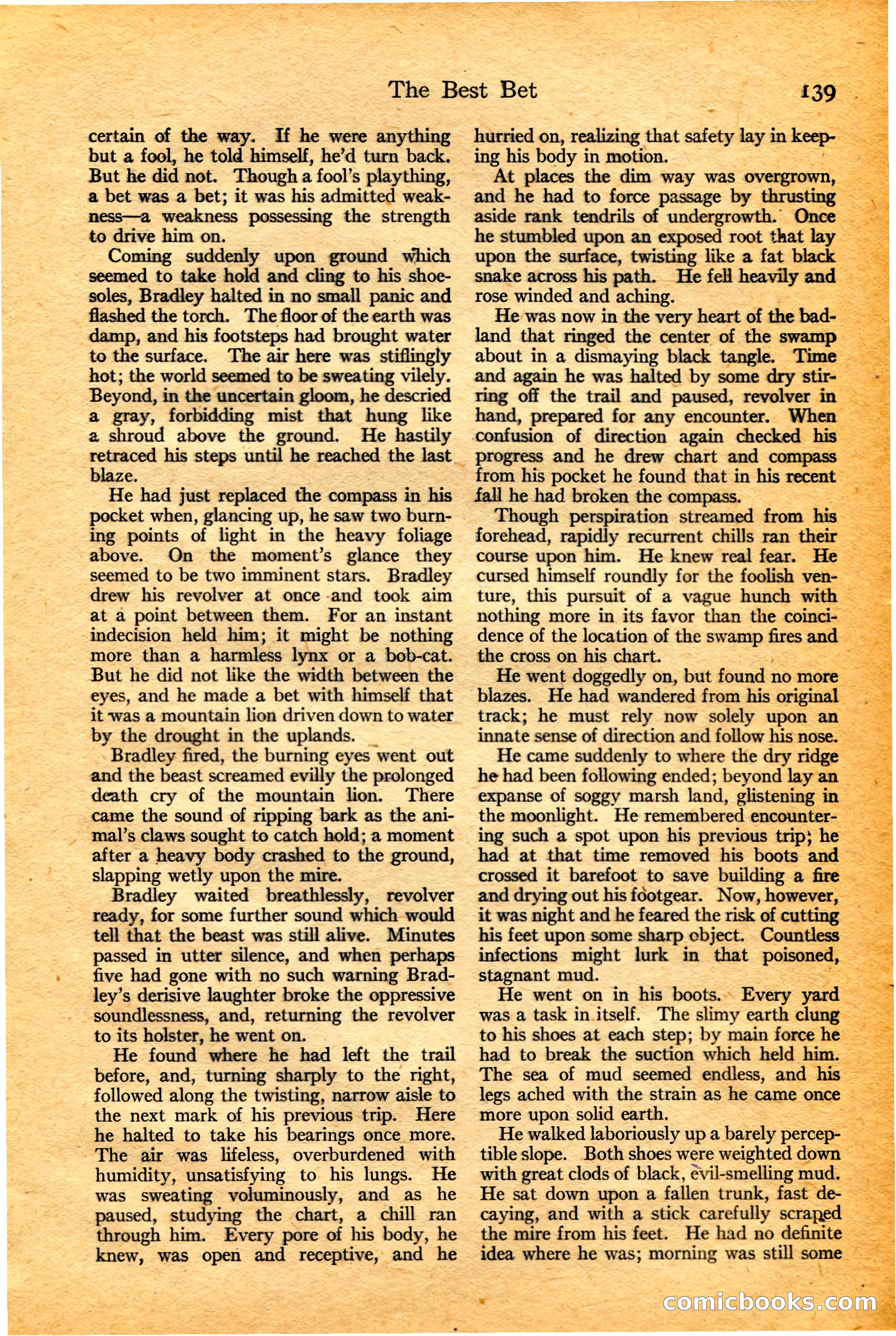
A restored page from Pulp Fiction, 1922. Page through the whole issue in the reader above.
📄 Transcribed text from this page (OCR, searchable)
Machine-transcribed from the original scan — historical spelling and the odd misread are preserved.
The Best Bet certain of the way. If he were anything but a fool, he told himself, he’d turn back. But he did not. Though a fool’s plaything, a bet was a bet; it was his admitted weak- ness—a weakness possessing the strength to drive him on. Coming suddenly upon ground which seemed to take hold and cling to his shoe- soles, Bradley halted in no small panic and flashed the torch. The floor of the earth was damp, and his footsteps had brought water to the surface. The air here was stiflingly hot; the world seemed to be sweating vilely. Beyond, in the uncertain gloom, he descried a gray, forbidding mist that hung like 2 shroud above the ground. He hastily retraced his steps until he reached the last blaze. He had just replaced the compass in his pocket when, glancing up, he saw two burn- ing points of light in the heavy foliage above. On the moment’s glance they seemed to be two imminent stars. Bradley drew his revolver at once and took aim at a point between them. For an instant indecision held him; it might be nothing more than a harmless lynx or a bob-cat. But he did not like the width between the eyes, and he made a bet with himself that it was a mountain lion driven down to water by the drought in the uplands. Bradley fired, the burning eyes went out and the beast screamed evilly the prolonged death cry of the mountain lion. There came the sound of ripping bark as the ani- _ mal’s claws sought to catch hold; a moment after a heavy body crashed to the ground, slapping wetly upon the mire. Bradley waited breathlessly, revolver ready, for some further sound which would tell that the beast was still alive. Minutes passed in utter silence, and when perhaps five had gone with no such warning Brad- ley’s derisive laughter broke the oppressive soundlessness, and, returning the revolver to its holster, he went on. He found where he had left the trail before, and, turning sharply to the right, followed along the twisting, narrow aisle to the next mark of his previous trip. Here he halted to take his bearings once more. The air was lifeless, overburdened with humidity, unsatisfying to his lungs. He was sweating voluminously, and as he paused, studying the chart, a chill ran through him. Every pore of his body, he knew, was open and receptive, and he confusion of direction again checked his — hurried on, realizing that safety lay in keep ing his body in motion. = At places the dim way was overgrown, and he had to force passage by thrusting _ aside rank tendrils of undergrowth. Once he stumbled upon an exposed root that lay upon the surface, twisting like a fat black — snake across his path. ite fell heavily wud. ae rose winded and aching. = He was now in the very heart of the bad- Be land that ringed the center of the swamp about in a dismaying black tangle. Time 3 s and again he was halted by some dry stir- ring off the trail and paused, revolver in > hand, prepared for any encounter. When — ' POEs | : ‘© +) ee ry URW Ain Hy id i * J | progress and he drew chart and compass — from his pocket he found that in his recent — fall he had broken the compass. Though perspiration streamed from iia forehead, rapidly recurrent chills ran their course upon him. He knew real fear. He — cursed himself roundly for the foolish ven- — ture, this pursuit of a vague hunch with = =: nothing more in its favor than the coinci- — dence of the location of the swamp fires and the cross on his chart. eo = He went doggedly on, but found no more blazes. He had wandered from his original — track; he must rely now solely upon an = | innate sense of direction and follow his nose. He came suddenly to where the dry ridge _ he had been following ended; beyond lay an — = : expanse of soggy marsh land, glistening in the moonlight. He remembered encounter- ing such a spot upon his previous trip; he = had at that time removed his boots and | crossed it barefoot to save building a fire = = and drying out his footgear. Now, however, pe it was night and he feared the risk of cutting — his feet upon some sharp ebject. Countless _ infections might lurk in ‘that poisoned, = stagnant mud. = He went on in his boots.~ Every ad ae was a task in itself. The slimy earth clung = to his shoes at each step; by main force hess: = = had to break the suction which held him. | The sea of mud seemed endless, and his _ “= legs ached with the strain as he came once — = more upon solid earth. 3 . = He walked laboriously up a barely percep- = = tible slope. Both shoes were weighted down — 2 =~ 5 with great clods of black, évil-smelling mud. He sat down upon a fallen trunk, fast de: = = caying, and with a stick carefully scraped — 7 = . the mire from his feet. He had no definite __ idea where he was; morning was still some ee -: Coe > AS a == . > ae : com EpgoKsicom 4