
Pulp Fiction, 1922 · page 137 of 196
Adventure, February 20, 1922 — page 137: what you’re looking at
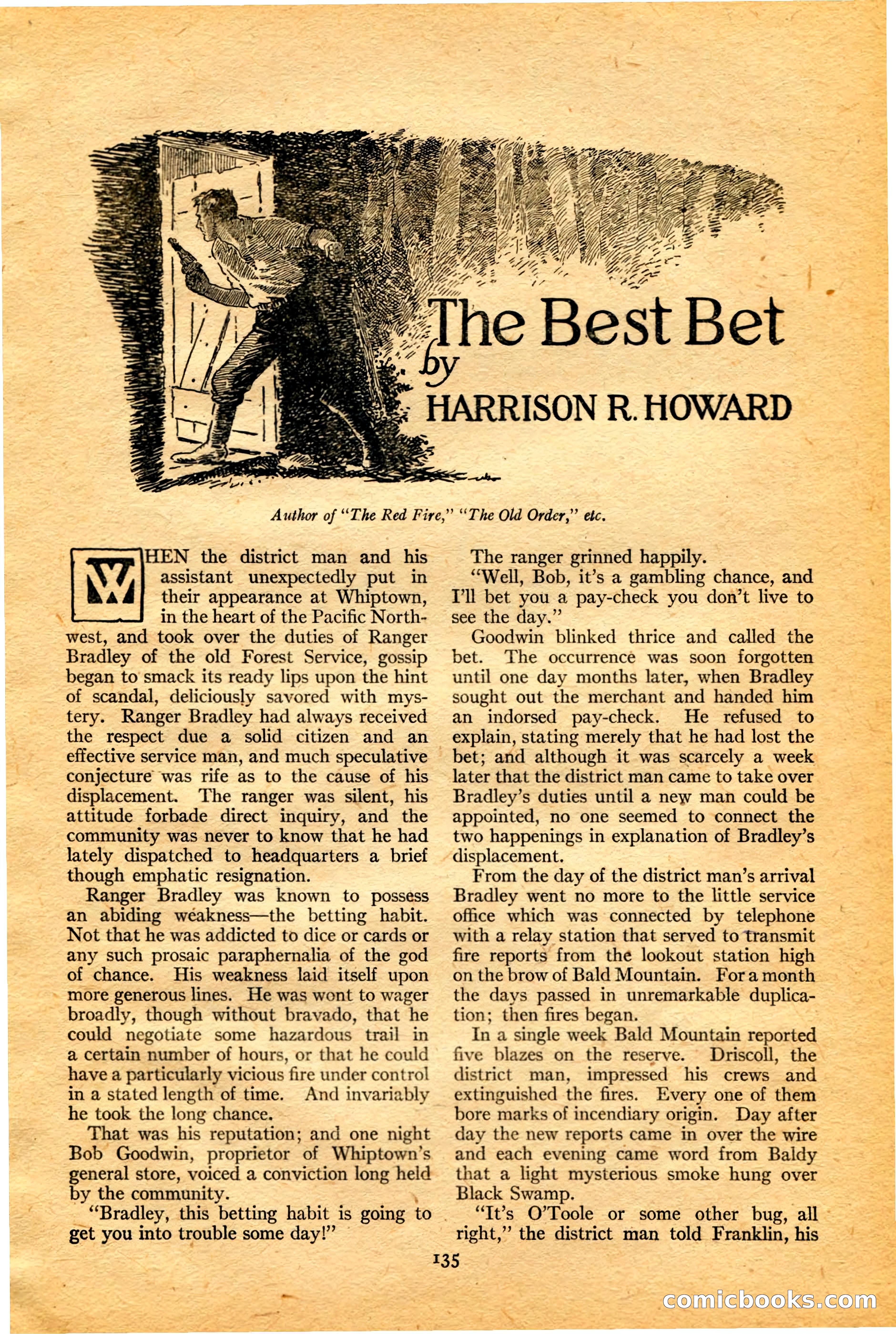
A restored page from Pulp Fiction, 1922. Page through the whole issue in the reader above.
📄 Transcribed text from this page (OCR, searchable)
Machine-transcribed from the original scan — historical spelling and the odd misread are preserved.
x rt , - <—s* = — i f hier YX YY Zz bight a 17 WI tt « HARRISON R. HOWARD \ ° “1. *~ : + t{@ , a | | « of . ~~ ‘* ~~ > ° s . ‘we. to sy > . _- i " a Liat S ‘, - . F ? : $ a = anh = ad oF 4 e . -." = * ° Aal* r - + TS 4 ' - nr” A: ; st Bet Author of “The Red Fire,” “The Old Order,” etc. HEN the district man and his j assistant unexpectedly put in WA A their appearance at Whiptown, : in the heart of the Pacific North- west, and took over the duties of Ranger Bradley of the old Forest Service, gossip began to smack its ready lips upon the hint of scandal, deliciously savored with mys- tery. Ranger Bradley had always received the respect due a solid citizen and an effective service man, and much speculative conjecture was rife as to the cause of his displacement. The ranger was silent, his attitude forbade direct inquiry, and the community was never to know that he had lately dispatched to headquarters a brief though emphatic resignation. Ranger Bradley was known to possess an abiding wéakness—the betting habit. Not that he was addicted to dice or cards or any such prosaic paraphernalia of the god of chance. His weakness laid itself upon ~ more generous lines. He was wont to wager broadly, though without bravado, that he could negotiate some hazardous trail in a certain number of hours, or that he could have a particularly vicious fire under control in a stated length of time. And invariably he took the long chance. That was his reputation; and one night Bob Goodwin, proprietor of Whiptown’s general store, voiced a conviction long held by the community. _ “Bradley, this betting habit is going get you into trouble some day!” to er? The ranger grinned happily. “Well, Bob, it’s a gambling chance, and I'll bet you a pay-check you don’t live to see the day.” Goodwin blinked thrice and called the bet. The occurrence was soon forgotten until one day months later, when Bradley sought out the merchant and handed him an indorsed pay-check. He refused to explain, stating merely that he had lost the bet; and although it was scarcely a week later that the district man came to take over Bradley’s duties until a new man could be appointed, no one seemed to connect the two happenings in explanation of Bradley’s displacement. From the day of the district man’s arrival Bradley went no more to the little service office which was connected by telephone with a relay station that served to transmit fire reports from thé lookout station high on the brow of Bald Mountain. Fora month the days passed in unremarkable duplica- tion; then fires began. In a single week Bald Mountain reported five blazes on the reserve. Driscoll, the district man, impressed his crews and extinguished the fires. Every one of them bore marks of incendiary origin. Day after day the new reports came in over the wire and each evening came word from Baldy that a light mysterious smoke hung over Black Swamp. _ “It’s O’Toole or some other bug, all © right,” the district man told Franklin, his 135 micboo (@) (EO) “S (E(0)