
Pulp Fiction, 1922 · page 122 of 196
Adventure, February 20, 1922 — page 122: what you’re looking at
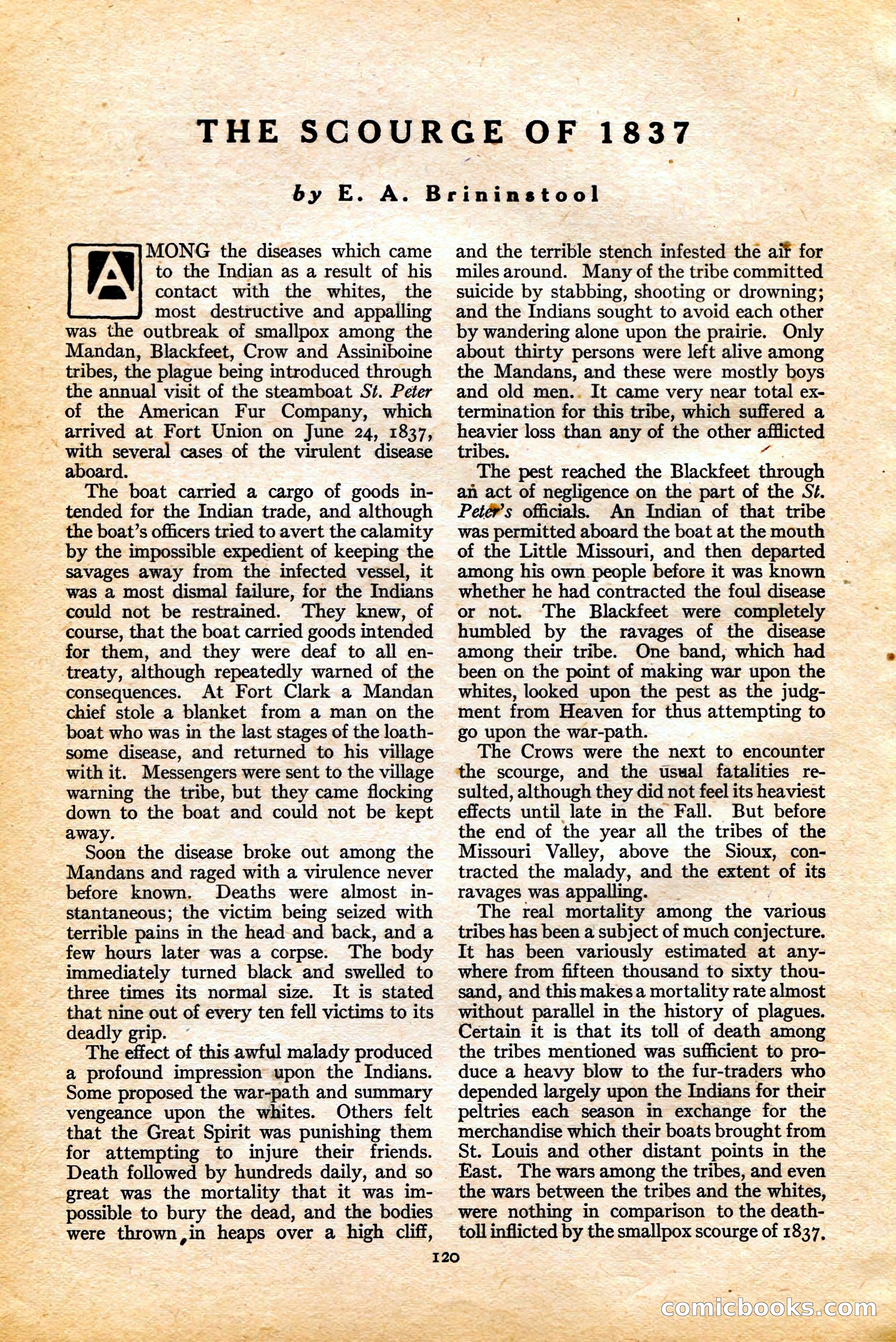
A restored page from Pulp Fiction, 1922. Page through the whole issue in the reader above.
📄 Transcribed text from this page (OCR, searchable)
Machine-transcribed from the original scan — historical spelling and the odd misread are preserved.
THE SCOURGE OF 1837 by E. A. Brininstool MONG the diseases which came to the Indian as a result of his contact with the whites, the most destructive and appalling was the outbreak of smallpox among the Mandan, Blackfeet, Crow and Assiniboine tribes, the plague being introduced through the annual visit of the steamboat St. Peter _ of the American Fur Company, which arrived at Fort Union on June 24, 1837, ‘with several cases of the virulent disease aboard. The boat carried a cargo of goods in- tended for the Indian trade, and although the boat’s officers tried to avert the calamity by the impossible expedient of keeping the savages away from the infected vessel, it was a most dismal failure, for the Indians could not be restrained. They knew, of course, that the boat carried goods intended for them, and they were deaf to all en- treaty, although repeatedly warned of the consequences. At Fort Clark a Mandan chief stole a blanket from a man on the boat who was in the last stages of the loath- some disease, and returned to his village with it. Messengers were sent to the village warning the tribe, but they came flocking down to the boat and could not be kept away. Soon the disease broke out among the Mandans and raged with a virulence never before known. Deaths were almost in- stantaneous; the victim being seized with terrible pains in the head and back, and a few hours later was a corpse. The body immediately turned black and swelled to three times its normal size. It is stated that nine out of every ten fell victims to its deadly grip. The effect of this awful malady produced a profound impression upon the Indians. Some proposed the war-path and summary vengeance upon the whites. Others felt that the Great Spirit was punishing them for attempting to injure their friends. Death followed by hundreds daily, and so _great was the mortality that it was im- possible to bury the dead, and the bodies - were thrown,in heaps over a high cliff, and the terrible stench infested the aif for miles around. Many of the tribe committed suicide by stabbing, shooting or drowning; and the Indians sought to avoid each other by wandering alone upon the prairie. Only about thirty persons were left alive among the Mandans, and these were mostly boys and old men.. It came very near total ex- termination for this tribe, which suffered a heavier loss than any of the other afflicted tribes. The pest reached the Blackfeet through an act of negligence on the part of the Sé. Pet&s officials. An Indian of that tribe was permitted aboard the boat at the mouth of the Little Missouri, and then departed among his own people before it was known whether he had contracted the foul disease or not. The Blackfeet were completely humbled by the ravages of the disease among their tribe. One band, which had been on the point of making war upon the whites, looked upon the pest as the judg- ment from Heaven for thus attempting to go upon the war-path. The Crows were the next to encounter the scourge, and the usual fatalities re- sulted, although they did not feel its heaviest effects until late in the Fall. But before the end of the year all the tribes of the Missouri Valley, above the Sioux, con- tracted the malady, and the extent of its ravages was appa The real mortality among the various tribes has been a subject of much conjecture. It has been variously estimated at any- where from fifteen thousand to sixty thou- sand, and this makes a mortality rate almost without parallel in the history of plagues. Certain it is that its toll of death among the tribes mentioned was sufficient to pro- duce a heavy blow to the fur-traders who depended largely upon the Indians for their peltries each season in exchange for the merchandise which their boats brought from St. Louis and other distant points in the East. The wars among the tribes, and even the wars between the tribes and the whites, were nothing in comparison to the death- toll inflicted by the smallpox scourge of 1837, I20 com () ibooks. co