
Pulp Fiction, 1921 · page 50 of 194
Adventure Magazine Cover — page 50: what you’re looking at
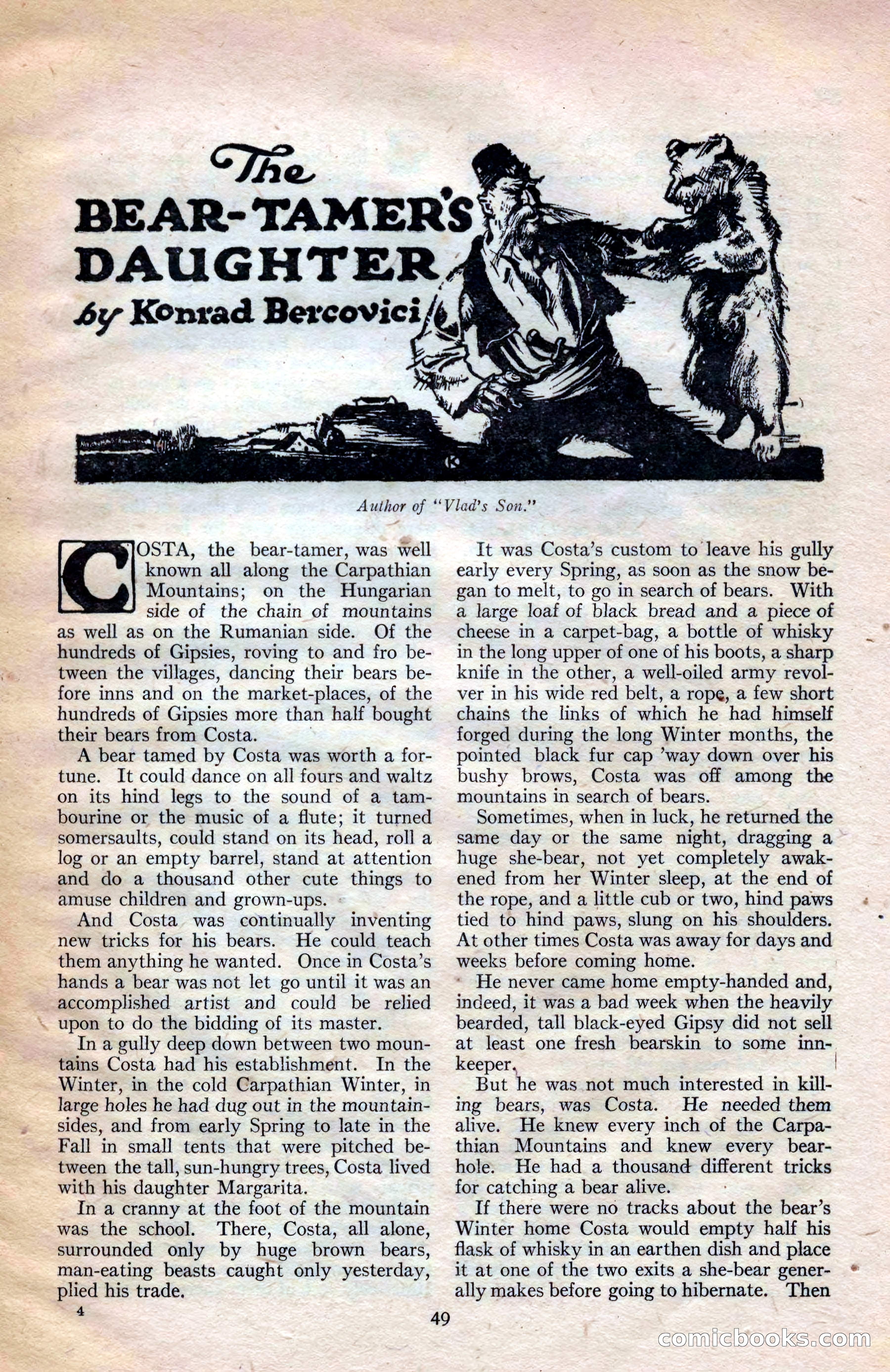
A restored page from Pulp Fiction, 1921. Page through the whole issue in the reader above.
📄 Transcribed text from this page (OCR, searchable)
Machine-transcribed from the original scan — historical spelling and the odd misread are preserved.
The BEAR- TAMERS}; DAUGHTERAN Author of “Viad’s Son.” r mIOSTA, the bear-tamer, was well known all along the Carpathian iS Mountains; on the Hungarian side of the chain of mountains as well as on the Rumanian side. Of the hundreds of Gipsies, roving to and fro be- tween the villages, dancing their bears be- fore inns and on the market-places, of the hundreds of Gipsies more than half bought their bears from Costa. A bear tamed by Costa was worth a for- tune. It could dance on all fours and waltz on its hind legs to the sound of a tam- bourine or the music of a flute; it turned somersaults, could stand on its head, roll a log or an empty barrel, stand at attention and do a thousand other cute things to amuse children and grown-ups. And Costa was continually inventing new tricks for his bears. He could teach them anything he wanted. Once in Costa’s hands a bear was not let go until it was an accomplished artist and could be relied \ upon to do the bidding of its master. In a gully deep down between two moun- tains Costa had his establishment. In the Winter, in the cold Carpathian Winter, in large holes he had dug out in the mountain- sides, and from early Spring to late in the Fall in small tents that were pitched be- tween the tall, sun-hungry trees, Costa lived with his daughter Margarita. In a cranny at the foot of the mountain was the school. There, Costa, all alone, surrounded only by huge brown bears, man-eating beasts caught only yesterday, plied his trade. 4 49 It was Costa’s custom to leave his gully early every Spring, as soon as the snow be- gan to melt, to go in search of bears. With a large loaf of black bread and a piece of cheese in a carpet-bag, a bottle of whisky in the long upper of one of his boots, a sharp knife in the other, a well-oiled army revol- ver in his wide red belt, a rope, a few short chains the links of which he had himself forged during the long Winter months, the pointed black fur cap ’way down over his bushy brows, Costa was off among the mountains in search of bears. Sometimes, when in luck, he returned the same day or the same night, dragging a huge she-bear, not yet completely awak- ened from her Winter sleep, at the end of the rope, and a little cub or two, hind paws tied to hind paws, slung on his shoulders. At other times Costa was away for days and weeks before coming home. ‘ He never came home empty-handed and, indeed, it was a bad week when the heavily bearded, tall black-eyed Gipsy did not sell at least one fresh bearskin to some — keeper. But he was not much interested in kill- ing bears, was Costa. He needed them alive. He knew every inch of the Carpa- thian Mountains and knew every bear- hole. He had a thousand different tricks for catching a bear alive. If there were no tracks about the bear’s Winter home Costa would empty half his flask of whisky in an earthen dish and place it at one of the two exits a she-bear gener- ally makes before going to hibernate. Then GCOMIIGD OO <SiGO o