
Pulp Fiction, 1921 · page 36 of 194
Adventure Magazine Cover — page 36: what you’re looking at
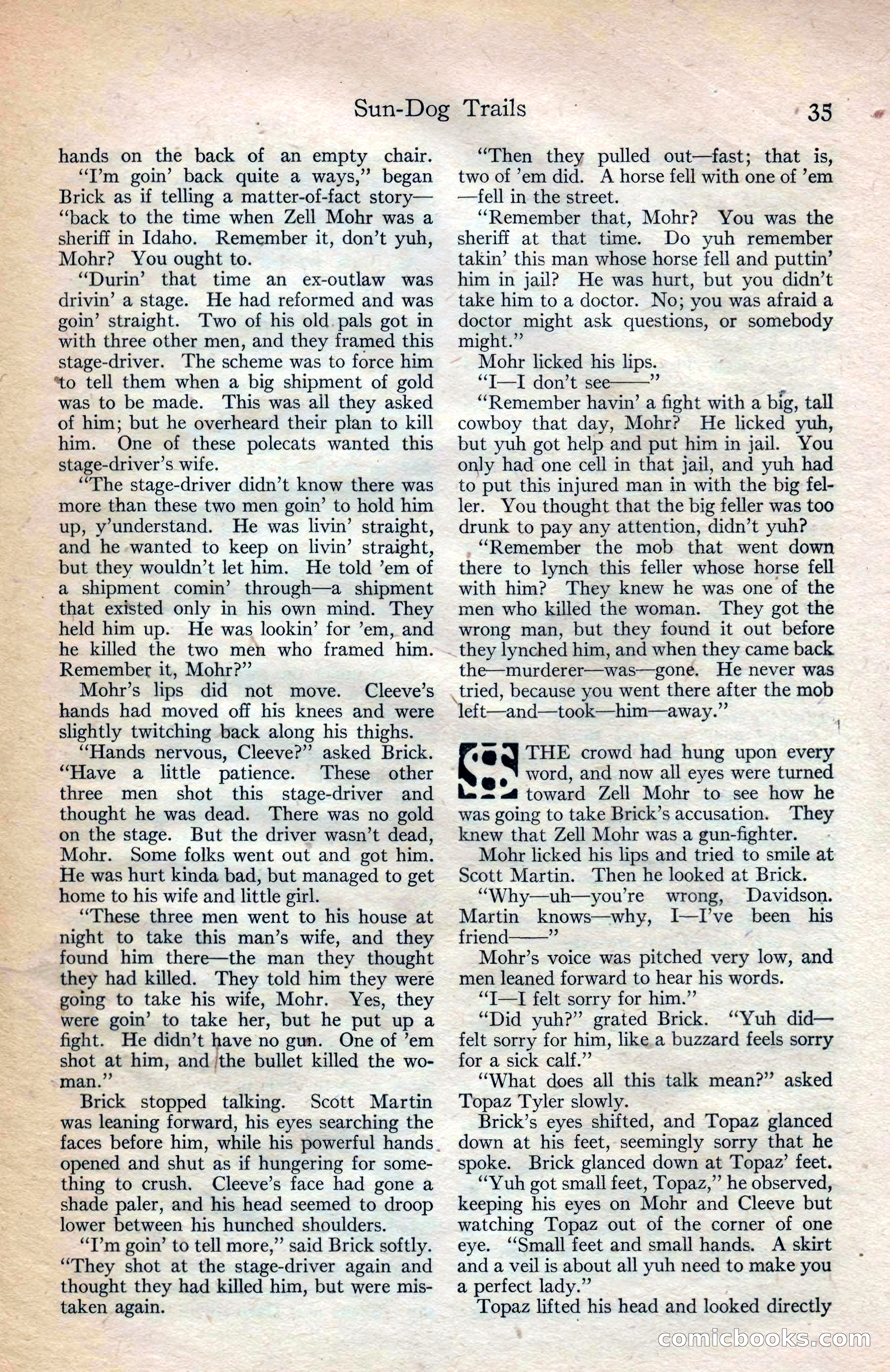
A restored page from Pulp Fiction, 1921. Page through the whole issue in the reader above.
📄 Transcribed text from this page (OCR, searchable)
Machine-transcribed from the original scan — historical spelling and the odd misread are preserved.
Sun-Dog Trails hands on the back of an empty chair. “Y’m goin’ back quite a ways,” began Brick as if telling a matter-of-fact story— “back to the time when Zell Mohr was a sheriff in Idaho. Remember it, don’t yuh, Mohr? You ought to. “Durin’ that time an ex-outlaw was drivin’ a stage. He had reformed and was goin’ straight. Two of his old. pals got in with three other men, and they framed this stage-driver. The scheme was to force him *to tell them when a big shipment of gold was to be made. This was all they asked of him; but he overheard their plan to kill him. One of these polecats wanted this stage-driver’s wife. : “The stage-driver didn’t know there was more than these two men goin’ to hold him up, y understand. He was livin’ straight, and he wanted to keep on livin’ straight, but they wouldn’t let him. He told ’em of _ a shipment comin’ through—a shipment that existed only in his own mind. They held him up. He was lookin’ for ’em, and he killed the two men who framed him. Remember it, Mohr?” Mohr’s lips did not move. Cleeve’s hands had moved off his knees and were slightly twitching back along his thighs. “Wands nervous, Cleeve?” asked Brick. “Have a little patience. These other three men shot this stage-driver and thought he was dead. There was no gold on the stage. But the driver wasn’t dead, Mohr. Some folks went out and got him. He was hurt kinda bad, but managed to get home to his wife and little girl. ‘“‘These three men went to his house at night to take this man’s wife, and they found him there—the man they thought they had killed. They told him they were going to take his wife, Mohr. Yes, they were goin’ to take her, but he put up a fight. He didn’t have no gun. One of ’em shot at him, and /the bullet killed the wo- ~man.” Brick stopped talking. Scott Martin was leaning forward, his eyes searching the faces before him, while his powerful hands. opened and shut as if hungering for some- thing to crush. Cleeve’s face had gone a shade paler, and his head seemed to droop lower between his hunched shoulders. “T’m goin’ to tell more,” said Brick softly. “They shot at the stage-driver again and thought they had killed him, but were mis- taken again. “Then they pulled out—fast; that is, two of ’em did. A horse fell with one of ’em —fell in the street. ‘‘Remember that, Mohr? You was the sheriff at that time. Do yuh remember takin’ this man whose horse fell and puttin’ him in jail? He was hurt, but you didn’t take him to a doctor. No; you was afraid a doctor might ask questions, or somebody might.” Mohr licked his lips. “II don t-s€¢ as 3 “Remember havin’ a fight with a big, tall cowboy that day, Mohr? He licked yuh, but yuh got help and put him in jail. You only had one cell in that jail, and yuh had to put this injured man in with the big fel- ler. You thought that the big feller was too drunk to pay any attention, didn’t yuh? “Remember the mob that went down there to lynch this feller whose horse fell with him? They knew he was one of the men who killed the woman. They got the wrong man, but they found it out before _ they lynched him, and when they came back the—murderer—was—gone. He never was tried, because you went there after the mob left—and—took—him—away.”’ ed THE crowd had hung upon every ee word, and now all eyes were turned L. = «4 toward Zell Mohr to see how he was going to take Brick’s accusation. They knew that Zell Mohr was a gun-fighter. Mohr licked his lips and tried to smile at Scott Martin. Then he looked at Brick. “Why—uh—you’re wrong, Davidson. Martin knows—why, I-—I’ve been his friend = Mohr’s voice was pitched very low, and men leaned forward to hear his words. “T—] felt sorry for him.” “Did yuh?” grated Brick. ‘Yuh did— felt sorry for him, like a buzzard feels sorry for a sick calf.” “What does all this talk mean?” asked Topaz Tyler slowly. Brick’s eyes shifted, and Topaz glanced down at his feet, seemingly sorry that he spoke. Brick glanced down at Topaz’ feet. “Vuh got small feet, Topaz,” he observed, keeping his eyes on Mohr and Cleeve but watching Topaz out of the corner of one eye. ‘Small feet and small hands. A skirt and a veil is about all yuh need to make you a perfect lady.” Topaz lifted his head and looked directly CoOnnicooolkSs (S@) (35