
Pulp Fiction, 1921 · page 187 of 194
Adventure Magazine Cover — page 187: what you’re looking at
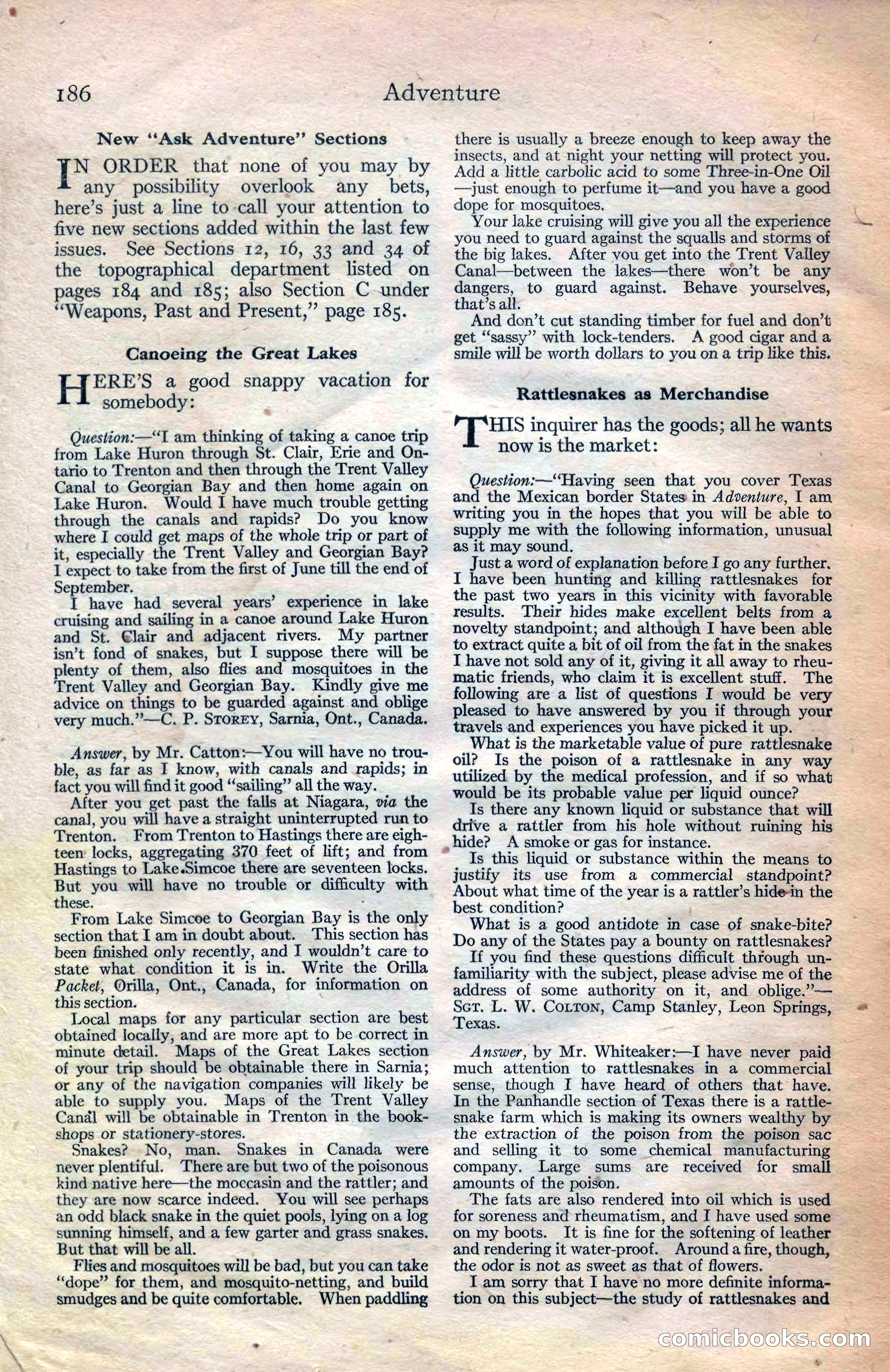
A restored page from Pulp Fiction, 1921. Page through the whole issue in the reader above.
📄 Transcribed text from this page (OCR, searchable)
Machine-transcribed from the original scan — historical spelling and the odd misread are preserved.
186 New ‘‘Ask Adventure’’ Sections N ORDER that none of you may by any possibility overlook any bets, here’s just a line to-call your attention to five new sections added within the last few issues. See Sections 12, 16, 33 and 34 of the topographical department listed on pages 184 and 185; also Section C under “Weapons, Past and Present,” page 185. Canoeing the Great Lakes ERE’S a good snappy vacation for somebody: Question: —“I am thinking of taking a canoe trip from Lake Huron through St. Clair, Erie and On- tario to Trenton and then through the Trent Valley Canal to Georgian Bay and then home again on Lake Huron. Would I have much trouble getting through the canals and rapids? Do you know where I could get maps of the whole trip or part of it, especially the Trent Valley and Georgian Bay? I expect to take from the first of June till the end of September. , IT have had several years’ experience in lake cruising and sailing in a canoe around Lake Huron and St. @lair and adjacent rivers. My partner isn’t fond of snakes, but I suppose there will be plenty of them, also flies and mosquitoes in the Trent Valley and Georgian Bay. Kindly give me advice on things to be guarded against and oblige very much.”—C, P. Storey, Sarnia, Ont., Canada. Answer, by Mr. Catton:—You will have no trou- ble, as far as I know, with canals and rapids; in fact you will find it good “sailing” all the way. After you get past the falls at Niagara, va the cana], you will have a straight uninterrupted run to Trenton. From Trenton to Hastings there are eigh- teen locks, aggregating 370 feet of lift; and from | Hastings to Lake.Simcoe there are seventeen locks. But you will have no trouble or difficulty with these. From Lake Simcoe to Georgian Bay is the only section that I am in doubt about. This section has been finished only recently, and I wouldn’t care to state what condition it is in. Write the Orilla Packet, Orilla, Ont., Canada, for information on this section. Local maps for any particular section are best obtained locally, and are more apt to be correct in minute detail. Maps of the Great Lakes section of your trip should be obtainable there m Sarnia; or any of the navigation companies will likely be able to supply you. Maps of the Trent Valley Canal will be obtainable in Trenton in the book- shops or stationery-stores. Snakes? No, man. Snakes in Canada were never plentiful. There are but two of the poisonous kind native here—the moccasin and the rattler; and they are now scarce indeed. You will see perhaps an odd black snake in the quiet pools, lying on a log sunning himself, and a few garter and grass snakes. But that will be all. Flies and mosquitoes will be bad, but you can take “dope” for them, and mosquito-netting, and build smudges and be quite comfortable. When paddling Adventure there is usually a breeze enough to keep away the insects, and at night your netting will protect you. Add a little carbolic acid to some Three-in-One Oil —just enough to perfume it—and you have a good dope for mosquitoes. Your lake cruising will give you all the experience you need to guard against the squalls and storms of the big lakes. After vou get into the Trent Valley Canal—between the lakes—there won’t be any dangers, to guard against. Behave yourselves, that’s all. And don’t cut standing timber for fuel and don’t get “sassy” with lock-tenders. A good cigar anda smile will be worth dollars to you on a trip like this. Rattlesnakes as Merchandise Ts inquirer has the goods; all he wants now is the market: Question: —“Having seen that you cover Texas and the Mexican border States in Adventure, I am writing you in the hopes that you will be able to supply me with the following information, unusual as it may sound. Just a word of explanation before I go any further. I have been hunting and killing rattlesnakes for the past two years in this vicinity with favorable results. Their hides make excellent belts from a novelty standpoint; and although I have been able to extract quite a bit of oil from the fat in the snakes I have not sold any of it, giving it all away to rheu- matic friends, who claim it is excellent stuff. The following are a list of questions I would be very pleased to have answered by you if through your travels and experiences you have picked it up. What is the marketable value of pure rattlesnake oil? Is the poison of a rattlesnake in any way utilized by the medical profession, and if so what would be its probable value per liquid ounce? Is there any known liquid or substance that will drive a rattler from his hole without ruining his hide? A smoke or gas for instance. Is this liquid or substance within the means to justify its use from a commercial standpoint? About what time of the year is a rattler’s hide-in the best condition? What is a good antidote in case of snake-bite? Do any of the States pay a bounty on rattlesnakes? If you find these questions difficult through un- familiarity with the subject, please advise me of the address of some authority on it, and oblige.”— oa L. W. Cotton, Camp Stanley, Leon Springs, eXas. Answer, by Mr. Whiteaker:—I have never paid much attention to rattlesnakes in a commercial sense, though I have heard of others that have. In the Panhandle section of Texas there is a rattle- snake farm which is making its owners wealthy by the extraction of the poison from the poison sac and selling it to some chemical manufacturing company. Large sums are received for small — amounts of the poison. The fats are also rendered into oil which is used for soreness and rheumatism, and I have used some on my boots. It is fine for the softening of leather and rendering it water-proof. Around a fire, though, the odor is not as sweet as that of flowers. I am sorry that I have no more definite informa- tion on this subject—the study of rattlesnakes and EoOmicbdoo s <SEGO