
Pulp Fiction, 1921 · page 163 of 194
Adventure Magazine Cover — page 163: what you’re looking at
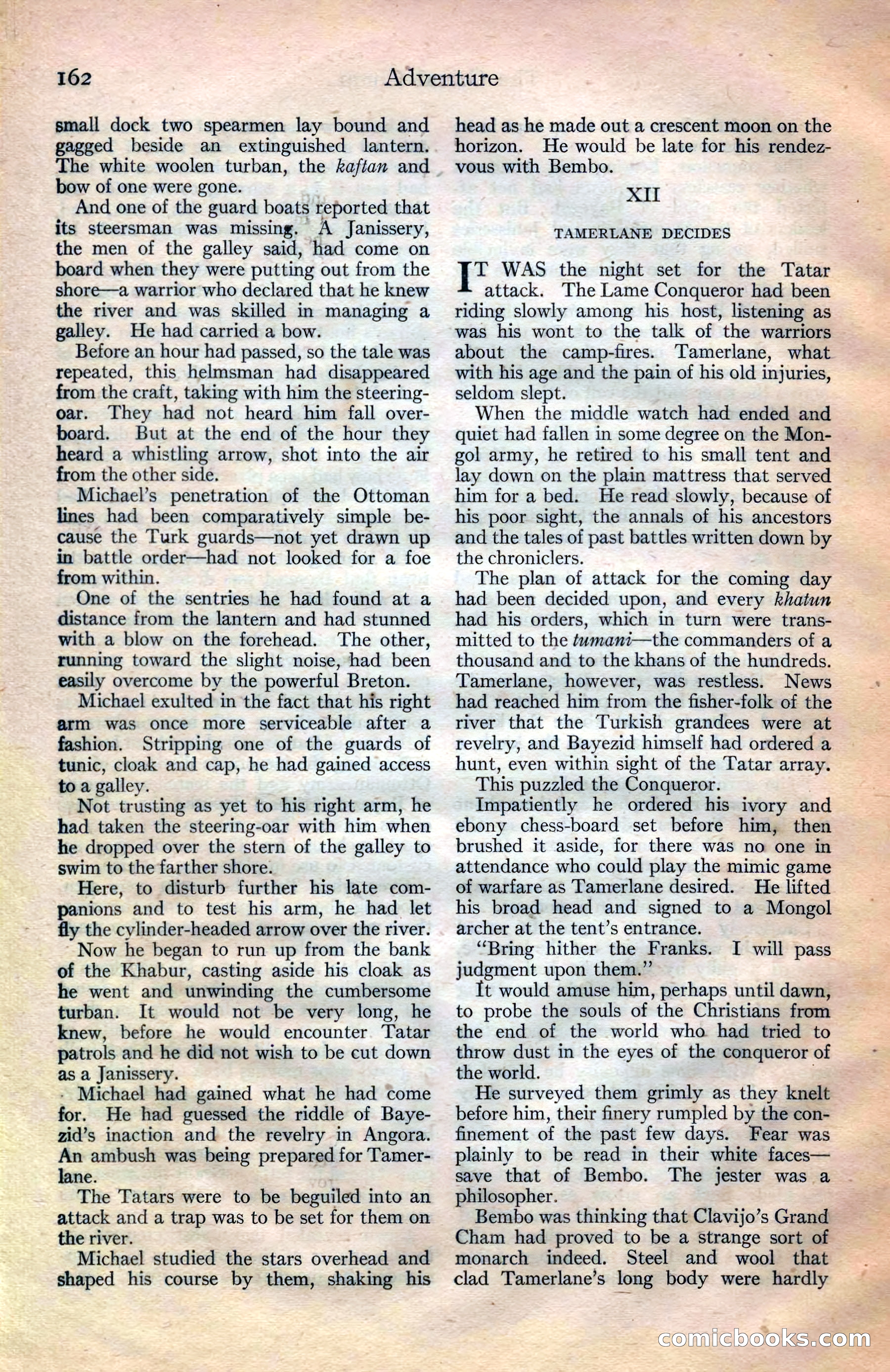
A restored page from Pulp Fiction, 1921. Page through the whole issue in the reader above.
📄 Transcribed text from this page (OCR, searchable)
Machine-transcribed from the original scan — historical spelling and the odd misread are preserved.
162 small dock two spearmen lay bound and gagged beside an extinguished lantern. The white woolen turban, the kaftan and bow of one were gone. And one of the guard boats reported that its steersman was missing. A Janissery, the men of the galley said, had come on board when they were putting out from the shore—a warrior who declared that he knew the river and was skilled in managing a galley. He had carried a bow. Before an hour had passed, so the tale was repeated, this helmsman had disappeared from the craft, taking with him the steering- oar. They had not heard him fall over- board. But at the end of the hour they heard a whistling arrow, shot into the air from the other side. Michael’s penetration of the Ottoman lines had been comparatively simple be- cause the Turk guards—not yet drawn up in battle order—had not looked for a foe from within. One of the sentries he had found at a distance from the lantern and had stunned with a blow on the forehead. The other, running toward the slight noise, had been easily overcome by the powerful Breton. Michael exulted in the fact that his right arm was once more serviceable after a fashion. Stripping one of the guards of tunic, cloak and cap, he had gained access to a galley. Not trusting as yet to his right arm, he had taken the steering-oar with him when he dropped over the stern of the galley to swim to the farther shore. Here, to disturb further his late com- panions and to test his arm, he had let fly the cylinder-headed arrow over the river. Now he began to run up from the bank of the Khabur, casting aside his cloak as he went and unwinding the cumbersome turban. It would not be very long, he knew, before he would encounter Tatar patrols and he did not wish to be cut down as a Janissery. - Michael had gained what he had come for. He had guessed the riddle of Baye- zid’s inaction and the revelry in Angora. An ambush was being prepared for Tamer- Jane. | The Tatars were to be beguiled into an attack and a trap was to be set for them on the river. Michael studied the stars overhead and shaped his course by them, shaking his Adventure head as he made out a crescent moon on the horizon. He would be late for his rendez- vous with Bembo. XIT TAMERLANE DECIDES ig WAS the night set for the Tatar attack. The Lame Conqueror had been riding slowly among his host, listening as was his wont to the talk of the warriors about the camp-fires. Tamerlane, what with his age and the pain of his old injuries, seldom slept. When the middle watch had ended and quiet had fallen in some degree on the Mon- gol army, he retired to his small tent and lay down on the plain mattress that served him for a bed. He read slowly, because of his poor sight, the annals of his ancestors and the tales of past battles written down by the chroniclers. The plan of attack for the coming day had been decided upon, and every khatun had his orders, which in turn were trans- mitted to the éwmani—the commanders of a thousand and to the khans of the hundreds. Tamerlane, however, was restless. News had reached him from the fisher-folk of the river that the Turkish grandees were at revelry, and Bayezid himself had ordered a hunt, even within sight of the Tatar array. This puzzled the Conqueror. Impatiently he ordered his ivory and ebony chess-board set before him, then brushed it aside, for there was no one in attendance who could play the mimic game of warfare as Tamerlane desired. He lifted his broad head and signed to a Mongol archer at the tent’s entrance. “Bring hither the Franks. judgment upon them.” It would amuse him, perhaps until dawn, to probe the souls of the Christians from the end of the world who had tried to throw dust in the eyes of the conqueror of the world. : He surveyed them grimly as they knelt before him, their finery rumpled by the con- finement of the past few days. Fear was plainly to be read in their white faces— save that of Bembo. The jester was a philosopher. Bembo was thinking that Clavijo’s Grand Cham had proved to be a strange sort of monarch indeed. Steel and wool that clad Tamerlane’s long body were hardly I will pass oO Gomicbooks.co