
Pulp Fiction, 1921 · page 120 of 194
Adventure Magazine Cover — page 120: what you’re looking at
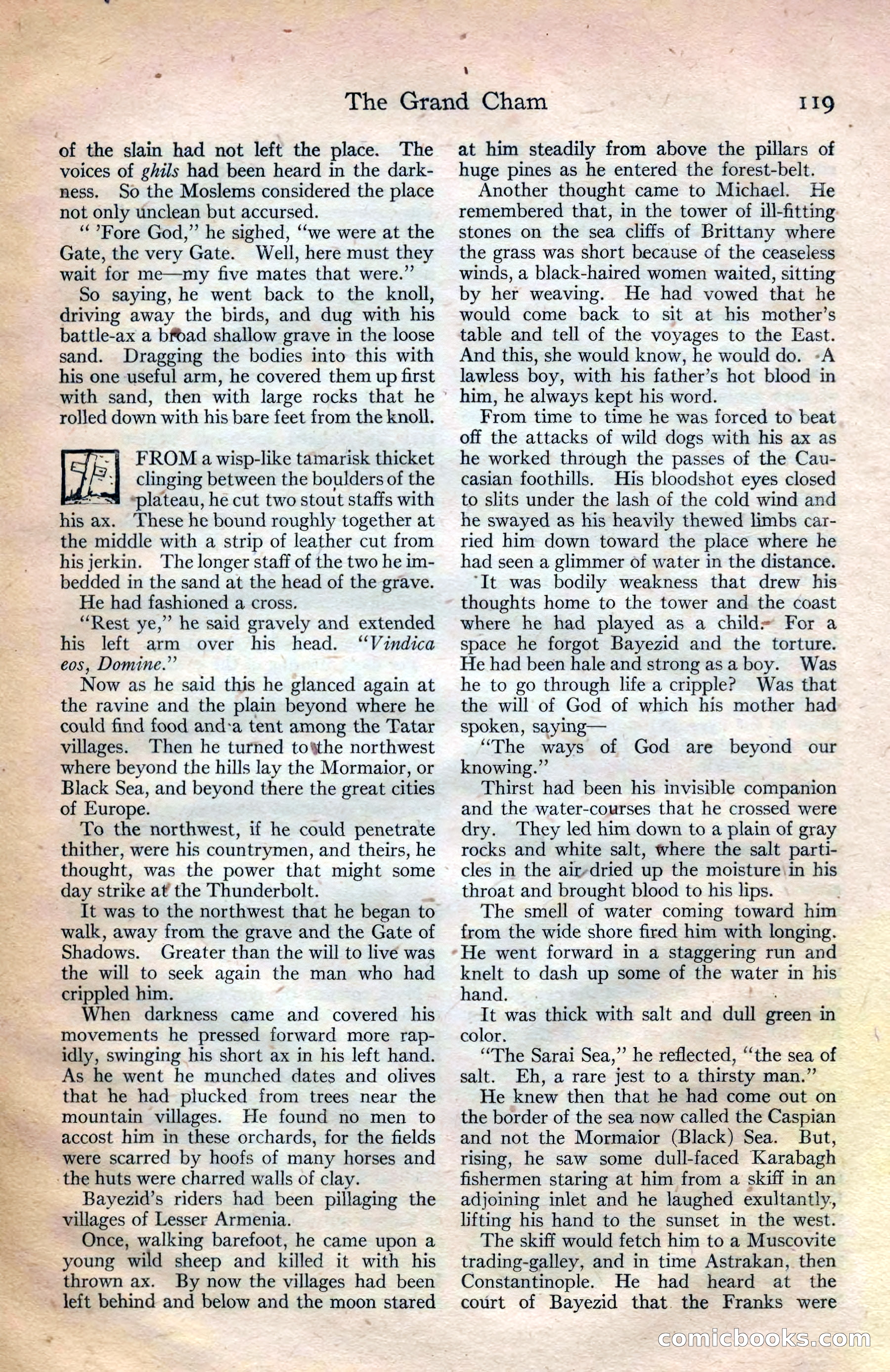
A restored page from Pulp Fiction, 1921. Page through the whole issue in the reader above.
📄 Transcribed text from this page (OCR, searchable)
Machine-transcribed from the original scan — historical spelling and the odd misread are preserved.
of the slain had not left the place. The Grand Cham The voices of ghils had been heard in the dark- ness. So the Moslems considered the place not only unclean but accursed. ‘Fore God,” he sighed, ‘‘we were at the Gate, the very Gate. Well, here must they wait for me—my five mates that were.” So saying, he went back to the knoll, driving away the birds, and dug with his battle-ax a bféad shallow grave in the loose sand. Dragging the bodies into this with his one useful arm, he covered them up first with sand, then with large rocks that he ° rolled down with his bare feet from the knoll. FROM a wisp-like tamarisk thicket clinging between the boulders of the 2 «plateau, he cut two stout staffs with hie ax. These he bound roughly together at the middle with a strip of leather cut from his jerkin. The longer staff of the two he im- bedded in the sand at the head of the grave. He had fashioned a cross. “Rest ye,” he said gravely and extended his left arm over his head. ‘“‘Vindica eos, Domine.” Now as he said this he glanced again at the ravine and the plain beyond where he could find food and:a tent among the Tatar villages. Then he turned totthe northwest where beyond the hills lay the Mormaior, or Black Sea, and beyond there the great cities of Europe. To the northwest, if he could penetrate thither, were his countrymen, and theirs, he thought, was the power that might some day strike at the Thunderbolt. It was to the northwest that he began to walk, away from the grave and the Gate of Shadows. Greater than the will to live was the will to seek again the man who had crippled him. When darkness came and covered his movements he pressed forward more rap- idly, swinging his short ax in his left hand. As he went he munched dates and olives that he had plucked from trees near the mountain villages. He found no men to accost him in these orchards, for the fields were scarred by hoofs of many horses and -the huts were charred walls of clay. Bayezid’s riders had been pillaging the villages of Lesser Armenia. Once, walking barefoot, he came upon a young wild sheep and killed it with his thrown ax. By now the villages had been _ left behind and below and the moon stared - a \ at him steadily from above the pillars of huge pines as he entered the forest-belt. Another thought came to Michael. He remembered that, in the tower of ill-fitting stones on the sea cliffs of Brittany where the grass was short because of the ceaseless winds, a black-haired women waited, sitting by her weaving. He had vowed that he would come back to sit at his mother’s table and tell of the voyages to the East. And this, she would know, he would do. -A lawless boy, with his father’s hot blood in him, he always kept his word. From time to time he was forced to beat off the attacks of wild dogs with his ax as he worked through the passes of the Cau- casian foothills. His bloodshot eyes closed to slits under the lash of the cold wind and he swayed as his heavily thewed limbs car- ried him down toward the place where he had seen a glimmer of water in the distance. ‘It was bodily weakness that drew his thoughts home to the tower and the coast where he had played as a child= For a space he forgot Bayezid and the torture. He had been hale and strong asa boy. Was he to go through life a cripple? Was that the will of God of which his mother had spoken, saying— ‘The ways of God are beyond our knowing.”’ Thirst had been his invisible companion and the water-courses that he crossed were dry. They led him down to a plain of gray rocks and white salt, where the salt parti- cles in the air-dried up the moisture.in his throat and brought blood to his lips. The smell of water coming toward him from the wide shore fired him with longing. He went forward in a staggering run and knelt to dash up some of the water in his hand. It was thick with salt and dull green in color. “The Sarai Sea,’’ he reflected, ‘‘the sea of salt. Eh, a rare jest to a thirsty man.” He knew then that he had come out on the border of the sea now called the Caspian and not the Mormaior (Black) Sea. But, rising, he saw some dull-faced Karabagh fishermen staring at him from a skiff in an adjoining inlet and he laughed exultantly, lifting his hand to the sunset in the west. The skiff would fetch him to a Muscovite trading-galley, and in time Astrakan, then Constantinople. He had heard at the court of Bayezid that. the Franks were (CoMMielo@oo <Si (S@) 119