
Pulp Fiction, 1921 · page 107 of 194
Adventure Magazine Cover — page 107: what you’re looking at
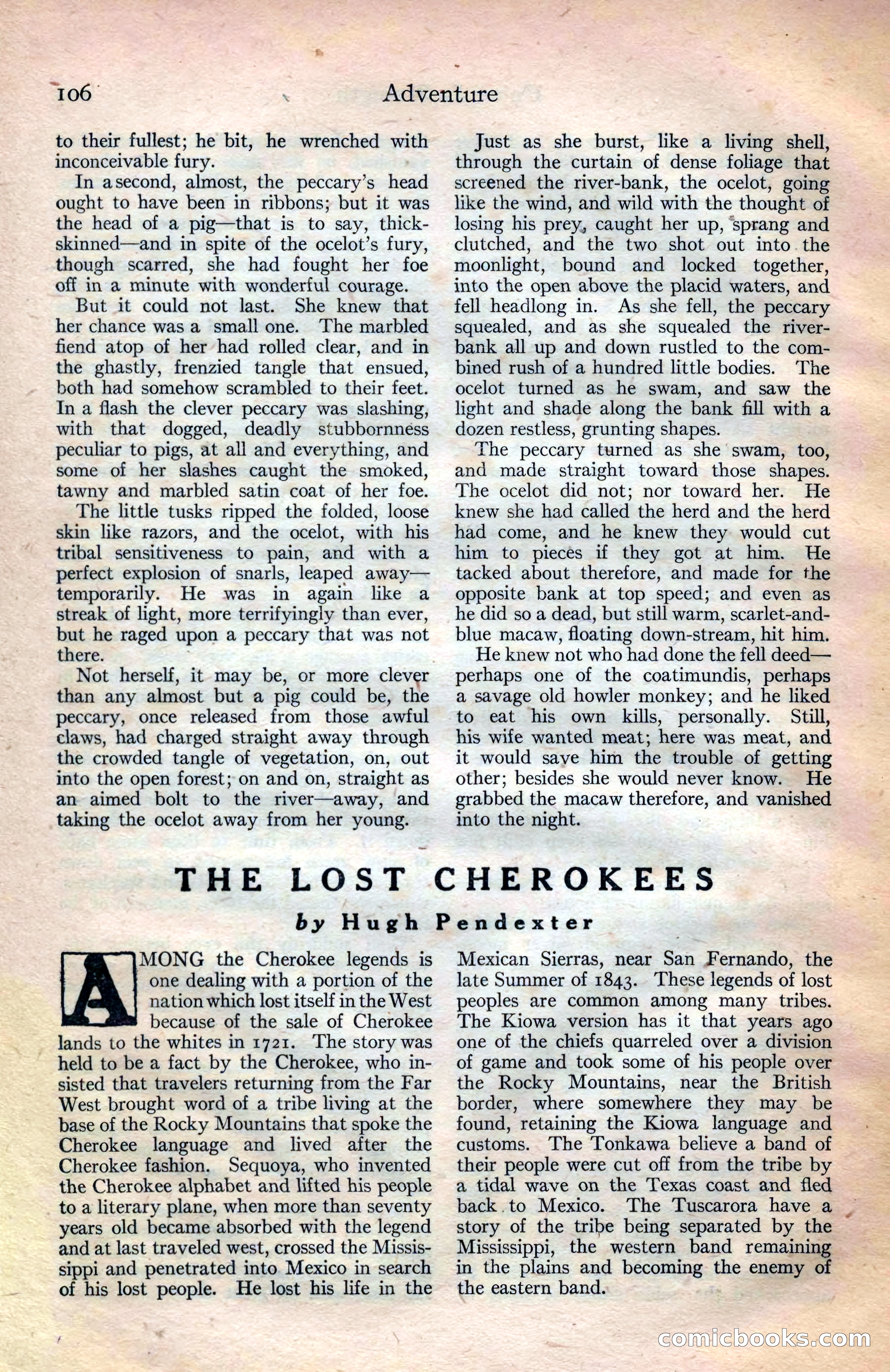
A restored page from Pulp Fiction, 1921. Page through the whole issue in the reader above.
📄 Transcribed text from this page (OCR, searchable)
Machine-transcribed from the original scan — historical spelling and the odd misread are preserved.
“106° to their fullest; he bit, he wrenched with inconceivable fury. In asecond, almost, the peccary’s head ought to have been in ribbons; but it was the head of a pig—that is to say, thick- skinned—and in spite of the ocelot’s fury, though scarred, she had fought her foe off in a minute with wonderful courage. But it could not last. She knew that her chance was a small one. The marbled fiend atop of her had rolled clear, and in the ghastly, frenzied tangle that ensued, both had somehow scrambled to their feet. In a flash the clever peccary was slashing, with that dogged, deadly stubbornnéss peculiar to pigs, at all and everything, and some of her slashes caught the smoked, tawny and marbled satin coat of her foe. The little tusks ripped the folded, loose skin like razors, and the ocelot, with his tribal sensitiveness to pain, and with a perfect explosion of snarls, leaped away— temporarily. He was in again like a streak of light, more terrifyingly than ever, but he raged upon a peccary that was not there. : Not herself, it may be, or more clever than any almost but a pig could be, the peccary, once released from those awful claws, had charged straight away through the crowded tangle of vegetation, on, out into the open forest; on and on, straight as an aimed bolt to the river—away, and taking the ocelot away from her young. Adventure Just as she burst, like a living shell, through the curtain of dense foliage that screened the river-bank, the ocelot, going like the wind, and wild with the thought of losing his prey, caught her up, ‘sprang and clutched, and the two shot out into the moonlight, bound and locked together, into the open above the placid waters, and fell headlong in. As she fell, the peccary squealed, and as she squealed the river- bank all up and down rustled to the com- bined rush of a hundred little bodies. The ocelot turned as he swam, and saw the light and shade along the bank fill with a dozen restless, grunting shapes. The peccary turned as she swam, too, and made straight toward those shapes. The ocelot did not; nor toward her. He knew she had called the herd and the herd had come, and he knew they would cut him to pieces if they got at him. He tacked about therefore, and made for the opposite bank at top speed; and even as he did so a dead, but still warm, scarlet-and- blue macaw, floating down-stream, hit him. He knew not who had done the fell deed— perhaps one of the coatimundis, perhaps a savage old howler monkey; and he liked to eat his own kills, personally. Still, his wife wanted meat; here was meat, and it would save him the trouble of getting other; besides she would never know. He grabbed the macaw therefore, and vanished into the night. THE LOST CHEROKEES by Hugh Pendexter MONG the Cherokee legends is one dealing with a portion of the nation which lost itself in the West because of the sale of Cherokee lands to the whites in 1721. The story was held to be a fact by the Cherokee, who in- sisted that travelers returning from the Far West brought word of a tribe living at the base of the Rocky Mountains that spoke the Cherokee language and lived after the Cherokee fashion. Sequoya, who invented the Cherokee alphabet and lifted his people to a literary plane, when more than seventy years old became absorbed with the legend and at last traveled west, crossed the Missis- sippi and penetrated into Mexico in search of his lost people. He lost his life in the Mexican Sierras, near San Fernando, the late Summer of 1843. These legends of lost peoples are common among many tribes. The Kiowa version has it that years ago one of the chiefs quarreled over a division of game and took some of his people over the Rocky Mountains, near the British border, where somewhere they may be found, retaining the Kiowa language and customs. The Tonkawa believe a band of their people were cut off from the tribe by a tidal wave on the Texas coast and fled back .to Mexico. The Tuscarora have a story of the tribe being separated by the Mississippi, the western band remaining in the plains and becoming the enemy of the eastern band. Eomichbooks: co