
Pulp Fiction, 1923 · page 139 of 196
Adventure Magazine Cover — page 139: what you’re looking at
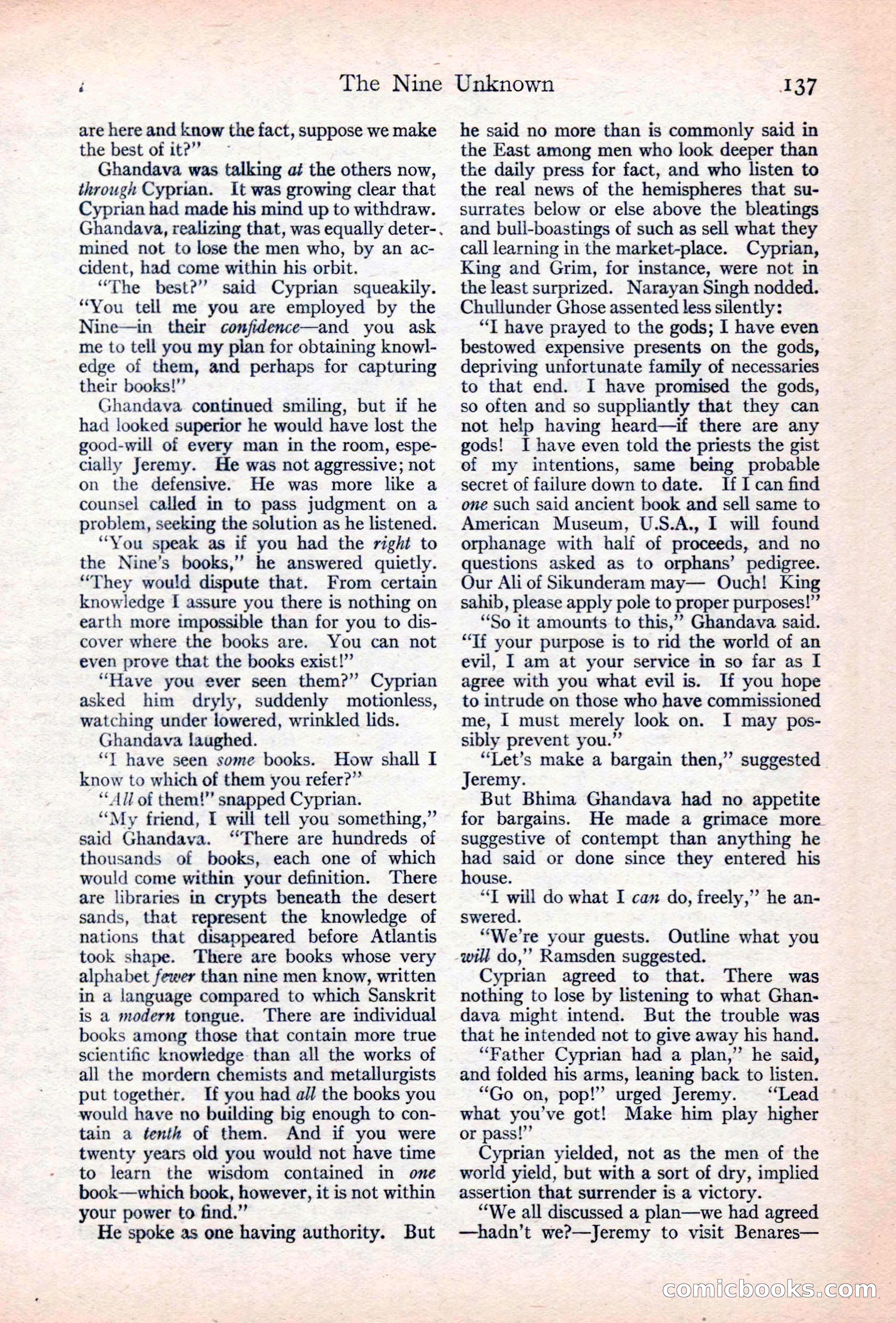
A restored page from Pulp Fiction, 1923. Page through the whole issue in the reader above.
📄 Transcribed text from this page (OCR, searchable)
Machine-transcribed from the original scan — historical spelling and the odd misread are preserved.
The Nee inkno we are here and know the fact, suppose we make the best of it?” Ghandava was talking af the others now, through Cyprian. It was growing clear that Cyprian had made his mind up to withdraw. Ghandava, realizing that, was equally deter-. mined not to lose the men who, by an ac- cident, had come within his orbit. “The best?’’ said Cyprian squeakily. ‘You tell me you are employed by the Nine—in their confidence—and you ask me to tell you my plan for obtaining knowl- edge of them, and perhaps for capturing their books!” Ghandava continued smiling, but if he had looked superior he would have lost the good-will of every man in the room, espe- cially Jeremy. He was not aggressive; not on the defensive. He was more like a counsel called in to pass judgment on a problem, seeking the solution as he listened. “You speak as if you had the right to the Nine’s books,” he answered quietly. “They would dispute that. From certain knowledge I assure you there is nothing on earth more impossible than for you to dis- cover where the books are. You can not even prove that the books exist!” “Have you ever seen them?” Cyprian asked him dryly, suddenly motionless, watching under lowered, wrinkled lids. Ghandava laughed. “TY have seen some books. How shall I know to which of them you refer?” “All of them!” snapped Cyprian. “My friend, I will tell you something,” said Ghandava. “There are hundreds of thousands of books, each one of which would come within your definition. There are libraries in crypts beneath the desert sands, that represent the knowledge of nations that disappeared before Atlantis took shape. There are books whose very alphabet fewer than nine men know, written in a language compared to which Sanskrit is a modern tongue. There are individual books among those that contain more true scientific knowledge than all the works of all the mordern chemists and metallurgists put together. If you had all the books you would have no building big enough to con- tain a tenth of them. And if you were twenty years old you would not have time to learn the wisdom contained in one book—which book, however, it is not within your power to find.” He spoke as one having authority. But 137 he said no more than is commonly said in the East among men who look deeper than the daily press for fact, and who listen to the real news of the hemispheres that su- surrates below or else above the bleatings and bull-boastings of such as sell what they call learning in the market-place. Cyprian, King and Grim, for instance, were not in the least surprized. Narayan Singh nodded. Chullunder Ghose assented less silently: “T have prayed to the gods; I have even bestowed expensive presents on the gods, depriving unfortunate family of necessaries to that end. I have promised the gods, so often and so suppliantly that they can not help having heard—if there are any gods! I have even told the priests the gist of my intentions, same being probable secret of failure down to date. If I can find one such said ancient book and sell same to American Museum, U.S.A., I will found orphanage with half of proceeds, and no questions asked as to orphans’ pedigree. Our Ali of Sikunderam may— Ouch! King sahib, please apply pole to proper purposes!” “So it amounts to this,’”’ Ghandava said. “Tf your purpose is to rid the world of an evil, I am at your service in so far as [ agree with you what evil is. If you hope to intrude on those who have commissioned me, I must merely look on. I may pos- sibly prevent you.” ““Let’s make a bargain then,” suggested Jeremy. But Bhima Ghandava had no appetite for bargains. He made a grimace more suggestive of contempt than anything he had said or done since they entered his house. “T will do what I can do, freely,” he an- swered. “We're your guests. Outline what you will do,” Ramsden suggested. Cyprian agreed to that. There was nothing to lose by listening to what Ghan- dava might intend. But the trouble was that he intended not to give away his hand. “Father Cyprian had a plan,” he said, and folded his arms, leaning back to listen. “Go on, pop!” urged Jeremy. what you’ve got! Make him play higher or pass!’ Cyprian yielded, not as the men of the world yield, but with a sort of dry, implied assertion that surrender is a victory. ““We all discussed a plan—we had agreed —hadn’t we?—Jeremy to visit Benares— Go 0) ANG S “Lead — (G)