
Pulp Fiction, 1922 · page 62 of 200
Adventure Magazine Cover, December 10, 1922 — page 62: what you’re looking at
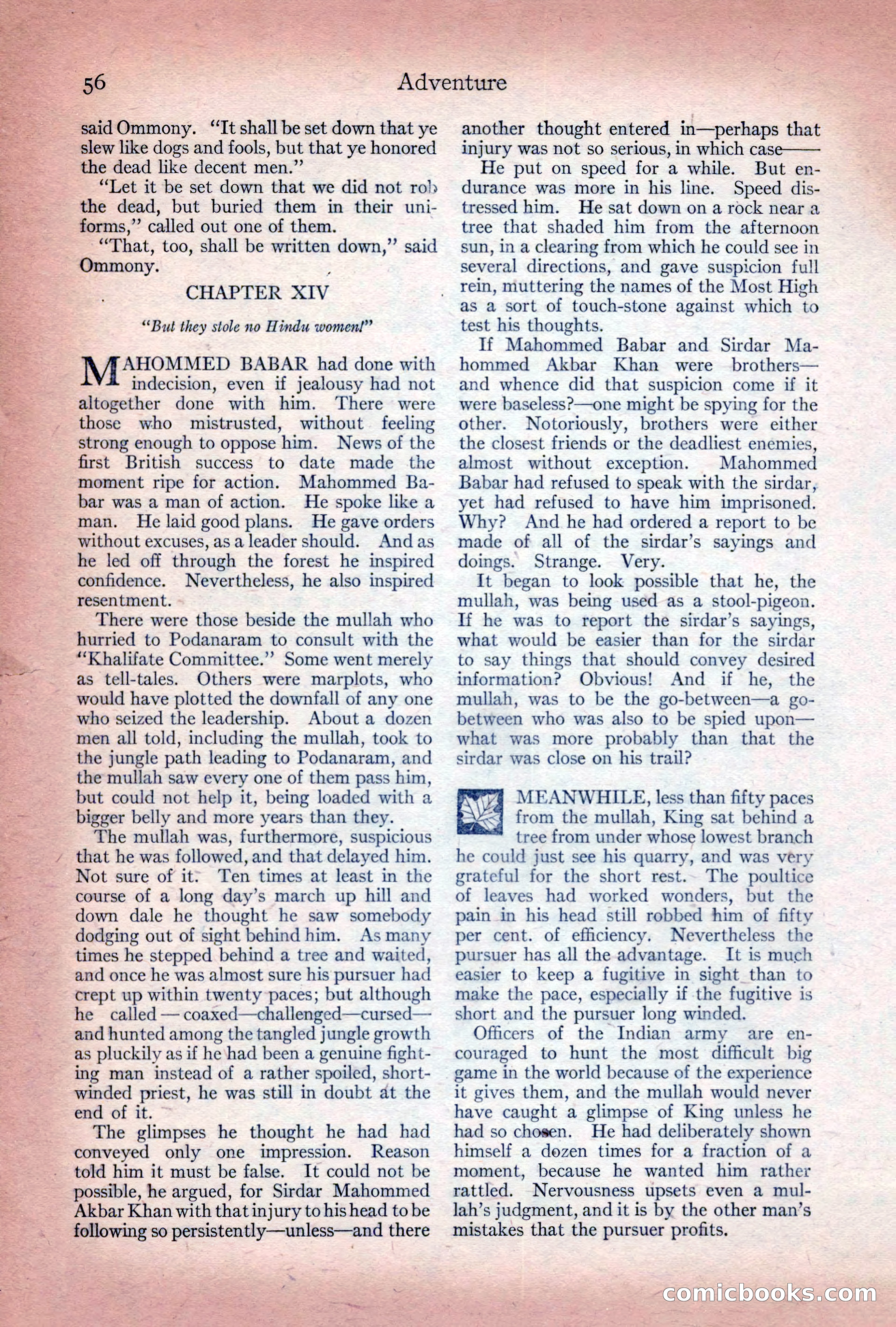
A restored page from Pulp Fiction, 1922. Page through the whole issue in the reader above.
📄 Transcribed text from this page (OCR, searchable)
Machine-transcribed from the original scan — historical spelling and the odd misread are preserved.
ee a “Let it be set down that we did not rob _ the dead, but buried them in their uni- ? _ forms,” called out one of them. — “That, too, shall be written down,”’ said 2 Ommony. : = CHAPTER XIV “But ey stole no Hindu women!” AHOMMED BABAR had done with indecision, even if jealousy had not = 5 Foss who mistrusted, without feeling __ strong enough to oppose ‘him. News of the first British success to date made the moment ripe for action. Mahommed Ba- _ bar was a man of action. He spoke like a -- man. He laid good plans. He gave orders 2 - without excuses, asa leader should. Andas he led off through the forest he inspired ae < ‘confidence. Nevertheless, he also inspired ==. resentment. - __ There were those beside the mullah who _ hurried to Podanaram to consult with the “Khalifate Committee.” Some went merely — as tell-tales. Others were marplots, who -.__ would have plotted the downfall of any one _ who seized the leadership. About a dozen = men all told, including the mullah, took to _ the jungle path leading to Podanaram, and = the mullah saw every one of them pass ‘him, _ but could not help it, being loaded with a = bigger belly and more years than they. ~~ ‘The mullah was, furthermore, suspicious / that he was followed, and that delayed him. : = Not sure of it: Ten times at least in the Baca dale he sucht he saw somebody _ dodging out of sight behind him. As many times he stepped behind a tree and waited, se and once he was almost sure his pursuer had x a called — ee chalieened- teed __ and hunted among the tangled jungle growth ___ as pluckily as if he had been a genuine fight- 7 : ing man instead of a rather spoiled, short- winded priest, he was still in doubt at the end of it. _ The glimpses he thought he had had _ conveyed only one impression. Reason told him it must be false. It could not be possible, he argued, for Sirdar Mahommed ey gabbar Khan with that vet ury to his head to be another thought entered in—perhaps that injury was not so serious, in which case—— He put on speed for a while. But en- durance was more in his line. Speed dis- tressed him. He sat down on a rock near a tree that shaded him from the afternoon sun, in a clearing from which he could see in several directions, and gave suspicion full rein, muttering the names of the Most High as a sort of touch-stone against which to test his thoughts. If Mahommed Babar and Sirdar Ma- hommed Akbar Khan were brothers— and whence did that suspicion come if it were baseless?—one might be spying for the other. Notoriously, brothers were either the closest friends or the deadliest enemies, almost without exception. Mahommed Babar had refused to speak with the sirdar, yet had refused to have him imprisoned. Why? And he had ordered a report to be made of all of the sirdar’s sayings and doings. Strange. Very. It began to look possible that he, the mullah, was being used as a stool-pigeon. If he was to report the sirdar’s sayings, what would be easier than for the sirdar to say things that should convey desired information? Obvious! And if he, the mullah, was to be the go-between—a go- between who was also to be spied upon— what was more probably than that the sirdar was close on his trail? NY, MEANWHILE, less than fifty paces = ya from the mullah, King sat behind a tree from under whose lowest branch he could just see his quarry, and was very grateful for the short rest.- The poultice of leaves had worked wonders, but the pain in his head still robbed him of fifty per cent. of efficiency. Nevertheless the pursuer has all the advantage. It is much easier to keep a fugitive in sight than to make the pace, especially if the fugitive is short and the pursuer long winded. Officers of the Indian army are en- couraged to hunt the most difficult big game in the world because of the experience it gives them, and the mullah would never have caught a glimpse of King unless he had so chosen. He had deliberately shown himself a dozen times for a fraction of a moment, because he wanted him rather rattled. Nervousness upsets even a mul- lah’s judgment, and it is by the other man’s mistakes that the pursuer profits.