
Pulp Fiction, 1922 · page 40 of 200
Adventure Magazine Cover, December 10, 1922 — page 40: what you’re looking at
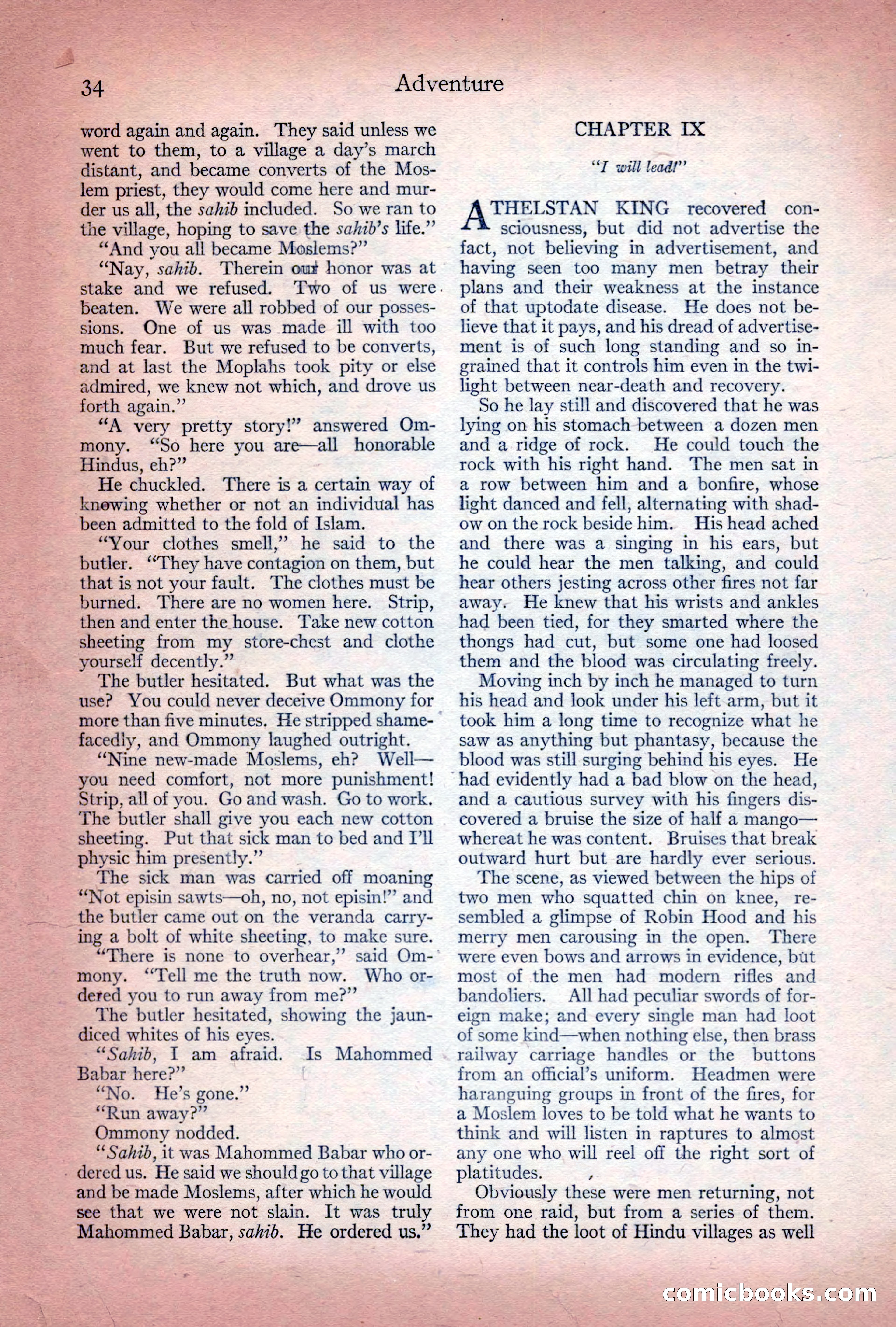
A restored page from Pulp Fiction, 1922. Page through the whole issue in the reader above.
📄 Transcribed text from this page (OCR, searchable)
Machine-transcribed from the original scan — historical spelling and the odd misread are preserved.
34 word again and again. They said unless we went to them, to a village a day’s march distant, and became converts of the Mos- lem priest, they would come here and mur- der us all, the sahib included. So we ran to the village, hoping to save the sahib’s life.” “And you all became Moslems?” “Nay, sahib. Therein out honor was at stake and we refused. Two of us were. beaten. We were all robbed of our posses- sions. One of us was made ill with too much fear. But we refused to be converts, and at last the Moplahs took pity or else admired, we knew not which, and drove us forth again.” “A very pretty story!” answered Om- mony. ‘So here you are—all honorable Hindus, eh?” He chuckled. There is a certain way of knewing whether or not an individual has been admitted to the fold of Islam. “Your clothes smell,’ he said to the butler. “They have contagion on them, but that is not your fault. The clothes must be burned. There are no women here. Strip, then and enter the house. Take new cotton sheeting from my store-chest and clothe yourself decently.” The butler hesitated. But what was the use? You could never deceive Ommony for more than five minutes. He stripped shame- facediy, and Ommony laughed outright. “Nine new-made Moslems, eh? Well— you need comfort, not more punishment! Strip, all of you. Go and wash. Go to work. The butler shall give you each new cotton sheeting. Put that sick man to bed and Ill physic him presently.” The sick man was carried off moaning “Not episin sawts—oh, no, not episin!”’ and the butler came out on the veranda carry- ing a bolt of white sheeting, to make sure. “There is none to overhear,” mony. “Tell me the truth now. dered you to run away from me?”’ The butler hesitated, showing the jaun- diced whites of his eyes. “Sahib, 1 am afraid. Babar here?” “No. He’s gone.” “Run away?” Ommony nodded. “Sahib, it was Mahommed Babar who or- - dered us. He said we should go to that village and be made Moslems, after which he would see that we were not slain. It was truly Mahommed Babar, sahib. He ordered us.” Who or- Is Mahommed said Om-’ Adventure CHAPTER IX “T will lead!” THELSTAN KING recovered con- sciousness, but did not advertise the fact, not believing in advertisement, and having seen too many men betray their plans and their weakness at the instance of that uptodate disease. He does not be- lieve that it pays, and his dread of advertise- ment is of such long standing and so in- grained that it controls him even in the twi- light between near-death and recovery. So he lay still and discovered that he was lying on his stomach between a dozen men and a ridge of rock. He could touch the rock with his right hand. The men sat in a row between him and a bonfire, whose light danced and fell, alternating with shad- ow on the rock beside him. His head ached and there was a singing in his ears, but he could hear the men talking, and could hear others jesting across other fires not far away. He knew that his wrists and ankles had been tied, for they smarted where the thongs had cut, but some one had loosed them and the blood was circulating freely. Moving inch by inch he managed to turn his head and look under his left arm, but it took him a long time to recognize what he saw as anything but phantasy, because the blood was still surging behind his eyes. He ‘had evidently had a bad blow on the head, and a cautious survey with his fingers dis- covered a bruise the size of half a mango— whereat he was content. Bruises that break outward hurt but are hardly ever serious. The scene, as viewed between the hips of two men who squatted chin on knee, re- sembled a glimpse of Robin Hood and his merry men carousing in the open. There were even bows and arrows in evidence, but most of the men had modern rifles and bandoliers. All had peculiar swords of for- eign make; and every single man had loot of some kind—when nothing else, then brass railway carriage handles or the buttons from an official’s uniform. Headmen were haranguing groups in front of the fires, for a Moslem loves to be told what he wants to think and will listen in raptures to almost any one who will reel off the right sort of platitudes. ; Obviously these were men returning, not from one raid, but from a series of them. They had the loot of Hindu villages as well GEomichbooks (E(0)