
Pulp Fiction, 1922 · page 196 of 200
Adventure Magazine Cover, December 10, 1922 — page 196: what you’re looking at
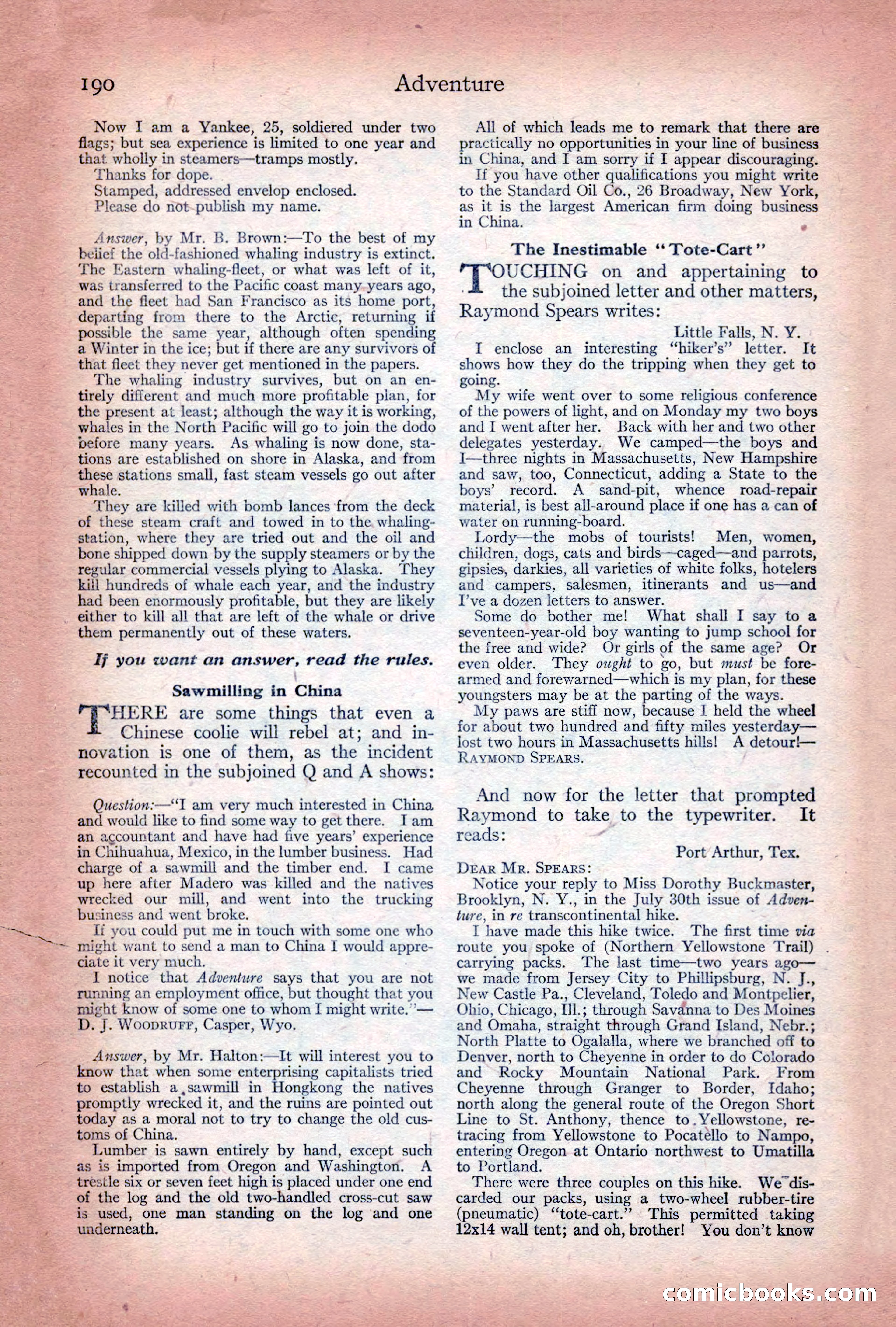
A restored page from Pulp Fiction, 1922. Page through the whole issue in the reader above.
📄 Transcribed text from this page (OCR, searchable)
Machine-transcribed from the original scan — historical spelling and the odd misread are preserved.
== = 190 Sade Now I am a Yankee, 25, soldiered under two _~ flags; but sea experience is limited to one year and et that wholly in steamers—tramps mostly. Se ee Thanks for dope. ey Stamped, addressed envelop enclosed. Please do not-publish my name. Sa Answer, by Mr. B. Brown:—To the best of my <e belief the old-fashioned whaling industry is extinct. <= The Eastern whaling-fleet, or what was left of it, os, was transferred to the Pacific coast many.years ago, TAA and the fleet had San Francisco as its home port, a departing from there to the Arctic, returning if possible the same year, although often spending a Winter in the ice; but if there are any survivors of ¥ that fleet they never get mentioned in the papers. The whaling industry survives, but on an en- tirely different and much more profitable pian, for the present at least; although the way it is working, whales in the North Pacific will go to join the dodo = pefore many years. As whaling is now done, sta- ____ tions are established on shore in Alaska, and from these stations small, fast steam vessels go out after whale. They are killed with bomb lances from the deck of these steam craft and towed in to the. whaling- eS station, where they are tried out and the oil and ¥ bone shipped down by the supply steamers or by the regular commercial vessels plying to Alaska. They Se kill hundreds of whale each year, and the industry - had been enormously profitable, but they are likely either to kill all that are left of the whale or drive them permanently out of these waters. Ij you want an answer, read the rules. Sawmilling in China ey HERE are some things that even a Chinese coolie will rebel at; and in- novation is one of them, as the incident recounted in the subjoined Q and A shows: Question: —“T am very much interested in China and would like to find some way to get there. Iam an accountant and have had five years’ experience in Chihuahua, Mexico, in the lumber business. Had charge of a sawmill and the timber end. I came up here after Madero was killed and the natives wrecked our mill, and went into the trucking business and went broke. Ti you could put me in touch with some one who might want to send a man to China I would appre- ciate it very much. I notice that Adventure says that you are not running an employment office, but thought that you might know of some one to whom | might write. ’— D. J. Wooprurr, Casper, Wyo. Answer, by Mr. Halton:—It will interest you to know that when some enterprising capitalists tried to establish a,sawmill in Hongkong the natives promptly wrecked it, and the ruins are pointed out today as a moral not to try to change the old cus- toms of China. Lumber is sawn entirely by hand, except such as is imported from Oregon and Washington. A tresile six or seven feet high is placed under one end of the log and the old two-handled cross-cut saw is used, one man standing on the log and one underneath. Adventure All of which leads me to remark that there are practically no opportunities in your line of business in China, and I am sorry if I appear discouraging. If you have other qualifications you might write to the Standard Oil Co., 26 Broadway, New York, as it is the largest American firm doing business in China. : The Inestimable ‘‘ Tote-Cart”’ "| QUCHING on and appertaining to the subjoined letter and other matters, Raymond Spears writes: Little Falls, N. Y. I enclose an interesting “hiker’s’” letter. It shows how they do the tripping when they get to going. My wife went over to some religious conference of the powers of light, and on Monday my two boys and I went after her. Back with her and two other delegates yesterday. We camped—the boys and I—three nights in Massachusetts, New Hampshire and saw, too, Connecticut, adding a State to the boys’ record. A sand-pit, whence road-repair material, is best all-around place if one has a can of water on running-board. Lordy—the mobs of tourists! Men, women, children, dogs, cats and birds—caged—and parrots, gipsies, darkies, all varieties of white folks, hotelers and campers, ‘salesmen, itinerants and us—and I’ve a dozen letters to answer. Some do bother me! What shall I say to a seventeen-year-old boy wanting to jump school for the free and wide? Or girls of the same age? Or even older. They ought to g0, but must be fore- armed and forewarned—which is my plan, for these youngsters may be at the parting of the ways. My paws are stiff now, because I held the wheel for about two hundred and fifty miles yesterday— lost two hours in Massachusetts hills! A detour!— RAYMOND SPEARS. And now for the letter that prompted Raymond to take to the typewriter. It eads: Port Arthur, Tex. DEAR Mr. SPEARS: Notice your reply to Miss Dorothy Buckmaster, Brooklyn, N. Y., in the July 30th issue of Adven- ture, in re transcontinental hike. I have made this hike twice. The first time via route you spoke of (Northern Yellowstone Trail) carrying packs. The last time—two years ago— _ we made from Jersey City to Phillipsburg, N. J., New Castle Pa., Cleveland, Toledo and Montpelier, Ohio, Chicago, tl; through Savanna to Des Moines and Omaha, straight through Grand Island, Nebr.; North Platte to Ogalalla, where we branched off to Denver, north to Cheyenne in order to do Colorado and Rocky Mountain National Park. From Cheyenne through Granger to Border, Idaho; north along the general route of the Oregon Short Line to St. Anthony, thence to.Yellowstone, re- tracing from Yellowstone to Pocatéllo to Nampo, entering Oregon at Ontario northwest to Umatilla to Portland. There were three couples on this hike. We dis- carded our packs, using a two-wheel rubber-tire (pneumatic) “tote-cart.” This permitted taking 12x14 wall tent; and oh, brother! You don’t know (EO) micghboo