
Pulp Fiction, 1922 · page 183 of 200
Adventure Magazine Cover, December 10, 1922 — page 183: what you’re looking at
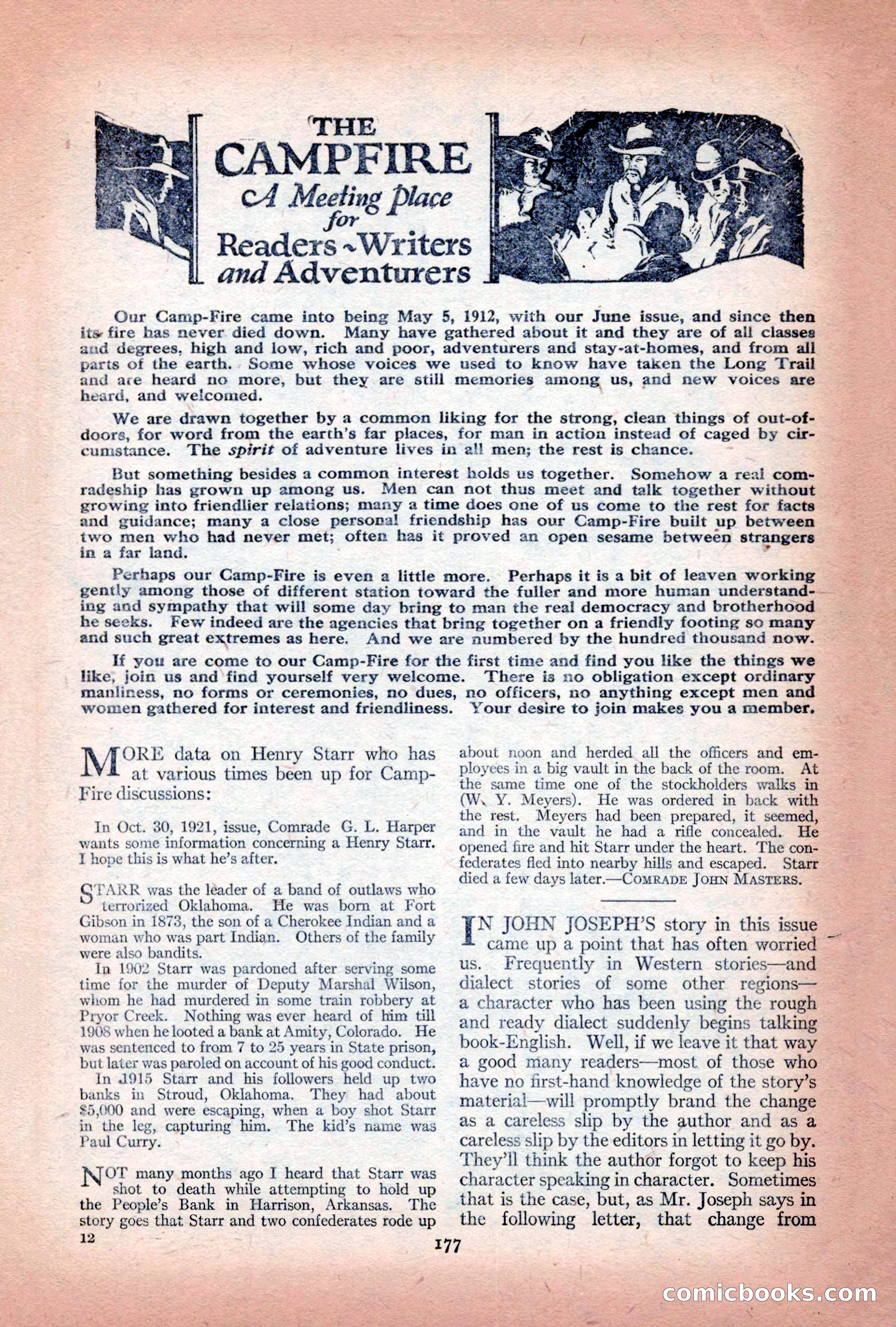
A restored page from Pulp Fiction, 1922. Page through the whole issue in the reader above.
📄 Transcribed text from this page (OCR, searchable)
Machine-transcribed from the original scan — historical spelling and the odd misread are preserved.
‘THE CAMPFIRE C4 Meeting place Readers ~Writers and Adventurers Our Camp-Fire came into being May 5, 1912, with our June issue, and since then its fire has never. died down. Many have gathered about it and they are of all classes and degrees, high and low, rich and poor, adventurers and stay-at-homes, and from all parts of the earth. Some whose voices we used to know have taken the Long Trail and ace heard no more, but they are still memories among us, and new voices are heard, and welcomed. We are drawn together by a common liking for the strong, clean things of out-of- doors, for word from the earth’s far places, for man in action instead of caged by cir- cunistance. But something besides a common interest holds us together. Men can not thus meet and talk together without radeship has grown up among us. The spirit of adventure lives in 2!! men; the rest is chance. Somehow a real com- growing into friendlier relations; many a time does one of us come to the rest for facts and guidance; many a close persona! friendship has our Camp-Fire built up between two men who had never met; oftem has it proved an open sesame between strangers in a far land. Perhaps our Camp-Fire is even a little more. Perhaps it is a bit of leaven working gently among those of different station toward the fuller and more human understand-~— ing and sympathy that will some day bring to man the real democracy and brotherhood he seeks. and such great extremes as here. Few indeed are the agencies that bring together on a friendly footing so many And we are numbered by the hundred thousand now. If you are come to our Camp-Fire for the first time and find you like the things we like, join us and find yourself very welcome. There is no obligation except ordinary manliness, no forms or ceremonies, no dues, no officers, no anything except men and women gathered for interest and friendliness. ORE data on Henry Starr who has at varlous times been up for Camp- Fire discussions: In Oct. 30, 1921, issue, Comrade G. L. Harper wants some information concerning a Henry Starr. I hope this is what he’s after. TARR was the leader of a band of outlaws who terrorized Oklahoma. He was born at Fort Gibson in 1878, the son of a Cherokee Indian and a woman who was part Indian. Others of the family were also bandits. In 1902 Starr was pardoned after serving some time for the murder of Deputy Marshal Wilson, whom he had murdered in some train robbery at Pryor Creek. Nothing was ever heard of him till 1908 when he looted a bank at Amity, Colorado. He was sentenced to from 7 to 25 years in State prison, but later was paroled on account of his good conduct. In 1915 Starr and his followers held up two banks in Stroud, Oklahoma. They had about $5,000 and were escaping, when a boy shot Starr in the leg, capturing him. The kid’s name was Paul Curry. Not many months ago I heard that Starr was shot to death while attempting to hold up the People’s Bank in Harrison, Arkansas. The story goes that Starr and two confederates rode up 12 Your desire to join makes you a member, about noon and herded all the officers and em- ployees in a big vault in the back of the room. At the same time one of the stockholders walks in (W. Y. Meyers). He was ordered in back with the rest. Meyers had been prepared, it seemed, and in the vault he had a rifle concealed. He opened fire and hit Starr under the heart. The con- federates fled into nearby hills and escaped. Starr died a few days later—ComRADE JOHN MASTERS. uN JOHN JOSEPH’S story in this issue came up a point that has often worried us. Frequently in Western stories—and dialect stories of some other regions— a character who has been using the rough and ready dialect suddenly begins talking book-English. Well, if we leave it that way a good many readers—most of those who have no first-hand knowledge of the story’s material—will promptly brand the change as a careless slip by the author and as a careless slip by the editors in letting it go by. They’ll think the author forgot to keep his character speaking in character. Sometimes that is the case, but, as Mr. Joseph says in the following letter, that change from 177 _ — * JOO